José P Miranda, Javiera Osorio, Marcia Silva, Carola Silva, Victoria Madrid, Rossana Camponovo, Marcela Henríquez-Henríquez
{"title":"Reagent efficiency and analytical sensitivity optimization for a reliable SARS-CoV-2 pool-based testing strategy.","authors":"José P Miranda, Javiera Osorio, Marcia Silva, Carola Silva, Victoria Madrid, Rossana Camponovo, Marcela Henríquez-Henríquez","doi":"10.1016/j.heliyon.2025.e41623","DOIUrl":null,"url":null,"abstract":"<p><strong>Background: </strong>The SARS-CoV-2 pandemic caused millions of infections worldwide. Among the strategies for effective containment, frequent and massive testing was fundamental. Although sample pooling allows multiplying the installed analysis capacity, the definition of the number of samples to include in a pool is commonly guided more by economic parameters than analytical quality.</p><p><strong>Methods: </strong>We developed a mathematical model to determine the pooling conditions that maximize reagent efficiency and analytical sensitivity. We evaluated 30 samples individually and in 2-sample to 12-sample pools. Using Passing Bablok regressions, we estimated the shift of Ct values in the RT-qPCR reaction for each pool size. With this Ct shift, we estimated sensitivity in the context of the distribution of 1,030 individually evaluated positive samples.</p><p><strong>Findings: </strong>Our results showed that the most significant gain in efficiency occurred in the 4-sample pool, while at pools greater than 8-sample, there was no considerable reagent savings. Sensitivity significantly dropped to 87.18 %-92.52 % for a 4-sample pool and reached as low as 77.09 %-80.87 % in a 12-sample pooling.</p><p><strong>Conclusions: </strong>Our results suggest that a 4-sample pooling maximizes reagent efficiency and analytical sensitivity. These considerations are essential to increase testing capacity and efficiently detect and contain contagious.</p>","PeriodicalId":12894,"journal":{"name":"Heliyon","volume":"11 1","pages":"e41623"},"PeriodicalIF":3.6000,"publicationDate":"2025-01-02","publicationTypes":"Journal Article","fieldsOfStudy":null,"isOpenAccess":false,"openAccessPdf":"https://www.ncbi.nlm.nih.gov/pmc/articles/PMC11761315/pdf/","citationCount":"0","resultStr":null,"platform":"Semanticscholar","paperid":null,"PeriodicalName":"Heliyon","FirstCategoryId":"103","ListUrlMain":"https://doi.org/10.1016/j.heliyon.2025.e41623","RegionNum":3,"RegionCategory":"综合性期刊","ArticlePicture":[],"TitleCN":null,"AbstractTextCN":null,"PMCID":null,"EPubDate":"2025/1/15 0:00:00","PubModel":"eCollection","JCR":"Q1","JCRName":"MULTIDISCIPLINARY SCIENCES","Score":null,"Total":0}
引用次数: 0
Abstract
Background: The SARS-CoV-2 pandemic caused millions of infections worldwide. Among the strategies for effective containment, frequent and massive testing was fundamental. Although sample pooling allows multiplying the installed analysis capacity, the definition of the number of samples to include in a pool is commonly guided more by economic parameters than analytical quality.
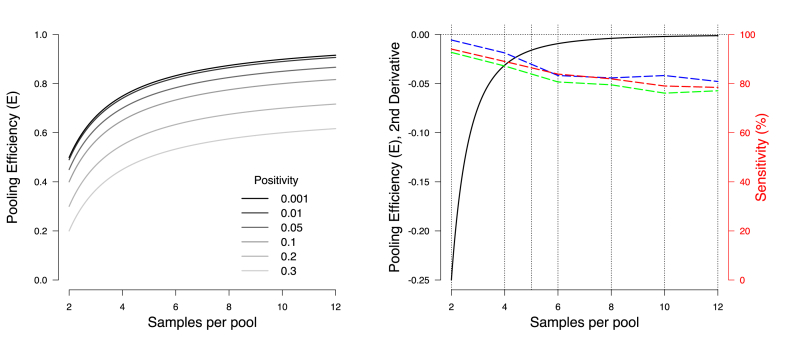
Methods: We developed a mathematical model to determine the pooling conditions that maximize reagent efficiency and analytical sensitivity. We evaluated 30 samples individually and in 2-sample to 12-sample pools. Using Passing Bablok regressions, we estimated the shift of Ct values in the RT-qPCR reaction for each pool size. With this Ct shift, we estimated sensitivity in the context of the distribution of 1,030 individually evaluated positive samples.
Findings: Our results showed that the most significant gain in efficiency occurred in the 4-sample pool, while at pools greater than 8-sample, there was no considerable reagent savings. Sensitivity significantly dropped to 87.18 %-92.52 % for a 4-sample pool and reached as low as 77.09 %-80.87 % in a 12-sample pooling.
Conclusions: Our results suggest that a 4-sample pooling maximizes reagent efficiency and analytical sensitivity. These considerations are essential to increase testing capacity and efficiently detect and contain contagious.
期刊介绍:
Heliyon is an all-science, open access journal that is part of the Cell Press family. Any paper reporting scientifically accurate and valuable research, which adheres to accepted ethical and scientific publishing standards, will be considered for publication. Our growing team of dedicated section editors, along with our in-house team, handle your paper and manage the publication process end-to-end, giving your research the editorial support it deserves.





 京公网安备 11010802042870号
京ICP备2023020795号-1
京公网安备 11010802042870号
京ICP备2023020795号-1

 分享
分享
 求助内容:
求助内容: 应助结果提醒方式:
 扫码关注我们
