Chunyan Liu, Qinan Yin, Zhaoying Wu, Wenhui Li, Jun Huang, Bo Chen, Yanjun Yang, Xuewei Zheng, Li Zeng, Jingjing Wang
{"title":"Inflammation and Immune Escape in Ovarian Cancer: Pathways and Therapeutic Opportunities.","authors":"Chunyan Liu, Qinan Yin, Zhaoying Wu, Wenhui Li, Jun Huang, Bo Chen, Yanjun Yang, Xuewei Zheng, Li Zeng, Jingjing Wang","doi":"10.2147/JIR.S503479","DOIUrl":null,"url":null,"abstract":"<p><p>Ovarian cancer (OC) remains one of the most lethal gynecological malignancies, largely due to its late-stage diagnosis and high recurrence rates. Chronic inflammation is a critical driver of OC progression, contributing to immune evasion, tumor growth, and metastasis. Inflammatory cytokines, including IL-6, TNF-α, and IL-8, as well as key signaling pathways such as nuclear factor kappa B (NF-kB) and signal transducer and activator of transcription 3 (STAT3), are upregulated in OC, promoting a tumor-promoting environment. The tumor microenvironment (TME) is characterized by immune cells like tumor-associated macrophages (TAMs) and regulatory T cells (Tregs), which suppress anti-tumor immune responses, facilitating immune evasion. Furthermore, OC cells utilize immune checkpoint pathways, including PD-1/PD-L1, to inhibit cytotoxic T cell activity. Targeting these inflammatory and immune evasion mechanisms offers promising therapeutic strategies. COX-2 inhibitors, Janus kinase/signal transducer and activator of transcription (JAK/STAT) pathway blockers, and NF-kB inhibitors have shown potential in preclinical studies, while immune checkpoint inhibitors targeting PD-1/PD-L1 and CTLA-4 have been explored with mixed results in OC. Additionally, emerging research on the microbiome and inflammation-related biomarkers, such as microRNAs (miRNAs) and exosomes, points to new opportunities for early detection and precision medicine. Future approaches to OC treatment must focus on personalized strategies that target the inflammatory TME, integrating anti-inflammatory therapies with immunotherapy to enhance patient outcomes. Continued research into the interplay between inflammation and immune evasion in OC is essential for developing effective, long-lasting treatments.</p>","PeriodicalId":16107,"journal":{"name":"Journal of Inflammation Research","volume":"18 ","pages":"895-909"},"PeriodicalIF":4.1000,"publicationDate":"2025-01-21","publicationTypes":"Journal Article","fieldsOfStudy":null,"isOpenAccess":false,"openAccessPdf":"https://www.ncbi.nlm.nih.gov/pmc/articles/PMC11762012/pdf/","citationCount":"0","resultStr":null,"platform":"Semanticscholar","paperid":null,"PeriodicalName":"Journal of Inflammation Research","FirstCategoryId":"3","ListUrlMain":"https://doi.org/10.2147/JIR.S503479","RegionNum":2,"RegionCategory":"医学","ArticlePicture":[],"TitleCN":null,"AbstractTextCN":null,"PMCID":null,"EPubDate":"2025/1/1 0:00:00","PubModel":"eCollection","JCR":"Q2","JCRName":"IMMUNOLOGY","Score":null,"Total":0}
引用次数: 0
Abstract
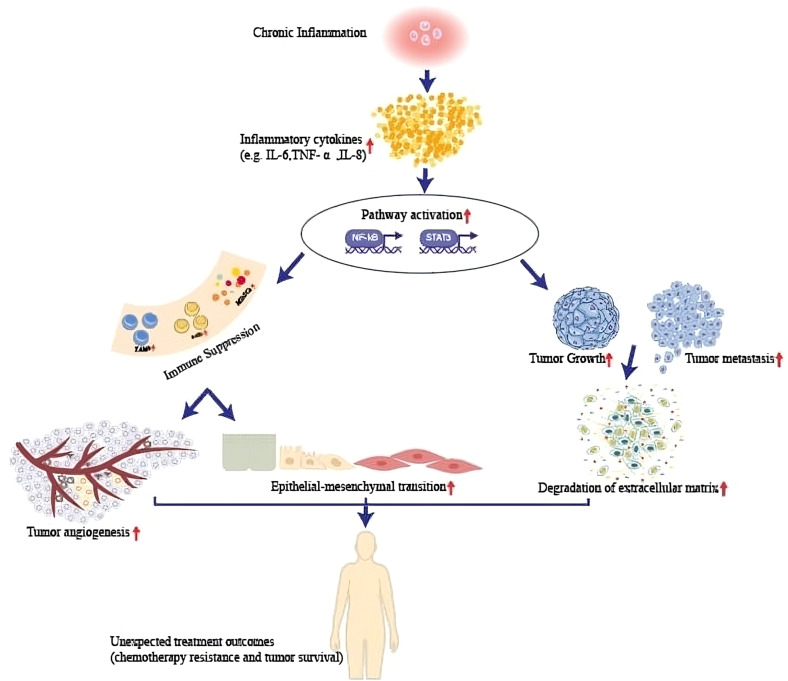
Ovarian cancer (OC) remains one of the most lethal gynecological malignancies, largely due to its late-stage diagnosis and high recurrence rates. Chronic inflammation is a critical driver of OC progression, contributing to immune evasion, tumor growth, and metastasis. Inflammatory cytokines, including IL-6, TNF-α, and IL-8, as well as key signaling pathways such as nuclear factor kappa B (NF-kB) and signal transducer and activator of transcription 3 (STAT3), are upregulated in OC, promoting a tumor-promoting environment. The tumor microenvironment (TME) is characterized by immune cells like tumor-associated macrophages (TAMs) and regulatory T cells (Tregs), which suppress anti-tumor immune responses, facilitating immune evasion. Furthermore, OC cells utilize immune checkpoint pathways, including PD-1/PD-L1, to inhibit cytotoxic T cell activity. Targeting these inflammatory and immune evasion mechanisms offers promising therapeutic strategies. COX-2 inhibitors, Janus kinase/signal transducer and activator of transcription (JAK/STAT) pathway blockers, and NF-kB inhibitors have shown potential in preclinical studies, while immune checkpoint inhibitors targeting PD-1/PD-L1 and CTLA-4 have been explored with mixed results in OC. Additionally, emerging research on the microbiome and inflammation-related biomarkers, such as microRNAs (miRNAs) and exosomes, points to new opportunities for early detection and precision medicine. Future approaches to OC treatment must focus on personalized strategies that target the inflammatory TME, integrating anti-inflammatory therapies with immunotherapy to enhance patient outcomes. Continued research into the interplay between inflammation and immune evasion in OC is essential for developing effective, long-lasting treatments.
期刊介绍:
An international, peer-reviewed, open access, online journal that welcomes laboratory and clinical findings on the molecular basis, cell biology and pharmacology of inflammation.




 京公网安备 11010802042870号
京ICP备2023020795号-1
京公网安备 11010802042870号
京ICP备2023020795号-1

 分享
分享
 求助内容:
求助内容: 应助结果提醒方式:
 扫码关注我们
