Sonja Porsche, Martin Klietz, Stephan Greten, Ines A Piot, Ida Jensen, Florian Wegner, Lan Ye, Lea Krey, Matthias Höllerhage, Monika Pötter-Nerger, Molly Zeitzschel, Keno Hagena, Jan Kassubek, Patrick Süß, Jürgen Winkler, Daniela Berg, Steffen Paschen, Lars Tönges, Doreen Gruber, Florin Gandor, Wolfgang H Jost, Andrea A Kühn, Inga Claus, Tobias Warnecke, David J Pedrosa, Carsten Eggers, Claudia Trenkwalder, Joseph Classen, Johannes Schwarz, Alfons Schnitzler, Patricia Krause, Anja Schneider, Moritz Brandt, Björn Falkenburger, Inga Zerr, Mathias Bähr, Endy Weidinger, Johannes Levin, Sabrina Katzdobler, Emrah Düzel, Wenzel Glanz, Stefan Teipel, Ingo Kilimann, Johannes Prudlo, Thomas Gasser, Kathrin Brockmann, Annika Spottke, Anna Esser, Gabor C Petzold, Gesine Respondek, Günter U Höglinger
{"title":"A Short Cognitive and Neuropsychiatric Assessment Scale for Progressive Supranuclear Palsy.","authors":"Sonja Porsche, Martin Klietz, Stephan Greten, Ines A Piot, Ida Jensen, Florian Wegner, Lan Ye, Lea Krey, Matthias Höllerhage, Monika Pötter-Nerger, Molly Zeitzschel, Keno Hagena, Jan Kassubek, Patrick Süß, Jürgen Winkler, Daniela Berg, Steffen Paschen, Lars Tönges, Doreen Gruber, Florin Gandor, Wolfgang H Jost, Andrea A Kühn, Inga Claus, Tobias Warnecke, David J Pedrosa, Carsten Eggers, Claudia Trenkwalder, Joseph Classen, Johannes Schwarz, Alfons Schnitzler, Patricia Krause, Anja Schneider, Moritz Brandt, Björn Falkenburger, Inga Zerr, Mathias Bähr, Endy Weidinger, Johannes Levin, Sabrina Katzdobler, Emrah Düzel, Wenzel Glanz, Stefan Teipel, Ingo Kilimann, Johannes Prudlo, Thomas Gasser, Kathrin Brockmann, Annika Spottke, Anna Esser, Gabor C Petzold, Gesine Respondek, Günter U Höglinger","doi":"10.1002/mdc3.14348","DOIUrl":null,"url":null,"abstract":"<p><strong>Background: </strong>Patients with Progressive Supranuclear Palsy (PSP) suffer from several neuropsychological impairments. These mainly affect the frontal lobe and subcortical brain structures. However, a scale for the assessment of cognitive and neuropsychiatric disability in PSP is still missing.</p><p><strong>Objectives: </strong>To create and validate a new scale for cognitive and neuropsychiatric impairment in PSP.</p><p><strong>Methods: </strong>The Short Cognitive and Neuropsychiatric (ShoCo) scale was developed containing five items (bradyphrenia, apathy, aphasia, dysexecution and disinhibition). Each item can be categorized into 0 = no deficit, 1 = mild deficit, 2 = moderate deficit and 3 = severe deficit. The total score includes 15 points, 0 meaning no deficit and 15 severe deficits. Cross-sectional and longitudinal data from 201 baseline and 71 follow up patients were analyzed.</p><p><strong>Results: </strong>Baseline ShoCo scale results were 5.9 ± 2.9. No significant differences between patients with Richardson syndrome (PSP-RS) and variants (vPSP) could be detected in the PSP-ShoCo scale scores (PSP-RS 6.1 ± 3.0, n = 160, vPSP 5.1 ± 2.6, n = 41, P = 0.057). The scale showed good correlation with established scores (eg, Montreal cognitive assessment r = -0.535, P = 0.001). The ShoCo scale showed significant annualized change within the PSP-RS patients (baseline 6.2 ± 2.9, follow up 6.9 ± 3.1, annualized diff. 1.0 ± 3.1, n = 57, P = 0.022).</p><p><strong>Conclusions: </strong>The ShoCo scale seems a promising and valid tool to measure specific neuropsychological disabilities of PSP patients in clinical routine and research.</p>","PeriodicalId":19029,"journal":{"name":"Movement Disorders Clinical Practice","volume":" ","pages":"764-774"},"PeriodicalIF":2.7000,"publicationDate":"2025-06-01","publicationTypes":"Journal Article","fieldsOfStudy":null,"isOpenAccess":false,"openAccessPdf":"https://www.ncbi.nlm.nih.gov/pmc/articles/PMC12187960/pdf/","citationCount":"0","resultStr":null,"platform":"Semanticscholar","paperid":null,"PeriodicalName":"Movement Disorders Clinical Practice","FirstCategoryId":"3","ListUrlMain":"https://doi.org/10.1002/mdc3.14348","RegionNum":4,"RegionCategory":"医学","ArticlePicture":[],"TitleCN":null,"AbstractTextCN":null,"PMCID":null,"EPubDate":"2025/1/27 0:00:00","PubModel":"Epub","JCR":"Q2","JCRName":"CLINICAL NEUROLOGY","Score":null,"Total":0}
引用次数: 0
Abstract
Background: Patients with Progressive Supranuclear Palsy (PSP) suffer from several neuropsychological impairments. These mainly affect the frontal lobe and subcortical brain structures. However, a scale for the assessment of cognitive and neuropsychiatric disability in PSP is still missing.
Objectives: To create and validate a new scale for cognitive and neuropsychiatric impairment in PSP.
Methods: The Short Cognitive and Neuropsychiatric (ShoCo) scale was developed containing five items (bradyphrenia, apathy, aphasia, dysexecution and disinhibition). Each item can be categorized into 0 = no deficit, 1 = mild deficit, 2 = moderate deficit and 3 = severe deficit. The total score includes 15 points, 0 meaning no deficit and 15 severe deficits. Cross-sectional and longitudinal data from 201 baseline and 71 follow up patients were analyzed.
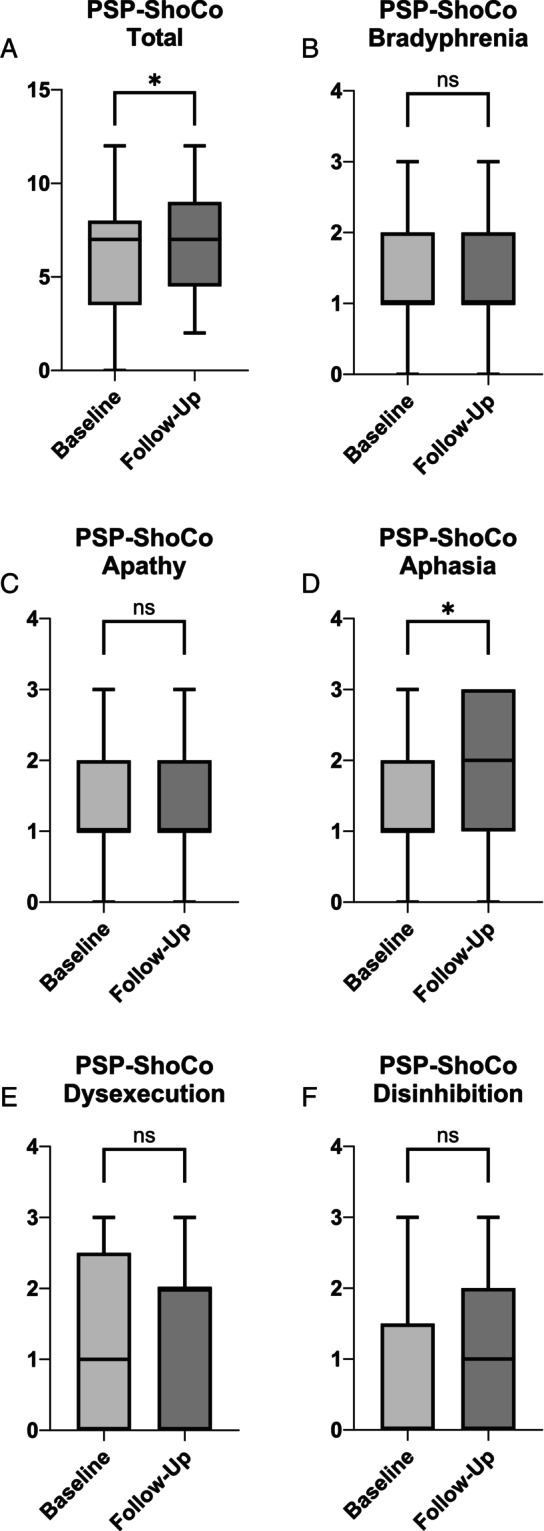
Results: Baseline ShoCo scale results were 5.9 ± 2.9. No significant differences between patients with Richardson syndrome (PSP-RS) and variants (vPSP) could be detected in the PSP-ShoCo scale scores (PSP-RS 6.1 ± 3.0, n = 160, vPSP 5.1 ± 2.6, n = 41, P = 0.057). The scale showed good correlation with established scores (eg, Montreal cognitive assessment r = -0.535, P = 0.001). The ShoCo scale showed significant annualized change within the PSP-RS patients (baseline 6.2 ± 2.9, follow up 6.9 ± 3.1, annualized diff. 1.0 ± 3.1, n = 57, P = 0.022).
Conclusions: The ShoCo scale seems a promising and valid tool to measure specific neuropsychological disabilities of PSP patients in clinical routine and research.
期刊介绍:
Movement Disorders Clinical Practice- is an online-only journal committed to publishing high quality peer reviewed articles related to clinical aspects of movement disorders which broadly include phenomenology (interesting case/case series/rarities), investigative (for e.g- genetics, imaging), translational (phenotype-genotype or other) and treatment aspects (clinical guidelines, diagnostic and treatment algorithms)




 京公网安备 11010802042870号
京ICP备2023020795号-1
京公网安备 11010802042870号
京ICP备2023020795号-1

 分享
分享
 求助内容:
求助内容: 应助结果提醒方式:
 扫码关注我们
