Lung Cancer Screening Program Quality Indicators—Review and Recommendations: An International Association for the Study of Lung Cancer Delphi Process Study
Martin C. Tammemägi DVM, MSc, PhD , Andrea Borondy-Kitts MS, MPH , John K. Field PhD , Claudia I. Henschke MD, PhD , Anant Mohan MD, PhD , Anna Kerpel-Fronius MD, PhD , Luigi Ventura MD , Dawei Yang MD , Long Jiang MD, PhD , Coenraad F.N. Koegelenberg MD, PhD , Milena Cavic PhD , Haval Balata MD, PhD , Lucia Viola MD , Javier J. Zulueta MD, PhD , Ricardo Sales dos Santos MD , Witold Rzyman MD, PhD , David F. Yankelevitz MD , Annette McWilliams M.B.B.S. , Stephen Lam MD , Ella A. Kazerooni MD, MS , Rudolf M. Huber MD, PhD
{"title":"Lung Cancer Screening Program Quality Indicators—Review and Recommendations: An International Association for the Study of Lung Cancer Delphi Process Study","authors":"Martin C. Tammemägi DVM, MSc, PhD , Andrea Borondy-Kitts MS, MPH , John K. Field PhD , Claudia I. Henschke MD, PhD , Anant Mohan MD, PhD , Anna Kerpel-Fronius MD, PhD , Luigi Ventura MD , Dawei Yang MD , Long Jiang MD, PhD , Coenraad F.N. Koegelenberg MD, PhD , Milena Cavic PhD , Haval Balata MD, PhD , Lucia Viola MD , Javier J. Zulueta MD, PhD , Ricardo Sales dos Santos MD , Witold Rzyman MD, PhD , David F. Yankelevitz MD , Annette McWilliams M.B.B.S. , Stephen Lam MD , Ella A. Kazerooni MD, MS , Rudolf M. Huber MD, PhD","doi":"10.1016/j.jtho.2025.01.019","DOIUrl":null,"url":null,"abstract":"<div><h3>Introduction</h3><div>Lung cancer screening (LCS) using low-dose-computed tomography reduces lung cancer mortality in high-risk individuals. Evaluating and monitoring LCS programs are important to ensure and improve quality, efficiency, and participant outcomes. There is no agreement on LCS quality indicators (QIs).</div></div><div><h3>Methods</h3><div>Twenty multidisciplinary members of the International Association for the Study of Lung Cancer used a Delphi process to develop consensus QIs. They considered 50 QIs during information/discussion sessions and two anonymous voting rounds. In total, 80% or more voting agree or strongly agree on a five-point Likert scale determined consensus.</div></div><div><h3>Results</h3><div>Twenty essential and six desirable QIs were identified in 10 of 11 LCS pathway domain categories <em>(ENTRY</em>: Proportion eligible who got screened; <em>SMOKING_CESSATION:</em> Proportion of current-smoking individuals offered cessation interventions; <em>IMAGING:</em> Proportion screened requiring clinical diagnostic assessment, scan results distribution, proportion scans requiring early follow-up, proportion baseline or regular scans with actionable additional findings; <em>ADHERENCE</em> to<em>:</em> Annual or regular scans, early interim scans, clinical diagnostic assessment; <em>DIAGNOSTIC:</em> Proportion suspicious-for-lung-cancer scans receiving clinical investigation, undergoing invasive diagnostic procedures; <em>OUTCOMES:</em> Cancer detection rate, stage distribution, interval cancer rate; <em>HARMS:</em> Number and proportion of serious complications after invasive procedures, non-lung cancer diagnoses after invasive procedures or surgery, 30-day mortality after invasive procedure; <em>TREATMENT:</em> Proportion early-stage cancers receiving treatment with curative intent; <em>WAIT_TIMES:</em> Suspicious-for-lung-cancer scan to definitive diagnosis, to curative-intent treatment for individuals with early-stage disease, scan completion to reporting results to primary care provider and participant; <em>EQ</em><em>UITY:</em> Race, sex, and socioeconomic differences in adherence to regular screens, early-stage cancer treatment, offer of smoking cessation interventions, clinical investigation of suspicious-for-lung-cancer screens).</div></div><div><h3>Conclusions</h3><div>A review among panel members provided recommended LCS QIs that should be considered in the development of LCS initiatives.</div></div>","PeriodicalId":17515,"journal":{"name":"Journal of Thoracic Oncology","volume":"20 7","pages":"Pages 871-883"},"PeriodicalIF":20.8000,"publicationDate":"2025-07-01","publicationTypes":"Journal Article","fieldsOfStudy":null,"isOpenAccess":false,"openAccessPdf":"","citationCount":"0","resultStr":null,"platform":"Semanticscholar","paperid":null,"PeriodicalName":"Journal of Thoracic Oncology","FirstCategoryId":"3","ListUrlMain":"https://www.sciencedirect.com/science/article/pii/S1556086425000528","RegionNum":1,"RegionCategory":"医学","ArticlePicture":[],"TitleCN":null,"AbstractTextCN":null,"PMCID":null,"EPubDate":"2025/1/24 0:00:00","PubModel":"Epub","JCR":"Q1","JCRName":"ONCOLOGY","Score":null,"Total":0}
引用次数: 0
Abstract
Introduction
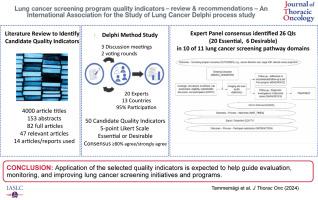
Lung cancer screening (LCS) using low-dose-computed tomography reduces lung cancer mortality in high-risk individuals. Evaluating and monitoring LCS programs are important to ensure and improve quality, efficiency, and participant outcomes. There is no agreement on LCS quality indicators (QIs).
Methods
Twenty multidisciplinary members of the International Association for the Study of Lung Cancer used a Delphi process to develop consensus QIs. They considered 50 QIs during information/discussion sessions and two anonymous voting rounds. In total, 80% or more voting agree or strongly agree on a five-point Likert scale determined consensus.
Results
Twenty essential and six desirable QIs were identified in 10 of 11 LCS pathway domain categories (ENTRY: Proportion eligible who got screened; SMOKING_CESSATION: Proportion of current-smoking individuals offered cessation interventions; IMAGING: Proportion screened requiring clinical diagnostic assessment, scan results distribution, proportion scans requiring early follow-up, proportion baseline or regular scans with actionable additional findings; ADHERENCE to: Annual or regular scans, early interim scans, clinical diagnostic assessment; DIAGNOSTIC: Proportion suspicious-for-lung-cancer scans receiving clinical investigation, undergoing invasive diagnostic procedures; OUTCOMES: Cancer detection rate, stage distribution, interval cancer rate; HARMS: Number and proportion of serious complications after invasive procedures, non-lung cancer diagnoses after invasive procedures or surgery, 30-day mortality after invasive procedure; TREATMENT: Proportion early-stage cancers receiving treatment with curative intent; WAIT_TIMES: Suspicious-for-lung-cancer scan to definitive diagnosis, to curative-intent treatment for individuals with early-stage disease, scan completion to reporting results to primary care provider and participant; EQUITY: Race, sex, and socioeconomic differences in adherence to regular screens, early-stage cancer treatment, offer of smoking cessation interventions, clinical investigation of suspicious-for-lung-cancer screens).
Conclusions
A review among panel members provided recommended LCS QIs that should be considered in the development of LCS initiatives.
期刊介绍:
Journal of Thoracic Oncology (JTO), the official journal of the International Association for the Study of Lung Cancer,is the primary educational and informational publication for topics relevant to the prevention, detection, diagnosis, and treatment of all thoracic malignancies.The readship includes epidemiologists, medical oncologists, radiation oncologists, thoracic surgeons, pulmonologists, radiologists, pathologists, nuclear medicine physicians, and research scientists with a special interest in thoracic oncology.



 京公网安备 11010802042870号
京ICP备2023020795号-1
京公网安备 11010802042870号
京ICP备2023020795号-1

 分享
分享
 求助内容:
求助内容: 应助结果提醒方式:
 扫码关注我们
