Ashwin Kumar Saravana Bhavan Venkatachalam, Anna Kadlecová, Anna Kapustová, Magdalena Kulich Fialová, Jana Brzoňová, Miroslav Šálek, Milena Svobodová
{"title":"Factors influencing a common but neglected blood parasite prevalence in breeding populations of passerines.","authors":"Ashwin Kumar Saravana Bhavan Venkatachalam, Anna Kadlecová, Anna Kapustová, Magdalena Kulich Fialová, Jana Brzoňová, Miroslav Šálek, Milena Svobodová","doi":"10.1017/S0031182025000095","DOIUrl":null,"url":null,"abstract":"<p><p>The occurrence of avian blood protists is affected by multiple factors that include the characteristics of the hosts, the vectors, the parasites, as well as the environmental factors. This study provides an insight into some of the factors that influence the prevalence of avian <i>Lankesterella</i>, neglected but common blood parasites in breeding populations of common passerines. The highest prevalences of <i>Lankesterella</i> infection were observed in 1 great tit (<i>Parus major</i>) population at 63%, 1 blue tit (<i>Cyanistes caeruleus</i>) population at 49% and a sedge warbler (<i>Acrocephalus schoenobaenus</i>) population at 33%. Prevalence was found to be significantly influenced by sampling site followed by host age, species and sex. Julian date had no significant effect on <i>Lankesterella</i> prevalence. Prevalence data from different sampling sites can reveal different patterns and should be combined critically. Higher prevalence in adults suggest that the infections are chronic, which helps the parasite to persist in host populations. The differences between sexes might be related to different exposure to the transmitting vectors (e. g., mites or mosquitoes) during breeding.</p>","PeriodicalId":19967,"journal":{"name":"Parasitology","volume":" ","pages":"172-178"},"PeriodicalIF":2.4000,"publicationDate":"2025-02-01","publicationTypes":"Journal Article","fieldsOfStudy":null,"isOpenAccess":false,"openAccessPdf":"https://www.ncbi.nlm.nih.gov/pmc/articles/PMC12089444/pdf/","citationCount":"0","resultStr":null,"platform":"Semanticscholar","paperid":null,"PeriodicalName":"Parasitology","FirstCategoryId":"3","ListUrlMain":"https://doi.org/10.1017/S0031182025000095","RegionNum":3,"RegionCategory":"医学","ArticlePicture":[],"TitleCN":null,"AbstractTextCN":null,"PMCID":null,"EPubDate":"","PubModel":"","JCR":"Q2","JCRName":"PARASITOLOGY","Score":null,"Total":0}
引用次数: 0
Abstract
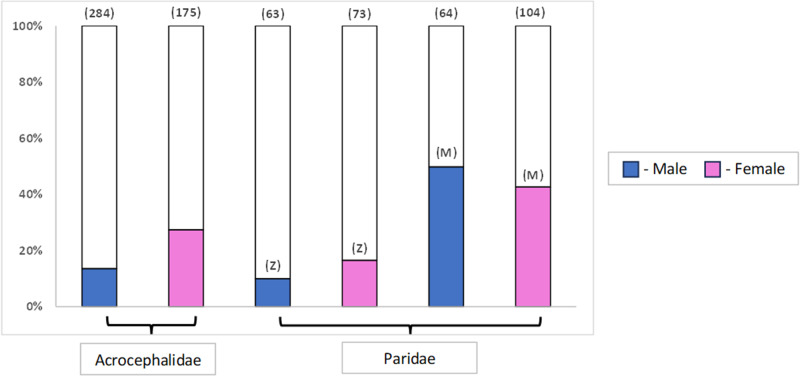
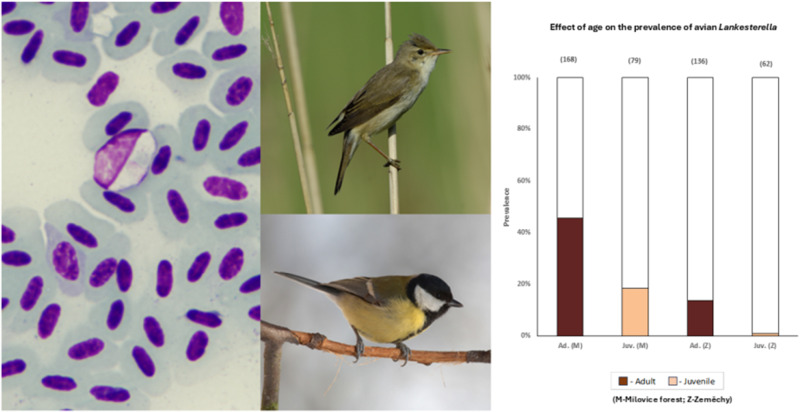
The occurrence of avian blood protists is affected by multiple factors that include the characteristics of the hosts, the vectors, the parasites, as well as the environmental factors. This study provides an insight into some of the factors that influence the prevalence of avian Lankesterella, neglected but common blood parasites in breeding populations of common passerines. The highest prevalences of Lankesterella infection were observed in 1 great tit (Parus major) population at 63%, 1 blue tit (Cyanistes caeruleus) population at 49% and a sedge warbler (Acrocephalus schoenobaenus) population at 33%. Prevalence was found to be significantly influenced by sampling site followed by host age, species and sex. Julian date had no significant effect on Lankesterella prevalence. Prevalence data from different sampling sites can reveal different patterns and should be combined critically. Higher prevalence in adults suggest that the infections are chronic, which helps the parasite to persist in host populations. The differences between sexes might be related to different exposure to the transmitting vectors (e. g., mites or mosquitoes) during breeding.
期刊介绍:
Parasitology is an important specialist journal covering the latest advances in the subject. It publishes original research and review papers on all aspects of parasitology and host-parasite relationships, including the latest discoveries in parasite biochemistry, molecular biology and genetics, ecology and epidemiology in the context of the biological, medical and veterinary sciences. Included in the subscription price are two special issues which contain reviews of current hot topics, one of which is the proceedings of the annual Symposia of the British Society for Parasitology, while the second, covering areas of significant topical interest, is commissioned by the editors and the editorial board.





 京公网安备 11010802042870号
京ICP备2023020795号-1
京公网安备 11010802042870号
京ICP备2023020795号-1

 分享
分享
 求助内容:
求助内容: 应助结果提醒方式:
 扫码关注我们
