Ivan Surya Pradipta, Kevin Aprilio, Yozi Fiedya Ningsih, Mochammad Andhika Aji Pratama, Vesara Ardhe Gatera, Sofa Dewi Alfian, Aulia Iskandarsyah, Rizky Abdulah
{"title":"How Does Indonesian Chronic Disease Patient Adhere to Their Treatment? A Cross-Sectional Analysis of 11,408 Subjects.","authors":"Ivan Surya Pradipta, Kevin Aprilio, Yozi Fiedya Ningsih, Mochammad Andhika Aji Pratama, Vesara Ardhe Gatera, Sofa Dewi Alfian, Aulia Iskandarsyah, Rizky Abdulah","doi":"10.2147/PPA.S503601","DOIUrl":null,"url":null,"abstract":"<p><strong>Background: </strong>Chronic disease has become an increasing burden in Indonesia, increasing the importance of treatment adherence to control the disease prognosis. Therefore, we aim to determine the prevalence and characteristics of nonadherence in Indonesian chronic disease population.</p><p><strong>Methods: </strong>We identified 11,408 adult subjects with chronic diseases from the fifth Indonesian Family Life Survey. We defined treatment nonadherence as the outcome variable and characteristics related to the World Health Organization Multidimensional Adherence Model as exposure variables. We used descriptive and multivariable analyses to analyze factors related to treatment nonadherence.</p><p><strong>Results: </strong>We identified that 57% (95% CI 56.1-57.9) of chronic disease patients were nonadherent to their treatment. Treatment nonadherence was notable in subjects with liver disease (61.8%), tuberculosis (59.8%), digestive diseases (57.9%), other lung diseases (56.8%), psychiatric diseases (51.6%), asthma (51.2%), and hypertension (50%). Treatment nonadherence was associated with socioeconomic-related factors of being aged 15-65 years, living in rural areas, having history of formal education, and having a household size of 2-6 people. Furthermore, in patient- and condition-related factors, positive perceptions of their health condition, missing 0-7 days of their regular activity in the last month, being ex- and non-smokers, having no depression symptoms, and having only one chronic disease were associated with treatment nonadherence.</p><p><strong>Conclusion: </strong>Treatment nonadherence for chronic diseases in Indonesia was found to be prevalent. Further consideration of characteristics associated with treatment nonadherence should be given to ensure optimal control of chronic diseases.</p>","PeriodicalId":19972,"journal":{"name":"Patient preference and adherence","volume":"19 ","pages":"173-184"},"PeriodicalIF":2.0000,"publicationDate":"2025-01-22","publicationTypes":"Journal Article","fieldsOfStudy":null,"isOpenAccess":false,"openAccessPdf":"https://www.ncbi.nlm.nih.gov/pmc/articles/PMC11766224/pdf/","citationCount":"0","resultStr":null,"platform":"Semanticscholar","paperid":null,"PeriodicalName":"Patient preference and adherence","FirstCategoryId":"3","ListUrlMain":"https://doi.org/10.2147/PPA.S503601","RegionNum":3,"RegionCategory":"医学","ArticlePicture":[],"TitleCN":null,"AbstractTextCN":null,"PMCID":null,"EPubDate":"2025/1/1 0:00:00","PubModel":"eCollection","JCR":"Q2","JCRName":"MEDICINE, GENERAL & INTERNAL","Score":null,"Total":0}
引用次数: 0
Abstract
Background: Chronic disease has become an increasing burden in Indonesia, increasing the importance of treatment adherence to control the disease prognosis. Therefore, we aim to determine the prevalence and characteristics of nonadherence in Indonesian chronic disease population.
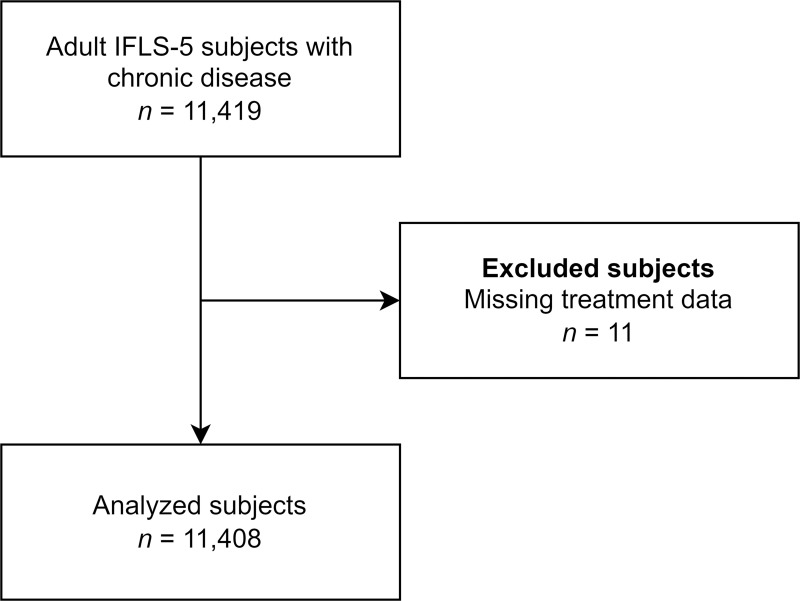
Methods: We identified 11,408 adult subjects with chronic diseases from the fifth Indonesian Family Life Survey. We defined treatment nonadherence as the outcome variable and characteristics related to the World Health Organization Multidimensional Adherence Model as exposure variables. We used descriptive and multivariable analyses to analyze factors related to treatment nonadherence.
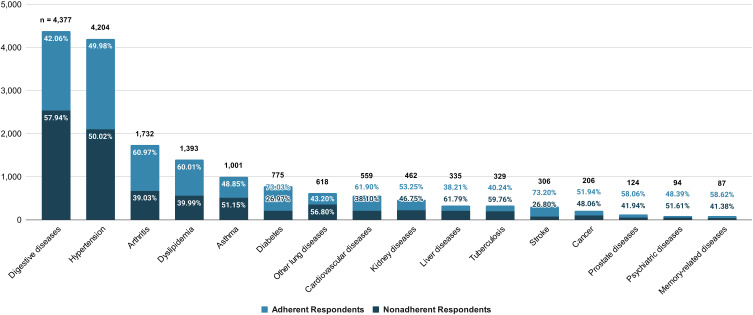
Results: We identified that 57% (95% CI 56.1-57.9) of chronic disease patients were nonadherent to their treatment. Treatment nonadherence was notable in subjects with liver disease (61.8%), tuberculosis (59.8%), digestive diseases (57.9%), other lung diseases (56.8%), psychiatric diseases (51.6%), asthma (51.2%), and hypertension (50%). Treatment nonadherence was associated with socioeconomic-related factors of being aged 15-65 years, living in rural areas, having history of formal education, and having a household size of 2-6 people. Furthermore, in patient- and condition-related factors, positive perceptions of their health condition, missing 0-7 days of their regular activity in the last month, being ex- and non-smokers, having no depression symptoms, and having only one chronic disease were associated with treatment nonadherence.
Conclusion: Treatment nonadherence for chronic diseases in Indonesia was found to be prevalent. Further consideration of characteristics associated with treatment nonadherence should be given to ensure optimal control of chronic diseases.
背景:在印度尼西亚,慢性病已成为日益加重的负担,这增加了坚持治疗对控制疾病预后的重要性。因此,我们的目的是确定印度尼西亚慢性疾病人群中不依从的患病率和特征。方法:我们从第五次印度尼西亚家庭生活调查中确定了11,408名患有慢性疾病的成人受试者。我们将治疗不依从性定义为结果变量,并将与世界卫生组织多维依从性模型相关的特征定义为暴露变量。我们使用描述性和多变量分析来分析与治疗不依从相关的因素。结果:我们发现57% (95% CI 56.1-57.9)的慢性疾病患者不坚持治疗。肝病(61.8%)、结核病(59.8%)、消化系统疾病(57.9%)、其他肺部疾病(56.8%)、精神疾病(51.6%)、哮喘(51.2%)和高血压(50%)患者的治疗不依从性显著。治疗不依从与社会经济相关的因素有:年龄15-65岁,居住在农村地区,受过正规教育,家庭规模为2-6人。此外,在患者和病情相关因素中,对其健康状况的积极看法、上个月缺少0-7天的常规活动、不吸烟或不吸烟、没有抑郁症状以及仅患有一种慢性疾病与治疗不依从性相关。结论:慢性疾病治疗不依从在印度尼西亚是普遍存在的。应进一步考虑与治疗不依从性相关的特征,以确保慢性病的最佳控制。
期刊介绍:
Patient Preference and Adherence is an international, peer reviewed, open access journal that focuses on the growing importance of patient preference and adherence throughout the therapeutic continuum. The journal is characterized by the rapid reporting of reviews, original research, modeling and clinical studies across all therapeutic areas. Patient satisfaction, acceptability, quality of life, compliance, persistence and their role in developing new therapeutic modalities and compounds to optimize clinical outcomes for existing disease states are major areas of interest for the journal.
As of 1st April 2019, Patient Preference and Adherence will no longer consider meta-analyses for publication.



 京公网安备 11010802042870号
京ICP备2023020795号-1
京公网安备 11010802042870号
京ICP备2023020795号-1

 分享
分享
 求助内容:
求助内容: 应助结果提醒方式:
 扫码关注我们
