Association of Immune Nutrition Indices with the Risk of All-Cause Mortality and Cardiovascular Mortality in Patients with Heart Failure in the NHANES (1999-2018).
{"title":"Association of Immune Nutrition Indices with the Risk of All-Cause Mortality and Cardiovascular Mortality in Patients with Heart Failure in the NHANES (1999-2018).","authors":"Feifei Zhang, Yuetao Xie, Litian Liu, Huiliang Liu, Ohua Feng, Yingxiao Li, Yi Dang","doi":"10.31083/RCM25055","DOIUrl":null,"url":null,"abstract":"<p><strong>Background: </strong>Heart failure (HF) remains a global challenge with disappointing long-term outcomes. Malnutrition is prevalent in patients with HF and disrupts the equilibrium of immune and inflammatory responses, resulting in further deterioration of the HF. Novel indicators emerge as immune nutrition indices, including the prognostic nutritional index (PNI), neutrophil-to-lymphocyte ratio (NLR), Controlling Nutritional Status (CONUT) score, and cholesterol-modified prognostic nutritional index (CPNI). This study examines the correlation between immune nutrition indices and all-cause and cardiovascular mortality in patients with HF.</p><p><strong>Methods: </strong>The data source for this study was the National Health and Nutrition Examination Survey (NHANES). A total of 1232 participants with HF were included. Weighted Cox proportional hazards models were employed to assess the independent association of different immune nutrition indices with mortality risk, alongside subgroup analyses and Kaplan-Meier survival curves. Restricted cubic spline analysis was utilized to clarify the detailed association between immune nutrition indices and hazard ratio (HR). A time-dependent receiver operating characteristic curve analysis was conducted to assess the predictive ability.</p><p><strong>Results: </strong>After full adjustments, PNI is independently related to all-cause mortality (HR = 0.94, 95% CI: 0.92-0.97) and cardiovascular mortality (HR = 0.94, 95% CI: 0.90-0.99). CPNI, CONUT, and NLR also showed an independent association with the prognosis of HF. Time-dependent receiver operating characteristic curve analysis indicated that PNI exhibited the highest predictive power for mortality among the CPNI, CONUT, and NLR indexes.</p><p><strong>Conclusions: </strong>Our study revealed that immune nutrition indicators, including CPNI, could predict all-cause mortality and cardiovascular mortality in the HF population. Compared with other indicators, PNI is the most effective predictor.</p>","PeriodicalId":20989,"journal":{"name":"Reviews in cardiovascular medicine","volume":"26 1","pages":"25055"},"PeriodicalIF":1.3000,"publicationDate":"2025-01-09","publicationTypes":"Journal Article","fieldsOfStudy":null,"isOpenAccess":false,"openAccessPdf":"https://www.ncbi.nlm.nih.gov/pmc/articles/PMC11759971/pdf/","citationCount":"0","resultStr":null,"platform":"Semanticscholar","paperid":null,"PeriodicalName":"Reviews in cardiovascular medicine","FirstCategoryId":"3","ListUrlMain":"https://doi.org/10.31083/RCM25055","RegionNum":4,"RegionCategory":"医学","ArticlePicture":[],"TitleCN":null,"AbstractTextCN":null,"PMCID":null,"EPubDate":"2025/1/1 0:00:00","PubModel":"eCollection","JCR":"Q3","JCRName":"CARDIAC & CARDIOVASCULAR SYSTEMS","Score":null,"Total":0}
引用次数: 0
Abstract
Background: Heart failure (HF) remains a global challenge with disappointing long-term outcomes. Malnutrition is prevalent in patients with HF and disrupts the equilibrium of immune and inflammatory responses, resulting in further deterioration of the HF. Novel indicators emerge as immune nutrition indices, including the prognostic nutritional index (PNI), neutrophil-to-lymphocyte ratio (NLR), Controlling Nutritional Status (CONUT) score, and cholesterol-modified prognostic nutritional index (CPNI). This study examines the correlation between immune nutrition indices and all-cause and cardiovascular mortality in patients with HF.
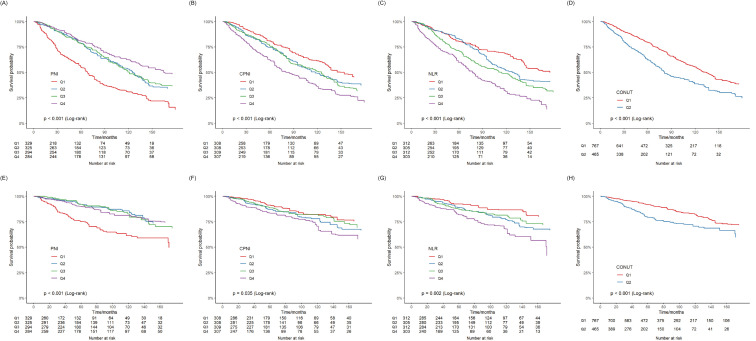
Methods: The data source for this study was the National Health and Nutrition Examination Survey (NHANES). A total of 1232 participants with HF were included. Weighted Cox proportional hazards models were employed to assess the independent association of different immune nutrition indices with mortality risk, alongside subgroup analyses and Kaplan-Meier survival curves. Restricted cubic spline analysis was utilized to clarify the detailed association between immune nutrition indices and hazard ratio (HR). A time-dependent receiver operating characteristic curve analysis was conducted to assess the predictive ability.
Results: After full adjustments, PNI is independently related to all-cause mortality (HR = 0.94, 95% CI: 0.92-0.97) and cardiovascular mortality (HR = 0.94, 95% CI: 0.90-0.99). CPNI, CONUT, and NLR also showed an independent association with the prognosis of HF. Time-dependent receiver operating characteristic curve analysis indicated that PNI exhibited the highest predictive power for mortality among the CPNI, CONUT, and NLR indexes.
Conclusions: Our study revealed that immune nutrition indicators, including CPNI, could predict all-cause mortality and cardiovascular mortality in the HF population. Compared with other indicators, PNI is the most effective predictor.
期刊介绍:
RCM is an international, peer-reviewed, open access journal. RCM publishes research articles, review papers and short communications on cardiovascular medicine as well as research on cardiovascular disease. We aim to provide a forum for publishing papers which explore the pathogenesis and promote the progression of cardiac and vascular diseases. We also seek to establish an interdisciplinary platform, focusing on translational issues, to facilitate the advancement of research, clinical treatment and diagnostic procedures. Heart surgery, cardiovascular imaging, risk factors and various clinical cardiac & vascular research will be considered.






 京公网安备 11010802042870号
京ICP备2023020795号-1
京公网安备 11010802042870号
京ICP备2023020795号-1

 分享
分享
 求助内容:
求助内容: 应助结果提醒方式:
 扫码关注我们
