Daniele S C Ramsay, Harvey Stevenson, Waseem Jerjes
{"title":"Auditory hallucinations induced by atorvastatin and exacerbated by cefalexin: a rare case report.","authors":"Daniele S C Ramsay, Harvey Stevenson, Waseem Jerjes","doi":"10.21037/acr-24-8","DOIUrl":null,"url":null,"abstract":"<p><strong>Background: </strong>Auditory hallucinations, commonly associated with psychiatric conditions such as schizophrenia, can arise as side effects to certain medications. Several drug classes are commonly implicated in the causation of hallucinations, such as anticholinergics. Medication associated with disruption of steroid production may lead to neuropsychiatric disruption. One such drug class, statins, may also have psychiatric sequelae. Wide prescribing of common medication such as atorvastatin, allows the unveiling of uncommon medication-related adverse events.</p><p><strong>Case description: </strong>We detail a unique case-report of a 60-year-old man experiencing auditory hallucinations post-initiation of atorvastatin. The content of the hallucinations consisted of voices of deceased family members. These were frequently accompanied by predominantly frontal headaches. Subsequently, during the treatment of a chest infection utilizing cefalexin, the auditory hallucinations intensified in clarity and increased in frequency. Despite initial concerns related to a family history of meningiomas, magnetic resonance imaging ruled out structural abnormalities. Comprehensive viral screening excluded infectious as the causative factor and there were no signs of concurrent delirium. Following termination of the course of cefalexin, the hallucinations reduced in intensity. The cessation of atorvastatin led to the resolution of hallucinations.</p><p><strong>Conclusions: </strong>This case emphasizes the importance of drug history evaluation in neuropsychiatric presentations and prompts further exploration into the neuropsychiatric effects of commonly prescribed drugs.</p>","PeriodicalId":29752,"journal":{"name":"AME Case Reports","volume":"9 ","pages":"11"},"PeriodicalIF":0.7000,"publicationDate":"2024-11-06","publicationTypes":"Journal Article","fieldsOfStudy":null,"isOpenAccess":false,"openAccessPdf":"https://www.ncbi.nlm.nih.gov/pmc/articles/PMC11760933/pdf/","citationCount":"0","resultStr":null,"platform":"Semanticscholar","paperid":null,"PeriodicalName":"AME Case Reports","FirstCategoryId":"1085","ListUrlMain":"https://doi.org/10.21037/acr-24-8","RegionNum":0,"RegionCategory":null,"ArticlePicture":[],"TitleCN":null,"AbstractTextCN":null,"PMCID":null,"EPubDate":"2025/1/1 0:00:00","PubModel":"eCollection","JCR":"Q3","JCRName":"MEDICINE, GENERAL & INTERNAL","Score":null,"Total":0}
引用次数: 0
Abstract
Background: Auditory hallucinations, commonly associated with psychiatric conditions such as schizophrenia, can arise as side effects to certain medications. Several drug classes are commonly implicated in the causation of hallucinations, such as anticholinergics. Medication associated with disruption of steroid production may lead to neuropsychiatric disruption. One such drug class, statins, may also have psychiatric sequelae. Wide prescribing of common medication such as atorvastatin, allows the unveiling of uncommon medication-related adverse events.
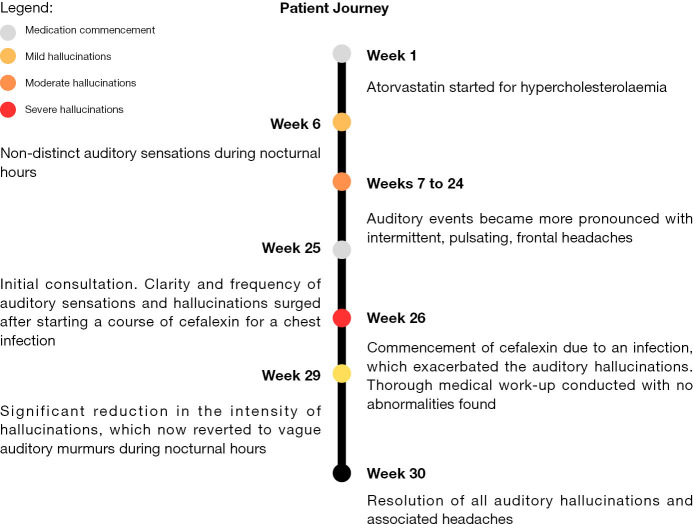
Case description: We detail a unique case-report of a 60-year-old man experiencing auditory hallucinations post-initiation of atorvastatin. The content of the hallucinations consisted of voices of deceased family members. These were frequently accompanied by predominantly frontal headaches. Subsequently, during the treatment of a chest infection utilizing cefalexin, the auditory hallucinations intensified in clarity and increased in frequency. Despite initial concerns related to a family history of meningiomas, magnetic resonance imaging ruled out structural abnormalities. Comprehensive viral screening excluded infectious as the causative factor and there were no signs of concurrent delirium. Following termination of the course of cefalexin, the hallucinations reduced in intensity. The cessation of atorvastatin led to the resolution of hallucinations.
Conclusions: This case emphasizes the importance of drug history evaluation in neuropsychiatric presentations and prompts further exploration into the neuropsychiatric effects of commonly prescribed drugs.



 京公网安备 11010802042870号
京ICP备2023020795号-1
京公网安备 11010802042870号
京ICP备2023020795号-1

 分享
分享

 求助内容:
求助内容: 应助结果提醒方式:
 扫码关注我们
