Maripat Corr, Vivian Reznik, Deborah Wingard, Danielle Fettes, Virginia Hazen, Maria Elena Martinez, JoAnn Trejo
{"title":"Assessing Recruitment Strategies for Creating an Inclusive Tenure Track Faculty in Health Sciences: A Cohort Study","authors":"Maripat Corr, Vivian Reznik, Deborah Wingard, Danielle Fettes, Virginia Hazen, Maria Elena Martinez, JoAnn Trejo","doi":"10.1002/hsr2.70363","DOIUrl":null,"url":null,"abstract":"<p>Health Sciences (HS) benefit from multiple perspectives and experiences which improve problem-solving, increase innovation, and can lead to higher-impact scientific publications in biomedical research [<span>1-3</span>]. The effort to create an inclusive tenure track faculty (TTF) in HS has been slow to reflect the diversity of the current scientific and biomedical trainee population [<span>4, 5</span>]. At the University of California (UC) San Diego HS, TTF positions are limited by the number of state-funded salary lines and these positions turnover slowly with a separation rate of ∼3% (averaged over 5 years), compared to other faculty series (∼6%). Another barrier to the inclusiveness of TTF in HS is the traditional practice of hiring faculty in individual departments, which relies on conducting single recruitments in target scientific areas. This conventional practice has resulted in searches with relatively narrow research foci and small pools of applicants that rarely reflect the diversity of the national trainee pool and surrounding community [<span>6</span>].</p><p>An alternative approach is cluster hiring, which has been adapted by multiple institutions to attract diverse pools of applicants and to seed large, cooperative initiatives with early-career faculty [<span>7</span>]. UC San Diego employed varied strategies to manage successive cluster hires that included HS Schools of Medicine, Pharmacy, Public Health, and the main campus (referred here as cross-campus). This study assesses the impact of these broader recruitments on the characteristics of TTF in HS over a 5 year time period.</p><p>The study was approved by the institutional review board and followed the STROBE reporting guidelines. Recruitments were conducted in compliance with University policy. Search committee members received unconscious bias training. Applicants were holistically reviewed for accomplishments in research, teaching, service, and contributions to diversity. Department-selected candidates were invited for interviews and offers were extended to the top candidate(s). Faculty recruits self-identify gender and race/ethnicity with historically underrepresented in medicine (URiM) per UC San Diego defined as African American/Black, Hispanic/Latino, American Indian/Alaskan Native, Pacific Islander, and Filipino. TTF salaries are supported at least in part by state funds. Source of non-departmental support for the coordination and organization of the searches and partial start-up funds for recruits are listed in Table 1.</p><p>The growth of total, URiM and female faculty in the TTF series was assessed between 2018 and 2023 in HS at UC San Diego (Figure 1). There was no significant change in the time trend for total TTF in HS over these 5 years (<i>S</i> = 0; <i>z</i> = 0; <i>p</i> = 1.0). In 2018, of 341 HS TTF, 87 (25%) self-identified as female and 23 (7%) as URiM. In 2023, among 346 HS TTF, 108 (31%) self-identified as female and 39 (11%) as URiM. The proportion of female TTF (<i>S</i> = 12; <i>z</i> = 2.1; <i>p</i> = 0.036) and URiM TTF (<i>S</i> = 15; <i>z</i> = 2.6; <i>p</i> = 0.008) increased significantly over this period (Figure 1).</p><p>Between 2019 and 2023, HS participated in three cluster hires that were supported in part by institutional and/or extramural funds (Table 1). In HS eight of the 19 URiM TTF recruited between 2019 and 2023 were from cluster hires. In contrast, only three of the 36 female TTF hired in HS between 2019 and 2023 were recruited from these cluster hires. Relatively few physician-scientists applied (e.g., <i>n</i> = 10 of 249 applicants, 3rd cluster) and ultimately none of these applicants were selected.</p><p>Recruitment is key to enriching the pool of talented TTF in HS [<span>5, 10, 11</span>]. At UC San Diego, cross-campus cluster recruitments were successful in hiring URiM faculty in HS. Cluster hires enabled access to robust pools of highly competitive applicants, which were holistically reviewed by multidisciplinary committees [<span>12</span>], and likely facilitated joint hires between departments. A centrally managed process enabled a broader view of achievements in research, teaching and service than a single departmental agenda focused exclusively on a specific research area. Importantly, top leadership was engaged in trialing alternative inclusive hiring practices.</p><p>This report is limited to tenure track positions in HS at a single institution and is a short-term study. Hence promotion and retention rates should be subsequently evaluated [<span>13, 14</span>]. We used the Mann–Kendall test to evaluate temporal trends; however, the data sets are relatively small which can reduce the sensitivity and limit the power of this test [<span>15</span>]. Our recruitments had highly competitive applicants, some of whom accepted alternate offers, which may have skewed representation in the relatively small numbers of hires. The number of TTF positions in HS at UC San Diego had not significantly increased in the time frame examined here; however, there has been a substantial increase in faculty with contingent appointments over the same timeframe (1293 to 1482) that warrants future comparisons [<span>14, 16</span>].</p><p>Overall there were roughly equal numbers of TTF hired between HS and the main campus in the clusters. The cluster hiring strategy was successful in the recruitment of URiM TTF in HS. However, this practice was less effective with hiring competitive female faculty, despite sufficient representation in the applicant pool (e.g., 51% of the third cluster applicants identified as female). We did not reach overall gender parity in these clusters, noting that we needed to exceed parity with these small numbers to increase the proportion of female TTF in HS [<span>5, 17</span>]. Physician-scientists were not selected in recruitments by cross-campus committees representative of all biomedical research departments at UC San Diego. These candidates may have been perceived as being less productive as their research and publications may have been delayed or interrupted by clinical training periods. This suggests a need to calibrate scientific achievements to allow for interruptions required for clinical training or have separate cluster hires for physician-scientists [<span>18</span>].</p><p>In summary, academic leadership valued efforts to engender a diverse, talented TTF in HS, and centrally governed cluster hire initiatives were successful in URiM TTF recruitment, but less so for female and physician-scientist TTF, indicating a need for further refinements [<span>17, 19, 20</span>].</p><p><b>Maripat Corr:</b> conceptualization, data curation, formal analysis, writing–review and editing, funding acquisition, writing–original draft. <b>Vivian Reznik:</b> conceptualization, writing–review and editing, funding acquisition. <b>Deborah Wingard:</b> funding acquisition, writing–review and editing, formal analysis. <b>Danielle Fettes:</b> formal analysis, funding acquisition, writing–review and editing. <b>Virginia Hazen:</b> writing–review and editing, formal analysis, data curation. <b>Maria Elena Martinez:</b> funding acquisition, writing–review and editing, formal analysis. <b>JoAnn Trejo:</b> funding acquisition, writing–review and editing, formal analysis.</p><p>This study followed the EQUATOR/STROBE reporting guideline and was approved by the institutional review board.</p><p>The authors declare no conflicts of interest.</p><p>The lead authors Maripat Corr, and JoAnn Trejo affirm that this manuscript is an honest, accurate, and transparent account of the study being reported; that no important aspects of the study have been omitted; and that any discrepancies from the study as planned (and, if relevant, registered) have been explained.</p>","PeriodicalId":36518,"journal":{"name":"Health Science Reports","volume":"8 1","pages":""},"PeriodicalIF":2.1000,"publicationDate":"2025-01-23","publicationTypes":"Journal Article","fieldsOfStudy":null,"isOpenAccess":false,"openAccessPdf":"https://www.ncbi.nlm.nih.gov/pmc/articles/PMC11757632/pdf/","citationCount":"0","resultStr":null,"platform":"Semanticscholar","paperid":null,"PeriodicalName":"Health Science Reports","FirstCategoryId":"1085","ListUrlMain":"https://onlinelibrary.wiley.com/doi/10.1002/hsr2.70363","RegionNum":0,"RegionCategory":null,"ArticlePicture":[],"TitleCN":null,"AbstractTextCN":null,"PMCID":null,"EPubDate":"","PubModel":"","JCR":"Q2","JCRName":"MEDICINE, GENERAL & INTERNAL","Score":null,"Total":0}
引用次数: 0
Abstract
Health Sciences (HS) benefit from multiple perspectives and experiences which improve problem-solving, increase innovation, and can lead to higher-impact scientific publications in biomedical research [1-3]. The effort to create an inclusive tenure track faculty (TTF) in HS has been slow to reflect the diversity of the current scientific and biomedical trainee population [4, 5]. At the University of California (UC) San Diego HS, TTF positions are limited by the number of state-funded salary lines and these positions turnover slowly with a separation rate of ∼3% (averaged over 5 years), compared to other faculty series (∼6%). Another barrier to the inclusiveness of TTF in HS is the traditional practice of hiring faculty in individual departments, which relies on conducting single recruitments in target scientific areas. This conventional practice has resulted in searches with relatively narrow research foci and small pools of applicants that rarely reflect the diversity of the national trainee pool and surrounding community [6].
An alternative approach is cluster hiring, which has been adapted by multiple institutions to attract diverse pools of applicants and to seed large, cooperative initiatives with early-career faculty [7]. UC San Diego employed varied strategies to manage successive cluster hires that included HS Schools of Medicine, Pharmacy, Public Health, and the main campus (referred here as cross-campus). This study assesses the impact of these broader recruitments on the characteristics of TTF in HS over a 5 year time period.
The study was approved by the institutional review board and followed the STROBE reporting guidelines. Recruitments were conducted in compliance with University policy. Search committee members received unconscious bias training. Applicants were holistically reviewed for accomplishments in research, teaching, service, and contributions to diversity. Department-selected candidates were invited for interviews and offers were extended to the top candidate(s). Faculty recruits self-identify gender and race/ethnicity with historically underrepresented in medicine (URiM) per UC San Diego defined as African American/Black, Hispanic/Latino, American Indian/Alaskan Native, Pacific Islander, and Filipino. TTF salaries are supported at least in part by state funds. Source of non-departmental support for the coordination and organization of the searches and partial start-up funds for recruits are listed in Table 1.
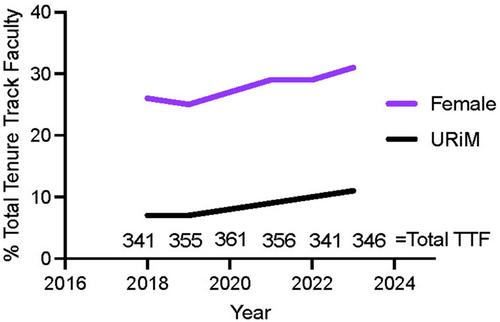
The growth of total, URiM and female faculty in the TTF series was assessed between 2018 and 2023 in HS at UC San Diego (Figure 1). There was no significant change in the time trend for total TTF in HS over these 5 years (S = 0; z = 0; p = 1.0). In 2018, of 341 HS TTF, 87 (25%) self-identified as female and 23 (7%) as URiM. In 2023, among 346 HS TTF, 108 (31%) self-identified as female and 39 (11%) as URiM. The proportion of female TTF (S = 12; z = 2.1; p = 0.036) and URiM TTF (S = 15; z = 2.6; p = 0.008) increased significantly over this period (Figure 1).
Between 2019 and 2023, HS participated in three cluster hires that were supported in part by institutional and/or extramural funds (Table 1). In HS eight of the 19 URiM TTF recruited between 2019 and 2023 were from cluster hires. In contrast, only three of the 36 female TTF hired in HS between 2019 and 2023 were recruited from these cluster hires. Relatively few physician-scientists applied (e.g., n = 10 of 249 applicants, 3rd cluster) and ultimately none of these applicants were selected.
Recruitment is key to enriching the pool of talented TTF in HS [5, 10, 11]. At UC San Diego, cross-campus cluster recruitments were successful in hiring URiM faculty in HS. Cluster hires enabled access to robust pools of highly competitive applicants, which were holistically reviewed by multidisciplinary committees [12], and likely facilitated joint hires between departments. A centrally managed process enabled a broader view of achievements in research, teaching and service than a single departmental agenda focused exclusively on a specific research area. Importantly, top leadership was engaged in trialing alternative inclusive hiring practices.
This report is limited to tenure track positions in HS at a single institution and is a short-term study. Hence promotion and retention rates should be subsequently evaluated [13, 14]. We used the Mann–Kendall test to evaluate temporal trends; however, the data sets are relatively small which can reduce the sensitivity and limit the power of this test [15]. Our recruitments had highly competitive applicants, some of whom accepted alternate offers, which may have skewed representation in the relatively small numbers of hires. The number of TTF positions in HS at UC San Diego had not significantly increased in the time frame examined here; however, there has been a substantial increase in faculty with contingent appointments over the same timeframe (1293 to 1482) that warrants future comparisons [14, 16].
Overall there were roughly equal numbers of TTF hired between HS and the main campus in the clusters. The cluster hiring strategy was successful in the recruitment of URiM TTF in HS. However, this practice was less effective with hiring competitive female faculty, despite sufficient representation in the applicant pool (e.g., 51% of the third cluster applicants identified as female). We did not reach overall gender parity in these clusters, noting that we needed to exceed parity with these small numbers to increase the proportion of female TTF in HS [5, 17]. Physician-scientists were not selected in recruitments by cross-campus committees representative of all biomedical research departments at UC San Diego. These candidates may have been perceived as being less productive as their research and publications may have been delayed or interrupted by clinical training periods. This suggests a need to calibrate scientific achievements to allow for interruptions required for clinical training or have separate cluster hires for physician-scientists [18].
In summary, academic leadership valued efforts to engender a diverse, talented TTF in HS, and centrally governed cluster hire initiatives were successful in URiM TTF recruitment, but less so for female and physician-scientist TTF, indicating a need for further refinements [17, 19, 20].
Maripat Corr: conceptualization, data curation, formal analysis, writing–review and editing, funding acquisition, writing–original draft. Vivian Reznik: conceptualization, writing–review and editing, funding acquisition. Deborah Wingard: funding acquisition, writing–review and editing, formal analysis. Danielle Fettes: formal analysis, funding acquisition, writing–review and editing. Virginia Hazen: writing–review and editing, formal analysis, data curation. Maria Elena Martinez: funding acquisition, writing–review and editing, formal analysis. JoAnn Trejo: funding acquisition, writing–review and editing, formal analysis.
This study followed the EQUATOR/STROBE reporting guideline and was approved by the institutional review board.
The authors declare no conflicts of interest.
The lead authors Maripat Corr, and JoAnn Trejo affirm that this manuscript is an honest, accurate, and transparent account of the study being reported; that no important aspects of the study have been omitted; and that any discrepancies from the study as planned (and, if relevant, registered) have been explained.



 京公网安备 11010802042870号
京ICP备2023020795号-1
京公网安备 11010802042870号
京ICP备2023020795号-1

 分享
分享
 求助内容:
求助内容: 应助结果提醒方式:
 扫码关注我们
