Sarah Sharmala Nadarajan, Ping Lei Chui, Wan Ling Lee, Noor Hanita Zaini
{"title":"Factors influencing compassion satisfaction and compassion fatigue among nurses: a study in a tertiary hospital.","authors":"Sarah Sharmala Nadarajan, Ping Lei Chui, Wan Ling Lee, Noor Hanita Zaini","doi":"10.1186/s12912-025-02736-3","DOIUrl":null,"url":null,"abstract":"<p><strong>Background: </strong>Nursing is a caring profession for which compassion is a core value. Increasing stress and declining job satisfaction are among the major challenges in nursing. Demographic and work-related factors may influence nurses' compassion satisfaction and compassion fatigue (i.e., burnout and secondary traumatic stress) levels. In this study, the level of compassion fatigue and compassion satisfaction and their associated factors were examined among nurses in a tertiary hospital.</p><p><strong>Methods: </strong>A cross-sectional study was conducted at a tertiary hospital in Malaysia. The data were collected over a period of 6 months via online distribution of the Personal Information Form, Copenhagen Psychosocial Questionnaire (COPSOQ) version III and Professional Quality of Life (ProQOL) version V questionnaires. The Cronbach's alpha internal consistency of the questionnaire scales was mostly acceptable and above 0.75. Descriptive statistics were used to summarize the sociodemographic and rank domains of work environment-related factors for nurses and their levels of compassion satisfaction and compassion fatigue. Relationships between sociodemographic factors and the levels of compassion fatigue, compassion satisfaction, and burnout were assessed by bivariate analyses. A p value < 0.05 was considered to indicate statistical significance.</p><p><strong>Results: </strong>A total of 323 registered nurses participated in this study. A majority of the participants were female (91%, n = 294), and the mean age of the participants was 33.01 ± 8.50 years. The majority of the participants had moderate levels of compassion satisfaction (71%, n = 229); 46% (n = 148) had moderate levels of burnout, and 45% (n = 147) had moderate levels of secondary traumatic stress. Hierarchical multiple regression analysis revealed that the health and well-being and demands at work domain were significantly associated with compassion satisfaction, burnout and secondary traumatic stress levels among nurses.</p><p><strong>Conclusions: </strong>In this study, the majority of the nurses reported decreased compassion satisfaction and increased burnout. These findings provide valuable insights, as there may be detrimental effects on the healthcare industry and retention of nurses if no action is taken to combat compassion fatigue. Recommendations to motivate nurses and reduce demands at work should be explored by healthcare organizations to increase nurses' performance and job satisfaction.</p>","PeriodicalId":48580,"journal":{"name":"BMC Nursing","volume":"24 1","pages":"93"},"PeriodicalIF":3.9000,"publicationDate":"2025-01-27","publicationTypes":"Journal Article","fieldsOfStudy":null,"isOpenAccess":false,"openAccessPdf":"https://www.ncbi.nlm.nih.gov/pmc/articles/PMC11770903/pdf/","citationCount":"0","resultStr":null,"platform":"Semanticscholar","paperid":null,"PeriodicalName":"BMC Nursing","FirstCategoryId":"3","ListUrlMain":"https://doi.org/10.1186/s12912-025-02736-3","RegionNum":2,"RegionCategory":"医学","ArticlePicture":[],"TitleCN":null,"AbstractTextCN":null,"PMCID":null,"EPubDate":"","PubModel":"","JCR":"Q1","JCRName":"NURSING","Score":null,"Total":0}
引用次数: 0
Abstract
Background: Nursing is a caring profession for which compassion is a core value. Increasing stress and declining job satisfaction are among the major challenges in nursing. Demographic and work-related factors may influence nurses' compassion satisfaction and compassion fatigue (i.e., burnout and secondary traumatic stress) levels. In this study, the level of compassion fatigue and compassion satisfaction and their associated factors were examined among nurses in a tertiary hospital.
Methods: A cross-sectional study was conducted at a tertiary hospital in Malaysia. The data were collected over a period of 6 months via online distribution of the Personal Information Form, Copenhagen Psychosocial Questionnaire (COPSOQ) version III and Professional Quality of Life (ProQOL) version V questionnaires. The Cronbach's alpha internal consistency of the questionnaire scales was mostly acceptable and above 0.75. Descriptive statistics were used to summarize the sociodemographic and rank domains of work environment-related factors for nurses and their levels of compassion satisfaction and compassion fatigue. Relationships between sociodemographic factors and the levels of compassion fatigue, compassion satisfaction, and burnout were assessed by bivariate analyses. A p value < 0.05 was considered to indicate statistical significance.
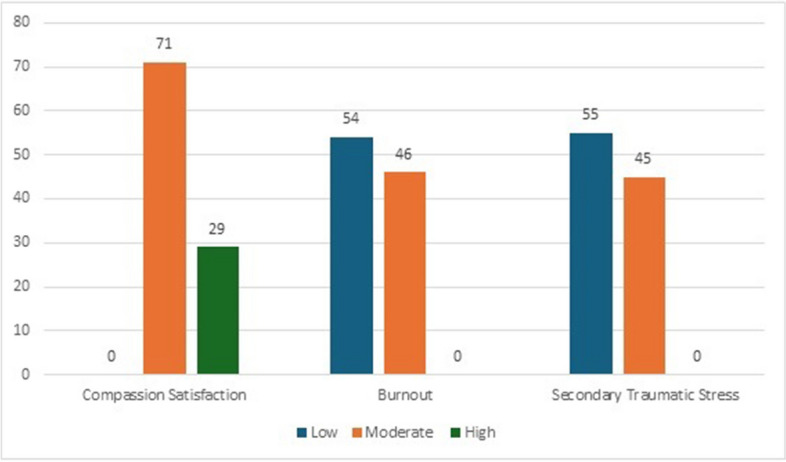
Results: A total of 323 registered nurses participated in this study. A majority of the participants were female (91%, n = 294), and the mean age of the participants was 33.01 ± 8.50 years. The majority of the participants had moderate levels of compassion satisfaction (71%, n = 229); 46% (n = 148) had moderate levels of burnout, and 45% (n = 147) had moderate levels of secondary traumatic stress. Hierarchical multiple regression analysis revealed that the health and well-being and demands at work domain were significantly associated with compassion satisfaction, burnout and secondary traumatic stress levels among nurses.
Conclusions: In this study, the majority of the nurses reported decreased compassion satisfaction and increased burnout. These findings provide valuable insights, as there may be detrimental effects on the healthcare industry and retention of nurses if no action is taken to combat compassion fatigue. Recommendations to motivate nurses and reduce demands at work should be explored by healthcare organizations to increase nurses' performance and job satisfaction.
期刊介绍:
BMC Nursing is an open access, peer-reviewed journal that considers articles on all aspects of nursing research, training, education and practice.



 京公网安备 11010802042870号
京ICP备2023020795号-1
京公网安备 11010802042870号
京ICP备2023020795号-1

 分享
分享
 求助内容:
求助内容: 应助结果提醒方式:
 扫码关注我们
