Marie C Dade, Aletta Bonn, Felix Eigenbrod, María R Felipe-Lucia, Brendan Fisher, Benjamin Goldstein, Robert A Holland, Kelly A Hopping, Sandra Lavorel, Yann Lede Polain Waroux, Graham K MacDonald, Lisa Mandle, Jean Paul Metzger, Unai Pascual, Jesse T Rieb, Améline Vallet, Geoff J Wells, Carly D Ziter, Elena M Bennett, Brian E Robinson
{"title":"Landscapes-a lens for assessing sustainability.","authors":"Marie C Dade, Aletta Bonn, Felix Eigenbrod, María R Felipe-Lucia, Brendan Fisher, Benjamin Goldstein, Robert A Holland, Kelly A Hopping, Sandra Lavorel, Yann Lede Polain Waroux, Graham K MacDonald, Lisa Mandle, Jean Paul Metzger, Unai Pascual, Jesse T Rieb, Améline Vallet, Geoff J Wells, Carly D Ziter, Elena M Bennett, Brian E Robinson","doi":"10.1007/s10980-024-02007-7","DOIUrl":null,"url":null,"abstract":"<p><strong>Context: </strong>There are urgent calls to transition society to more sustainable trajectories, at scales ranging from local to global. Landscape sustainability (LS), or the capacity for landscapes to provide equitable access to ecosystem services essential for human wellbeing for both current and future generations, provides an operational approach to monitor these transitions. However, the complexity of landscapes complicates how and what to consider when assessing LS.</p><p><strong>Objectives: </strong>To identify important features of landscapes that remain challenging to consider in LS assessments and provide guidance to strengthen future assessments.</p><p><strong>Methods: </strong>We conducted two workshops to identify the complex features of landscapes that remain under-considered in LS assessments, and developed guidelines on how to better incorporate these features.</p><p><strong>Results: </strong>We identify open and connected boundaries and diversity of values as landscape features that must be better considered in LS assessments or risk exacerbating offstage sustainability burdens and power inequalities. We provide guidelines to avoid these pitfalls which emphasize assessing ecosystem service interactions across interconnected landscapes and incorporating local actors' diverse values.</p><p><strong>Conclusions: </strong>Our guidelines provide a stepping stone for researchers and practitioners to better incorporate landscape complexities into LS assessments to inform landscape-level decisions and actions.</p>","PeriodicalId":54745,"journal":{"name":"Landscape Ecology","volume":"40 2","pages":"28"},"PeriodicalIF":3.7000,"publicationDate":"2025-01-01","publicationTypes":"Journal Article","fieldsOfStudy":null,"isOpenAccess":false,"openAccessPdf":"https://www.ncbi.nlm.nih.gov/pmc/articles/PMC11754308/pdf/","citationCount":"0","resultStr":null,"platform":"Semanticscholar","paperid":null,"PeriodicalName":"Landscape Ecology","FirstCategoryId":"93","ListUrlMain":"https://doi.org/10.1007/s10980-024-02007-7","RegionNum":2,"RegionCategory":"环境科学与生态学","ArticlePicture":[],"TitleCN":null,"AbstractTextCN":null,"PMCID":null,"EPubDate":"2025/1/22 0:00:00","PubModel":"Epub","JCR":"Q1","JCRName":"ECOLOGY","Score":null,"Total":0}
引用次数: 0
Abstract
Context: There are urgent calls to transition society to more sustainable trajectories, at scales ranging from local to global. Landscape sustainability (LS), or the capacity for landscapes to provide equitable access to ecosystem services essential for human wellbeing for both current and future generations, provides an operational approach to monitor these transitions. However, the complexity of landscapes complicates how and what to consider when assessing LS.
Objectives: To identify important features of landscapes that remain challenging to consider in LS assessments and provide guidance to strengthen future assessments.
Methods: We conducted two workshops to identify the complex features of landscapes that remain under-considered in LS assessments, and developed guidelines on how to better incorporate these features.
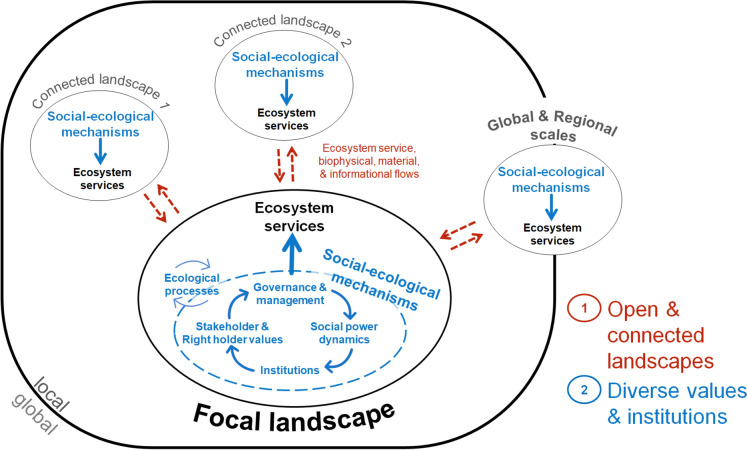
Results: We identify open and connected boundaries and diversity of values as landscape features that must be better considered in LS assessments or risk exacerbating offstage sustainability burdens and power inequalities. We provide guidelines to avoid these pitfalls which emphasize assessing ecosystem service interactions across interconnected landscapes and incorporating local actors' diverse values.
Conclusions: Our guidelines provide a stepping stone for researchers and practitioners to better incorporate landscape complexities into LS assessments to inform landscape-level decisions and actions.
期刊介绍:
Landscape Ecology is the flagship journal of a well-established and rapidly developing interdisciplinary science that focuses explicitly on the ecological understanding of spatial heterogeneity. Landscape Ecology draws together expertise from both biophysical and socioeconomic sciences to explore basic and applied research questions concerning the ecology, conservation, management, design/planning, and sustainability of landscapes as coupled human-environment systems. Landscape ecology studies are characterized by spatially explicit methods in which spatial attributes and arrangements of landscape elements are directly analyzed and related to ecological processes.




 京公网安备 11010802042870号
京ICP备2023020795号-1
京公网安备 11010802042870号
京ICP备2023020795号-1

 分享
分享
 求助内容:
求助内容: 应助结果提醒方式:
 扫码关注我们
