Song Zhai, Andy Liaw, Judong Shen, Yuting Xu, Vladimir Svetnik, James J FitzGerald, Chrystalina A Antoniades, Dan Holder, Marissa F Dockendorf, Jie Ren, Richard Baumgartner
{"title":"A novel machine learning based framework for developing composite digital biomarkers of disease progression.","authors":"Song Zhai, Andy Liaw, Judong Shen, Yuting Xu, Vladimir Svetnik, James J FitzGerald, Chrystalina A Antoniades, Dan Holder, Marissa F Dockendorf, Jie Ren, Richard Baumgartner","doi":"10.3389/fdgth.2024.1500811","DOIUrl":null,"url":null,"abstract":"<p><strong>Background: </strong>Current methods of measuring disease progression of neurodegenerative disorders, including Parkinson's disease (PD), largely rely on composite clinical rating scales, which are prone to subjective biases and lack the sensitivity to detect progression signals in a timely manner. Digital health technology (DHT)-derived measures offer potential solutions to provide objective, precise, and sensitive measures that address these limitations. However, the complexity of DHT datasets and the potential to derive numerous digital features that were not previously possible to measure pose challenges, including in selection of the most important digital features and construction of composite digital biomarkers.</p><p><strong>Methods: </strong>We present a comprehensive machine learning based framework to construct composite digital biomarkers for progression tracking. This framework consists of a marginal (univariate) digital feature screening, a univariate association test, digital feature selection, and subsequent construction of composite (multivariate) digital disease progression biomarkers using Penalized Generalized Estimating Equations (PGEE). As an illustrative example, we applied this framework to data collected from a PD longitudinal observational study. The data consisted of Opal™ sensor-based movement measurements and MDS-UPDRS Part III scores collected at 3-month intervals for 2 years in 30 PD and 10 healthy control participants.</p><p><strong>Results: </strong>In our illustrative example, 77 out of 235 digital features from the study passed univariate feature screening, with 11 features selected by PGEE to include in construction of the composite digital measure. Compared to MDS-UPDRS Part III, the composite digital measure exhibited a smoother and more significant increasing trend over time in PD groups with less variability, indicating improved ability for tracking disease progression. This composite digital measure also demonstrated the ability to classify between <i>de novo</i> PD and healthy control groups.</p><p><strong>Conclusion: </strong>Measures from DHTs show promise in tracking neurodegenerative disease progression with increased sensitivity and reduced variability as compared to traditional clinical scores. Herein, we present a novel framework and methodology to construct composite digital measure of disease progression from high-dimensional DHT datasets, which may have utility in accelerating the development and application of composite digital biomarkers in drug development.</p>","PeriodicalId":73078,"journal":{"name":"Frontiers in digital health","volume":"6 ","pages":"1500811"},"PeriodicalIF":3.2000,"publicationDate":"2025-01-10","publicationTypes":"Journal Article","fieldsOfStudy":null,"isOpenAccess":false,"openAccessPdf":"https://www.ncbi.nlm.nih.gov/pmc/articles/PMC11760596/pdf/","citationCount":"0","resultStr":null,"platform":"Semanticscholar","paperid":null,"PeriodicalName":"Frontiers in digital health","FirstCategoryId":"1085","ListUrlMain":"https://doi.org/10.3389/fdgth.2024.1500811","RegionNum":0,"RegionCategory":null,"ArticlePicture":[],"TitleCN":null,"AbstractTextCN":null,"PMCID":null,"EPubDate":"2024/1/1 0:00:00","PubModel":"eCollection","JCR":"Q1","JCRName":"HEALTH CARE SCIENCES & SERVICES","Score":null,"Total":0}
引用次数: 0
Abstract
Background: Current methods of measuring disease progression of neurodegenerative disorders, including Parkinson's disease (PD), largely rely on composite clinical rating scales, which are prone to subjective biases and lack the sensitivity to detect progression signals in a timely manner. Digital health technology (DHT)-derived measures offer potential solutions to provide objective, precise, and sensitive measures that address these limitations. However, the complexity of DHT datasets and the potential to derive numerous digital features that were not previously possible to measure pose challenges, including in selection of the most important digital features and construction of composite digital biomarkers.
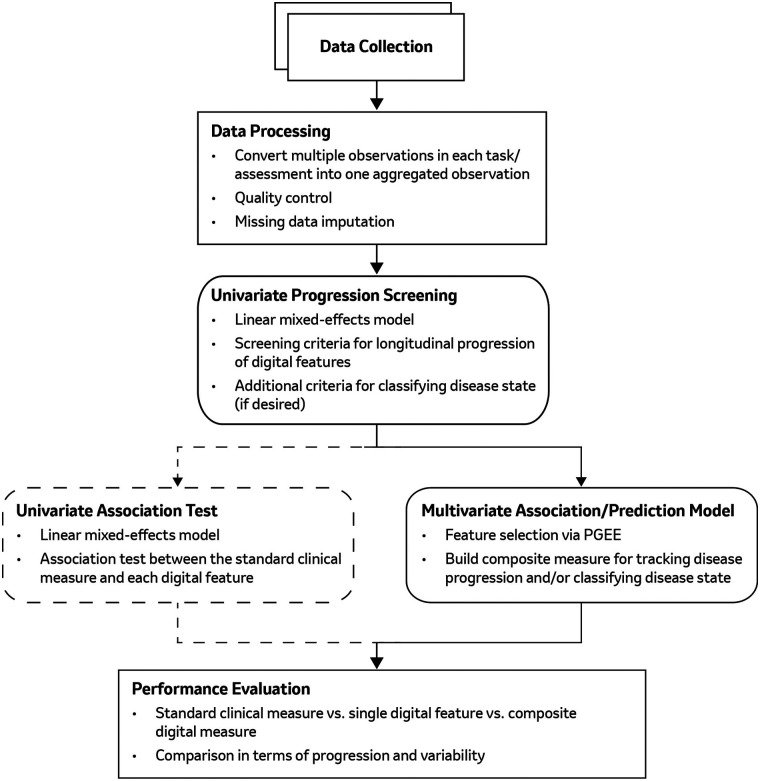
Methods: We present a comprehensive machine learning based framework to construct composite digital biomarkers for progression tracking. This framework consists of a marginal (univariate) digital feature screening, a univariate association test, digital feature selection, and subsequent construction of composite (multivariate) digital disease progression biomarkers using Penalized Generalized Estimating Equations (PGEE). As an illustrative example, we applied this framework to data collected from a PD longitudinal observational study. The data consisted of Opal™ sensor-based movement measurements and MDS-UPDRS Part III scores collected at 3-month intervals for 2 years in 30 PD and 10 healthy control participants.
Results: In our illustrative example, 77 out of 235 digital features from the study passed univariate feature screening, with 11 features selected by PGEE to include in construction of the composite digital measure. Compared to MDS-UPDRS Part III, the composite digital measure exhibited a smoother and more significant increasing trend over time in PD groups with less variability, indicating improved ability for tracking disease progression. This composite digital measure also demonstrated the ability to classify between de novo PD and healthy control groups.
Conclusion: Measures from DHTs show promise in tracking neurodegenerative disease progression with increased sensitivity and reduced variability as compared to traditional clinical scores. Herein, we present a novel framework and methodology to construct composite digital measure of disease progression from high-dimensional DHT datasets, which may have utility in accelerating the development and application of composite digital biomarkers in drug development.





 京公网安备 11010802042870号
京ICP备2023020795号-1
京公网安备 11010802042870号
京ICP备2023020795号-1

 分享
分享

 求助内容:
求助内容: 应助结果提醒方式:
 扫码关注我们
