Kevin McLaughlin, Kate I Minick, Julie M Fritz, Nicole Tannahill, Anne Spar, Marissa Feinsilver, Matthew Weber, Erika Opoku, Jeff Adams, Richard L Skolasky
{"title":"Physical therapists' perceptions of telerehabilitation for patients with musculoskeletal conditions in a post-pandemic world.","authors":"Kevin McLaughlin, Kate I Minick, Julie M Fritz, Nicole Tannahill, Anne Spar, Marissa Feinsilver, Matthew Weber, Erika Opoku, Jeff Adams, Richard L Skolasky","doi":"10.1101/2025.01.17.25320739","DOIUrl":null,"url":null,"abstract":"<p><strong>Objective: </strong>To examine physical therapists' experience providing telerehabilitation and their perceptions of telerehabilitation for patients with musculoskeletal conditions.</p><p><strong>Methods: </strong>Survey of members of the Academy of Orthopaedic Physical Therapy.</p><p><strong>Results: </strong>We received 208 completed responses to our survey invitation. Most physical therapists responding to our survey reported using little to no telerehabilitation prior to the pandemic but increased use during the pandemic, followed by decreased use of telerehabilitation after the pandemic. Respondents reported using telerehabilitation slightly more after the pandemic than beforehand. Physical therapists reported that they believed they could deliver effective care using telerehabilitation but that it was not as effective as in-clinic care and they would prefer to use telerehabilitation as part of a hybrid care model versus using only telerehabilitation. Physical therapists suggested that certain patients were more likely than others to benefit from telerehabilitation and identified specific factors (e.g., patient preference, self-efficacy, postoperative status) that influenced whom they would consider to be most appropriate for telerehabilitation. \"Patient issues with technology\" was identified as the most common barrier to telerehabilitation use. Most physical therapists reported that they planned to use telerehabilitation in the future and agreed that telerehabilitation plays an important role in expanding access to physical therapy in the United States.</p><p><strong>Conclusions: </strong>Physical therapists believed that telerehabilitation continues to play an important role in a post-pandemic world. Although physical therapists reported that they considered telerehabilitation to be an effective method for delivering care, they did not consider it to be a replacement for in-clinic care and believed that certain patients are more likely than others to benefit from this approach.</p><p><strong>Impact statement: </strong>Physical therapists consider telerehabilitation to be a viable care option for patients with musculoskeletal pain.</p>","PeriodicalId":94281,"journal":{"name":"medRxiv : the preprint server for health sciences","volume":" ","pages":""},"PeriodicalIF":0.0000,"publicationDate":"2025-01-18","publicationTypes":"Journal Article","fieldsOfStudy":null,"isOpenAccess":false,"openAccessPdf":"https://www.ncbi.nlm.nih.gov/pmc/articles/PMC11759599/pdf/","citationCount":"0","resultStr":null,"platform":"Semanticscholar","paperid":null,"PeriodicalName":"medRxiv : the preprint server for health sciences","FirstCategoryId":"1085","ListUrlMain":"https://doi.org/10.1101/2025.01.17.25320739","RegionNum":0,"RegionCategory":null,"ArticlePicture":[],"TitleCN":null,"AbstractTextCN":null,"PMCID":null,"EPubDate":"","PubModel":"","JCR":"","JCRName":"","Score":null,"Total":0}
引用次数: 0
Abstract
Objective: To examine physical therapists' experience providing telerehabilitation and their perceptions of telerehabilitation for patients with musculoskeletal conditions.
Methods: Survey of members of the Academy of Orthopaedic Physical Therapy.
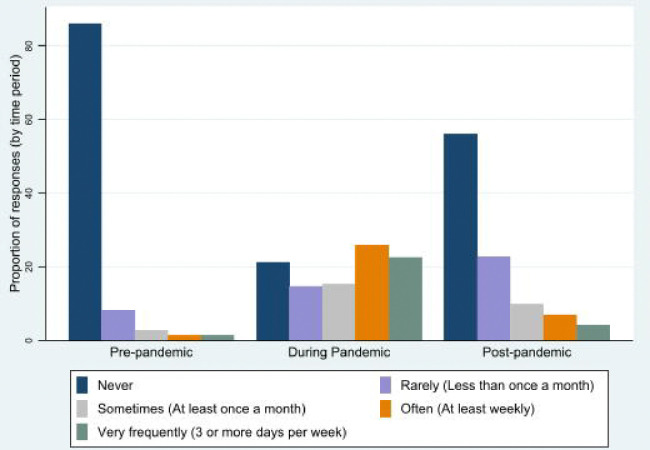
Results: We received 208 completed responses to our survey invitation. Most physical therapists responding to our survey reported using little to no telerehabilitation prior to the pandemic but increased use during the pandemic, followed by decreased use of telerehabilitation after the pandemic. Respondents reported using telerehabilitation slightly more after the pandemic than beforehand. Physical therapists reported that they believed they could deliver effective care using telerehabilitation but that it was not as effective as in-clinic care and they would prefer to use telerehabilitation as part of a hybrid care model versus using only telerehabilitation. Physical therapists suggested that certain patients were more likely than others to benefit from telerehabilitation and identified specific factors (e.g., patient preference, self-efficacy, postoperative status) that influenced whom they would consider to be most appropriate for telerehabilitation. "Patient issues with technology" was identified as the most common barrier to telerehabilitation use. Most physical therapists reported that they planned to use telerehabilitation in the future and agreed that telerehabilitation plays an important role in expanding access to physical therapy in the United States.
Conclusions: Physical therapists believed that telerehabilitation continues to play an important role in a post-pandemic world. Although physical therapists reported that they considered telerehabilitation to be an effective method for delivering care, they did not consider it to be a replacement for in-clinic care and believed that certain patients are more likely than others to benefit from this approach.
Impact statement: Physical therapists consider telerehabilitation to be a viable care option for patients with musculoskeletal pain.





 京公网安备 11010802042870号
京ICP备2023020795号-1
京公网安备 11010802042870号
京ICP备2023020795号-1

 分享
分享

 求助内容:
求助内容: 应助结果提醒方式:
 扫码关注我们
