Jinmin Tian, Bingli Shang, Jianing Zhang, Yuanyuan Guo, Min Li, Yuechao Hu, Dan Bai, Junying She, Yang Han, Peipei Guo, Mengkun Huang, Yalan Wang, Maoshun Liu, Jie Zhang, Beiwei Ye, Yaxin Guo, Mengjie Yang, Ying Lin, Ting Zhang, Xin Sun, Xiaoju Yuan, Danni Zhang, Ziqian Xu, Yan Chai, Jianxun Qi, Kefang Liu, Shuguang Tan, Yingze Zhao, Jikun Zhou, Rui Song, George F. Gao, Jun Liu
{"title":"T cell immune evasion by SARS-CoV-2 JN.1 escapees targeting two cytotoxic T cell epitope hotspots","authors":"Jinmin Tian, Bingli Shang, Jianing Zhang, Yuanyuan Guo, Min Li, Yuechao Hu, Dan Bai, Junying She, Yang Han, Peipei Guo, Mengkun Huang, Yalan Wang, Maoshun Liu, Jie Zhang, Beiwei Ye, Yaxin Guo, Mengjie Yang, Ying Lin, Ting Zhang, Xin Sun, Xiaoju Yuan, Danni Zhang, Ziqian Xu, Yan Chai, Jianxun Qi, Kefang Liu, Shuguang Tan, Yingze Zhao, Jikun Zhou, Rui Song, George F. Gao, Jun Liu","doi":"10.1038/s41590-024-02051-0","DOIUrl":null,"url":null,"abstract":"Although antibody escape is observed in emerging severe acute respiratory syndrome coronavirus 2 variants, T cell escape, especially after the global circulation of BA.2.86/JN.1, is unexplored. Here we demonstrate that T cell evasion exists in epitope hotspots spanning BA.2.86/JN.1 mutations. The newly emerging Q229K at this conserved nucleocapsid protein site impairs HLA-A2 epitope hotspot recognition. The association between HLA-A24 convalescents and T cell immune escape points to the spike (S) protein epitope S448–456NYNYLYRLF, with multiple mutations from Delta to JN.1, including L452Q, L452R, F456L, N450D and L452W, and N450D, L452W and L455S. A cliff drop of immune responses was observed for S448–456NYNYRYRLF (Delta/BA.5.2) and S448–456NYDYWYRSF (JN.1), but with immune preservation of S448–456NYDYWYRLF (BA.2.86). Structural analyses showed that hydrophobicity exposure determines the pronounced escape of L452R and L455S mutants, which was further confirmed by T cell receptor binding. This study highlights the characteristics and molecular mechanisms of the T cell immune escape for JN.1 and provides new insights into understanding the dominant circulation of variants, from the viewpoint of cytotoxic T cell evasion. Liu and colleagues examine how severe acute respiratory syndrome coronavirus 2 variants evade CD8+ T cell epitope recognition.","PeriodicalId":19032,"journal":{"name":"Nature Immunology","volume":"26 2","pages":"265-278"},"PeriodicalIF":27.6000,"publicationDate":"2025-01-28","publicationTypes":"Journal Article","fieldsOfStudy":null,"isOpenAccess":false,"openAccessPdf":"","citationCount":"0","resultStr":null,"platform":"Semanticscholar","paperid":null,"PeriodicalName":"Nature Immunology","FirstCategoryId":"3","ListUrlMain":"https://www.nature.com/articles/s41590-024-02051-0","RegionNum":1,"RegionCategory":"医学","ArticlePicture":[],"TitleCN":null,"AbstractTextCN":null,"PMCID":null,"EPubDate":"","PubModel":"","JCR":"Q1","JCRName":"IMMUNOLOGY","Score":null,"Total":0}
引用次数: 0
Abstract
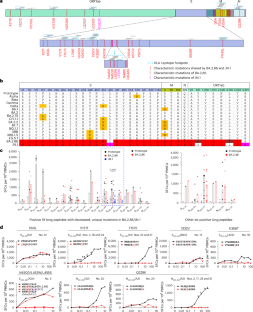
Although antibody escape is observed in emerging severe acute respiratory syndrome coronavirus 2 variants, T cell escape, especially after the global circulation of BA.2.86/JN.1, is unexplored. Here we demonstrate that T cell evasion exists in epitope hotspots spanning BA.2.86/JN.1 mutations. The newly emerging Q229K at this conserved nucleocapsid protein site impairs HLA-A2 epitope hotspot recognition. The association between HLA-A24 convalescents and T cell immune escape points to the spike (S) protein epitope S448–456NYNYLYRLF, with multiple mutations from Delta to JN.1, including L452Q, L452R, F456L, N450D and L452W, and N450D, L452W and L455S. A cliff drop of immune responses was observed for S448–456NYNYRYRLF (Delta/BA.5.2) and S448–456NYDYWYRSF (JN.1), but with immune preservation of S448–456NYDYWYRLF (BA.2.86). Structural analyses showed that hydrophobicity exposure determines the pronounced escape of L452R and L455S mutants, which was further confirmed by T cell receptor binding. This study highlights the characteristics and molecular mechanisms of the T cell immune escape for JN.1 and provides new insights into understanding the dominant circulation of variants, from the viewpoint of cytotoxic T cell evasion. Liu and colleagues examine how severe acute respiratory syndrome coronavirus 2 variants evade CD8+ T cell epitope recognition.
期刊介绍:
Nature Immunology is a monthly journal that publishes the highest quality research in all areas of immunology. The editorial decisions are made by a team of full-time professional editors. The journal prioritizes work that provides translational and/or fundamental insight into the workings of the immune system. It covers a wide range of topics including innate immunity and inflammation, development, immune receptors, signaling and apoptosis, antigen presentation, gene regulation and recombination, cellular and systemic immunity, vaccines, immune tolerance, autoimmunity, tumor immunology, and microbial immunopathology. In addition to publishing significant original research, Nature Immunology also includes comments, News and Views, research highlights, matters arising from readers, and reviews of the literature. The journal serves as a major conduit of top-quality information for the immunology community.




 京公网安备 11010802042870号
京ICP备2023020795号-1
京公网安备 11010802042870号
京ICP备2023020795号-1

 分享
分享
 求助内容:
求助内容: 应助结果提醒方式:
 扫码关注我们
