Shihu Zhang, Yi-Chi Li, Yang Chen, Yonghui Zhou, Shuyang Wang, Ying Zhou, Min Zhang, Chao An, Yong Fang, Jian Zhou, Zhaorong Yang
{"title":"Pressure-Driven Structural Transition in the Charge Density Wave Material SrAl4","authors":"Shihu Zhang, Yi-Chi Li, Yang Chen, Yonghui Zhou, Shuyang Wang, Ying Zhou, Min Zhang, Chao An, Yong Fang, Jian Zhou, Zhaorong Yang","doi":"10.1021/acs.jpcc.4c08594","DOIUrl":null,"url":null,"abstract":"SrAl<sub>4</sub>, which possesses a BaAl<sub>4</sub>-type tetragonal structure (<i>I</i>4/<i>mmm</i>, No. 139), exhibits both a charge density wave (CDW) order and a topological semimetal state at ambient pressure. Here, the electronic and structural properties of SrAl<sub>4</sub> were systematically investigated with pressure up to 49.4 GPa through electrical transport, X-ray diffraction (XRD), and Raman scattering measurements, as well as theoretical calculations. With increasing pressure, the <i>T</i><sub>CDW</sub> is monotonically decreased, and the CDW state is eventually suppressed to zero temperature at ∼10 GPa based on the linear extrapolation. At ambient pressure, three Raman vibrational modes are identified, which are assigned to <i>B</i><sub>1<i>g</i></sub> (230.9 cm<sup>–1</sup>), <i></i><span style=\"color: inherit;\"></span><span data-mathml='<math xmlns=\"http://www.w3.org/1998/Math/MathML\" display=\"inline\"><msubsup><mrow><mi>E</mi></mrow><mrow><mi>g</mi></mrow><mrow><mn>2</mn></mrow></msubsup></math>' role=\"presentation\" style=\"position: relative;\" tabindex=\"0\"><nobr aria-hidden=\"true\"><span style=\"width: 1.539em; display: inline-block;\"><span style=\"display: inline-block; position: relative; width: 1.232em; height: 0px; font-size: 122%;\"><span style=\"position: absolute; clip: rect(1.181em, 1001.23em, 2.769em, -999.997em); top: -2.2em; left: 0em;\"><span><span><span style=\"display: inline-block; position: relative; width: 1.232em; height: 0px;\"><span style=\"position: absolute; clip: rect(3.179em, 1000.77em, 4.152em, -999.997em); top: -3.993em; left: 0em;\"><span><span style=\"font-family: MathJax_Math-italic;\">E<span style=\"display: inline-block; overflow: hidden; height: 1px; width: 0.054em;\"></span></span></span><span style=\"display: inline-block; width: 0px; height: 3.998em;\"></span></span><span style=\"position: absolute; clip: rect(3.384em, 1000.41em, 4.152em, -999.997em); top: -4.403em; left: 0.822em;\"><span><span style=\"font-size: 70.7%; font-family: MathJax_Main;\">2</span></span><span style=\"display: inline-block; width: 0px; height: 3.998em;\"></span></span><span style=\"position: absolute; clip: rect(3.537em, 1000.41em, 4.306em, -999.997em); top: -3.737em; left: 0.72em;\"><span><span style=\"font-size: 70.7%; font-family: MathJax_Math-italic;\">g<span style=\"display: inline-block; overflow: hidden; height: 1px; width: 0.003em;\"></span></span></span><span style=\"display: inline-block; width: 0px; height: 3.998em;\"></span></span></span></span></span><span style=\"display: inline-block; width: 0px; height: 2.205em;\"></span></span></span><span style=\"display: inline-block; overflow: hidden; vertical-align: -0.559em; border-left: 0px solid; width: 0px; height: 1.691em;\"></span></span></nobr><span role=\"presentation\"><math display=\"inline\" xmlns=\"http://www.w3.org/1998/Math/MathML\"><msubsup><mrow><mi>E</mi></mrow><mrow><mi>g</mi></mrow><mrow><mn>2</mn></mrow></msubsup></math></span></span><script type=\"math/mml\"><math display=\"inline\"><msubsup><mrow><mi>E</mi></mrow><mrow><mi>g</mi></mrow><mrow><mn>2</mn></mrow></msubsup></math></script> (302.7 cm<sup>–1</sup>), and <i>A</i><sub>1<i>g</i></sub> (357.4 cm<sup>–1</sup>), respectively. Upon compression to <i>P</i><sub>C</sub> = 19.0 GPa, the original Raman modes all disappear, and simultaneously, four new peaks emerge, which indicate the occurrence of a structural transition. Combined with XRD and theoretical calculations, the <i>C</i>2/<i>m</i> phase is believed to be the most plausible crystal structure of SrAl<sub>4</sub> above <i>P</i><sub>C</sub>. In addition, the residual resistance ratio as well as magnetoresistance shows abrupt changes across <i>P</i><sub>C</sub>, which further manifest the structural transition (<i>I</i>4/<i>mmm</i> → <i>C</i>2/<i>m</i>) of SrAl<sub>4</sub> under high pressure.","PeriodicalId":61,"journal":{"name":"The Journal of Physical Chemistry C","volume":"39 1","pages":""},"PeriodicalIF":3.2000,"publicationDate":"2025-01-27","publicationTypes":"Journal Article","fieldsOfStudy":null,"isOpenAccess":false,"openAccessPdf":"","citationCount":"0","resultStr":null,"platform":"Semanticscholar","paperid":null,"PeriodicalName":"The Journal of Physical Chemistry C","FirstCategoryId":"1","ListUrlMain":"https://doi.org/10.1021/acs.jpcc.4c08594","RegionNum":3,"RegionCategory":"化学","ArticlePicture":[],"TitleCN":null,"AbstractTextCN":null,"PMCID":null,"EPubDate":"","PubModel":"","JCR":"Q2","JCRName":"CHEMISTRY, PHYSICAL","Score":null,"Total":0}
引用次数: 0
Abstract
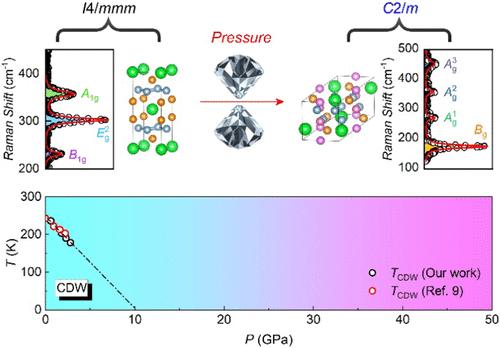
SrAl4, which possesses a BaAl4-type tetragonal structure (I4/mmm, No. 139), exhibits both a charge density wave (CDW) order and a topological semimetal state at ambient pressure. Here, the electronic and structural properties of SrAl4 were systematically investigated with pressure up to 49.4 GPa through electrical transport, X-ray diffraction (XRD), and Raman scattering measurements, as well as theoretical calculations. With increasing pressure, the TCDW is monotonically decreased, and the CDW state is eventually suppressed to zero temperature at ∼10 GPa based on the linear extrapolation. At ambient pressure, three Raman vibrational modes are identified, which are assigned to B1g (230.9 cm–1), E2g (302.7 cm–1), and A1g (357.4 cm–1), respectively. Upon compression to PC = 19.0 GPa, the original Raman modes all disappear, and simultaneously, four new peaks emerge, which indicate the occurrence of a structural transition. Combined with XRD and theoretical calculations, the C2/m phase is believed to be the most plausible crystal structure of SrAl4 above PC. In addition, the residual resistance ratio as well as magnetoresistance shows abrupt changes across PC, which further manifest the structural transition (I4/mmm → C2/m) of SrAl4 under high pressure.
期刊介绍:
The Journal of Physical Chemistry A/B/C is devoted to reporting new and original experimental and theoretical basic research of interest to physical chemists, biophysical chemists, and chemical physicists.



 京公网安备 11010802042870号
京ICP备2023020795号-1
京公网安备 11010802042870号
京ICP备2023020795号-1

 分享
分享
 求助内容:
求助内容: 应助结果提醒方式:
 扫码关注我们
