Dr. Shen Xu, Tuoya Naren, Yanwei Zhao, Qianfeng Gu, Ting Wai Lau, Prof. Dr. Chun-Sing Lee, Prof. Dr. Fu-Rong Chen, Dr. Jun Yin, Prof. Libao Chen, Prof. Dr. Qichun Zhang
{"title":"Soluble Covalent Organic Frameworks as Efficient Lithiophilic Modulator for High-Performance Lithium Metal Batteries","authors":"Dr. Shen Xu, Tuoya Naren, Yanwei Zhao, Qianfeng Gu, Ting Wai Lau, Prof. Dr. Chun-Sing Lee, Prof. Dr. Fu-Rong Chen, Dr. Jun Yin, Prof. Libao Chen, Prof. Dr. Qichun Zhang","doi":"10.1002/anie.202422040","DOIUrl":null,"url":null,"abstract":"<p>Lithium metal batteries (LMBs) are regarded as the potential alternative of lithium-ion batteries due to their ultrahigh theoretical specific capacity (3860 mAh g<sup>−1</sup>). However, severe instability and safety problems caused by the dendrite growth and inevitable side reactions have hindered the commercialization of LMBs. To solve them, in this contribution, a design strategy of soluble lithiophilic covalent organic frameworks (COFs) is proposed. By introducing polyethylene glycol as the side chains, two COFs (<b>CityU-28</b> and <b>CityU-29</b>) not only become soluble for the facile coating technique, but also can facilitate the lithium-ion migration in batteries. Furthermore, when coated on the lithium anode of LMB, both COFs can act as artificial solid electrolyte interphase to prevent dendrite growth thus enabling the long-term stability of the cells. Notably, the symmetric CityU-29@Li cell can work for more than 5000 h at a current density of 2 mA cm<sup>−2</sup> and an areal capacity of 1 mAh cm<sup>−2</sup>. A remarkable capacity retention of 78.9 % after 1500 cycles and a Coulombic efficiency of about 99.9 % at 1.0 C can also be realized in CityU-29@Li||LiFePO<sub>4</sub> full cell. This work could provide a universal design strategy for soluble COFs and enlighten their application in diverse scenarios, especially energy-related fields.</p>","PeriodicalId":125,"journal":{"name":"Angewandte Chemie International Edition","volume":"64 15","pages":""},"PeriodicalIF":16.9000,"publicationDate":"2025-01-28","publicationTypes":"Journal Article","fieldsOfStudy":null,"isOpenAccess":false,"openAccessPdf":"https://onlinelibrary.wiley.com/doi/epdf/10.1002/anie.202422040","citationCount":"0","resultStr":null,"platform":"Semanticscholar","paperid":null,"PeriodicalName":"Angewandte Chemie International Edition","FirstCategoryId":"92","ListUrlMain":"https://onlinelibrary.wiley.com/doi/10.1002/anie.202422040","RegionNum":1,"RegionCategory":"化学","ArticlePicture":[],"TitleCN":null,"AbstractTextCN":null,"PMCID":null,"EPubDate":"","PubModel":"","JCR":"Q1","JCRName":"CHEMISTRY, MULTIDISCIPLINARY","Score":null,"Total":0}
引用次数: 0
Abstract
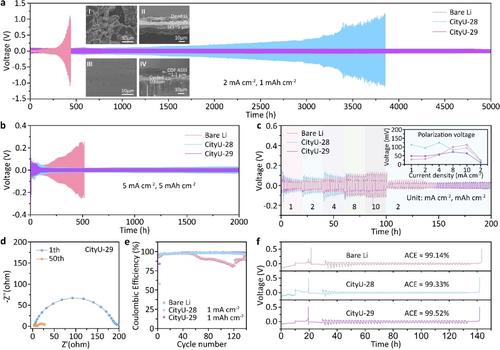
Lithium metal batteries (LMBs) are regarded as the potential alternative of lithium-ion batteries due to their ultrahigh theoretical specific capacity (3860 mAh g−1). However, severe instability and safety problems caused by the dendrite growth and inevitable side reactions have hindered the commercialization of LMBs. To solve them, in this contribution, a design strategy of soluble lithiophilic covalent organic frameworks (COFs) is proposed. By introducing polyethylene glycol as the side chains, two COFs (CityU-28 and CityU-29) not only become soluble for the facile coating technique, but also can facilitate the lithium-ion migration in batteries. Furthermore, when coated on the lithium anode of LMB, both COFs can act as artificial solid electrolyte interphase to prevent dendrite growth thus enabling the long-term stability of the cells. Notably, the symmetric CityU-29@Li cell can work for more than 5000 h at a current density of 2 mA cm−2 and an areal capacity of 1 mAh cm−2. A remarkable capacity retention of 78.9 % after 1500 cycles and a Coulombic efficiency of about 99.9 % at 1.0 C can also be realized in CityU-29@Li||LiFePO4 full cell. This work could provide a universal design strategy for soluble COFs and enlighten their application in diverse scenarios, especially energy-related fields.
锂金属电池(lmb)具有超高的理论比容量(3860 mAh g-1),被认为是锂离子电池的潜在替代品。然而,由于枝晶生长引起的严重的不稳定性和安全性问题以及不可避免的副反应阻碍了lmb的商业化。为了解决这些问题,本文提出了一种可溶亲锂共价有机框架(COFs)的设计策略。通过引入聚乙二醇作为侧链,两种COFs (CityU-28和CityU-29)不仅可以在快速自旋涂覆技术中溶解,而且可以促进锂离子在电池中的迁移。此外,当涂层在LMB的锂阳极上时,这两种COFs都可以作为人工固体电解质间相来阻止枝晶的生长,从而使电池具有长期稳定性。值得注意的是,对称的CityU-29@Li电池可以在2毫安厘米-2的电流密度和1毫安厘米-2的面容量下工作超过5000小时。在CityU-29@Li||LiFePO4充满电池中,循环1500次后容量保持率达到78.9%,1.0℃时库仑效率达到99.9%。本研究为可溶性COFs提供了一种通用的设计策略,并为其在各种场景,特别是能源相关领域的应用提供了启示。
期刊介绍:
Angewandte Chemie, a journal of the German Chemical Society (GDCh), maintains a leading position among scholarly journals in general chemistry with an impressive Impact Factor of 16.6 (2022 Journal Citation Reports, Clarivate, 2023). Published weekly in a reader-friendly format, it features new articles almost every day. Established in 1887, Angewandte Chemie is a prominent chemistry journal, offering a dynamic blend of Review-type articles, Highlights, Communications, and Research Articles on a weekly basis, making it unique in the field.



 京公网安备 11010802042870号
京ICP备2023020795号-1
京公网安备 11010802042870号
京ICP备2023020795号-1

 分享
分享
 求助内容:
求助内容: 应助结果提醒方式:
 扫码关注我们
