Songlin Lu , Sanming Du , Zhen Li , Xiaoxiong Liu , Xiaochao Wang , Zipeng Ding
{"title":"Effect of Zr addition on microstructure, mechanical and tribological properties of Cu-Ni-Sn alloy fabricated by spark plasma sintering","authors":"Songlin Lu , Sanming Du , Zhen Li , Xiaoxiong Liu , Xiaochao Wang , Zipeng Ding","doi":"10.1016/j.jallcom.2025.178887","DOIUrl":null,"url":null,"abstract":"<div><div>Synergistic improvement between the mechanical properties and wear resistance of Cu-Ni-Sn alloys is critical for extending the service life of materials in practical applications. In this study, Cu-12.5Ni-5Sn-xZr alloys (x = 0, 0.5, 1.0, and 1.5 wt%) were prepared by spark plasma sintering (SPS). Subsequently, the effects of Zr addition on the microstructure, mechanical, and high temperature tribological properties were systematically investigated. We found that Zr addition significantly refined the alloy grains and allowed the γ-phase to more easily precipitate with needle-like or particulate-like shapes. When 1.0 wt% Zr was added, the formation of nano-scale Ni<sub>4</sub>SnZr phase inhibited discontinuous precipitation (DP) nucleation and reduced the growth rate. Meanwhile, the hardness and yield strength reached aging peaks of 326.8 HB and 669.5 MPa, respectively, which were approximately 30 % and 43 % higher than without Zr. This improvement was mainly attributed to grain refinement, nano-precipitation strengthening and the inhibition of DP. Furthermore, the addition of 1.0 wt% Zr could improve the tribological properties of the matrix alloy, especially the wear rate reached an order of magnitude of 9.28 × 10<sup>−6</sup> mm<sup>3</sup>/N⋅m at room temperature. From room temperature to 500 °C, the decrease in friction coefficient of the alloys was mainly due to the formation of metal oxides, whereas the increase in wear rate was mainly the decrease in mechanical properties and severe oxidation at high temperature.</div></div>","PeriodicalId":344,"journal":{"name":"Journal of Alloys and Compounds","volume":"1015 ","pages":"Article 178887"},"PeriodicalIF":6.3000,"publicationDate":"2025-01-28","publicationTypes":"Journal Article","fieldsOfStudy":null,"isOpenAccess":false,"openAccessPdf":"","citationCount":"0","resultStr":null,"platform":"Semanticscholar","paperid":null,"PeriodicalName":"Journal of Alloys and Compounds","FirstCategoryId":"88","ListUrlMain":"https://www.sciencedirect.com/science/article/pii/S0925838825004451","RegionNum":2,"RegionCategory":"材料科学","ArticlePicture":[],"TitleCN":null,"AbstractTextCN":null,"PMCID":null,"EPubDate":"","PubModel":"","JCR":"Q2","JCRName":"CHEMISTRY, PHYSICAL","Score":null,"Total":0}
引用次数: 0
Abstract
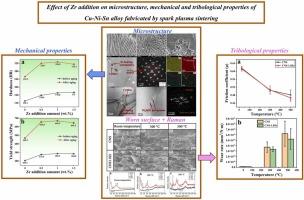
Synergistic improvement between the mechanical properties and wear resistance of Cu-Ni-Sn alloys is critical for extending the service life of materials in practical applications. In this study, Cu-12.5Ni-5Sn-xZr alloys (x = 0, 0.5, 1.0, and 1.5 wt%) were prepared by spark plasma sintering (SPS). Subsequently, the effects of Zr addition on the microstructure, mechanical, and high temperature tribological properties were systematically investigated. We found that Zr addition significantly refined the alloy grains and allowed the γ-phase to more easily precipitate with needle-like or particulate-like shapes. When 1.0 wt% Zr was added, the formation of nano-scale Ni4SnZr phase inhibited discontinuous precipitation (DP) nucleation and reduced the growth rate. Meanwhile, the hardness and yield strength reached aging peaks of 326.8 HB and 669.5 MPa, respectively, which were approximately 30 % and 43 % higher than without Zr. This improvement was mainly attributed to grain refinement, nano-precipitation strengthening and the inhibition of DP. Furthermore, the addition of 1.0 wt% Zr could improve the tribological properties of the matrix alloy, especially the wear rate reached an order of magnitude of 9.28 × 10⁻⁶ mm3/N⋅m at room temperature. From room temperature to 500 °C, the decrease in friction coefficient of the alloys was mainly due to the formation of metal oxides, whereas the increase in wear rate was mainly the decrease in mechanical properties and severe oxidation at high temperature.
期刊介绍:
The Journal of Alloys and Compounds is intended to serve as an international medium for the publication of work on solid materials comprising compounds as well as alloys. Its great strength lies in the diversity of discipline which it encompasses, drawing together results from materials science, solid-state chemistry and physics.



 京公网安备 11010802042870号
京ICP备2023020795号-1
京公网安备 11010802042870号
京ICP备2023020795号-1

 分享
分享
 求助内容:
求助内容: 应助结果提醒方式:
 扫码关注我们
