Physical Exercise Decreases Complement-Mediated Synaptic Loss and Protects Against Cognitive Impairment by Inhibiting Microglial Tmem9-ATP6V0D1 in Alzheimer's Disease
Shiyin Li, Mingyue Li, Ge Li, Lili Li, Xiaofeng Yang, Zejie Zuo, Liying Zhang, Xiquan Hu, Xiaofei He
{"title":"Physical Exercise Decreases Complement-Mediated Synaptic Loss and Protects Against Cognitive Impairment by Inhibiting Microglial Tmem9-ATP6V0D1 in Alzheimer's Disease","authors":"Shiyin Li, Mingyue Li, Ge Li, Lili Li, Xiaofeng Yang, Zejie Zuo, Liying Zhang, Xiquan Hu, Xiaofei He","doi":"10.1111/acel.14496","DOIUrl":null,"url":null,"abstract":"<p>Physical exercise is known to slow synaptic neurodegeneration and cognitive aging in Alzheimer's disease (AD). The benefits of physical exercise are related to reduced amyloid beta (A<i>β</i>) deposition and increased synaptic plasticity. Yet little is known about the mechanisms that mediate these effects. Here, we show that physical exercise down-regulated the microglial Tmem9 protein, inhibited C1q activation, and decreased C1q-dependent microglial synapse engulfment, eventually ameliorating cognitive impairment in 5xFAD mice. Furthermore, using oA<i>β</i> cultured-BV2 in vitro, we show that downregulation of microglial Tmem9 was sufficient to restrain complement activity and decrease microglia-mediated synaptic loss, whereas overexpression of microglial Tmem9 tended to promote complement activation and induced synaptic loss, abolishing exercise-associated protection. Finally, we show that microglial Tmem9 contributed to complement activation by regulating ATP6V0D1, a vesicular (H<sup>+</sup>) ATP-dependent proton pump (V-ATPase) subunit that regulates V-ATPase assembly. Together, our results demonstrate that exercise is a potential treatment for AD patients. In an AD mouse model, it decreased the levels of microglial Tmem9 to inhibit the activation of complement, alleviated complement-dependent synaptic loss, and eventually ameliorated emotional and cognitive disorders.</p>","PeriodicalId":55543,"journal":{"name":"Aging Cell","volume":"24 5","pages":""},"PeriodicalIF":7.1000,"publicationDate":"2025-01-27","publicationTypes":"Journal Article","fieldsOfStudy":null,"isOpenAccess":false,"openAccessPdf":"https://onlinelibrary.wiley.com/doi/epdf/10.1111/acel.14496","citationCount":"0","resultStr":null,"platform":"Semanticscholar","paperid":null,"PeriodicalName":"Aging Cell","FirstCategoryId":"99","ListUrlMain":"https://onlinelibrary.wiley.com/doi/10.1111/acel.14496","RegionNum":1,"RegionCategory":"医学","ArticlePicture":[],"TitleCN":null,"AbstractTextCN":null,"PMCID":null,"EPubDate":"","PubModel":"","JCR":"Q1","JCRName":"Biochemistry, Genetics and Molecular Biology","Score":null,"Total":0}
引用次数: 0
Abstract
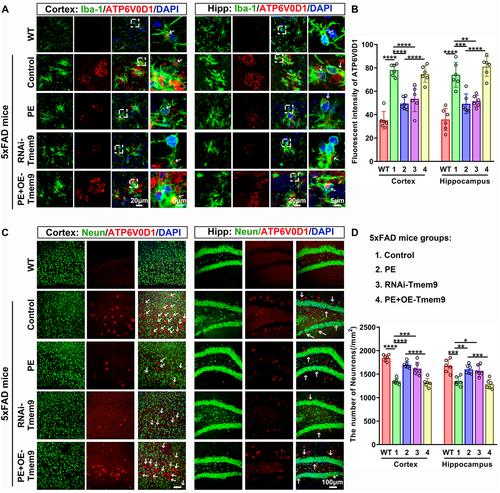
Physical exercise is known to slow synaptic neurodegeneration and cognitive aging in Alzheimer's disease (AD). The benefits of physical exercise are related to reduced amyloid beta (Aβ) deposition and increased synaptic plasticity. Yet little is known about the mechanisms that mediate these effects. Here, we show that physical exercise down-regulated the microglial Tmem9 protein, inhibited C1q activation, and decreased C1q-dependent microglial synapse engulfment, eventually ameliorating cognitive impairment in 5xFAD mice. Furthermore, using oAβ cultured-BV2 in vitro, we show that downregulation of microglial Tmem9 was sufficient to restrain complement activity and decrease microglia-mediated synaptic loss, whereas overexpression of microglial Tmem9 tended to promote complement activation and induced synaptic loss, abolishing exercise-associated protection. Finally, we show that microglial Tmem9 contributed to complement activation by regulating ATP6V0D1, a vesicular (H+) ATP-dependent proton pump (V-ATPase) subunit that regulates V-ATPase assembly. Together, our results demonstrate that exercise is a potential treatment for AD patients. In an AD mouse model, it decreased the levels of microglial Tmem9 to inhibit the activation of complement, alleviated complement-dependent synaptic loss, and eventually ameliorated emotional and cognitive disorders.
期刊介绍:
Aging Cell, an Open Access journal, delves into fundamental aspects of aging biology. It comprehensively explores geroscience, emphasizing research on the mechanisms underlying the aging process and the connections between aging and age-related diseases.




 京公网安备 11010802042870号
京ICP备2023020795号-1
京公网安备 11010802042870号
京ICP备2023020795号-1

 分享
分享
 求助内容:
求助内容: 应助结果提醒方式:
 扫码关注我们
