Bhanu Siva Mohan Pinnam MD , Pius Ehiremen Ojemolon MD , Abdul Mohammed MD , Dushyant Singh Dahiya MD , Saurabh Chandan MD , Harishankar Gopakumar MD , Hassam Ali MD , Manesh Kumar Gangwani MD , Rohit Agrawal MD , Benjamin Mba MD , Hemant Mutneja MD , Seema Gandhi MD , Muhammad K. Hasan MD , Sumant Inamdar MD
{"title":"Comparison of endoscopic and surgical gastrojejunostomy in patients with malignant gastric outlet obstruction: a national cohort analysis (2016-2020)","authors":"Bhanu Siva Mohan Pinnam MD , Pius Ehiremen Ojemolon MD , Abdul Mohammed MD , Dushyant Singh Dahiya MD , Saurabh Chandan MD , Harishankar Gopakumar MD , Hassam Ali MD , Manesh Kumar Gangwani MD , Rohit Agrawal MD , Benjamin Mba MD , Hemant Mutneja MD , Seema Gandhi MD , Muhammad K. Hasan MD , Sumant Inamdar MD","doi":"10.1016/j.gie.2025.01.025","DOIUrl":null,"url":null,"abstract":"<div><h3>Background and Aims</h3><div>Malignant gastric outlet obstruction (MGOO) is an unfortunate adverse event of advanced upper GI malignancies. Historically, surgical gastrojejunostomy (SGJ) has been the procedure of choice to achieve enteral bypass. Recently, endoscopic techniques have gained popularity in the management of MGOO. We aimed to compare periprocedural outcomes between SGJ and endoscopic gastrojejunostomy (EGJ) in patients with MGOO.</div></div><div><h3>Methods</h3><div>The National Inpatient Sample was queried from 2016 through 2020. The International Classification of Diseases, Tenth Revision, codes were used to identify adult admissions with a principal diagnosis of gastric, pancreatic, or duodenal cancer undergoing EGJ or SGJ. The 2 cohorts were compared for periprocedural adverse events.</div></div><div><h3>Results</h3><div>Of 20,930 patients undergoing gastrojejunostomy for MGOO, 16,585 underwent SGJ and 4345 underwent EGJ. The SGJ cohort had a higher proportion of patients with pancreatic cancer (36.16% vs 19.56%) and a lower proportion of patients with gastric cancer (55.16% vs 71.99%). A higher percentage of EGJs were performed in the Northeast (20.33% vs 27.66%, <em>P</em> < .001), whereas a smaller percentage of EGJs were performed in the South (30.56% vs 39.52%, <em>P</em> < .001). Between the 2 groups, the difference in mortality rates was not significantly different (0.62; 95% CI, 0.35-1.10; <em>P</em> = .106), but the EGJ group had lower odds of respiratory failure (4.7% vs 7.4%; adjusted odds ratio [aOR], 0.68; 95% CI, 0.48-0.96; <em>P</em> = .032), blood transfusion (9.25% vs 13.74%; aOR, 0.63; 95% CI, 0.48-0.82; <em>P</em> = .001), and peritonitis (2.19% vs 4.5%; aOR, 0.55; 95% CI, 0.33-0.91; <em>P</em> = .022). The EGJ group had lesser hospitalization charges (mean $164,794 vs $183,519; adjusted difference on regression, $16,495; 95% CI, 29,204-3786; <em>P</em> = .011) and shorter hospital stays (mean, 9.88 vs 12.56 days; adjusted difference, 2.24 days; 95% CI, 1.53-2.96; <em>P</em> < .001). The use of EGJ increased over 5 years (16.86% in 2016 to 24.14% in 2020, <em>P</em> for trend = .002), whereas the use of SGJ decreased (83.13% in 2016 to 75.85% in 2020, <em>P</em> for trend = .002).</div></div><div><h3>Conclusions</h3><div>Compared with SGJ, EGJ is associated with lower rates of periprocedural adverse events, hospitalization charges, and length of stay. For these reasons, EGJ should be strongly considered in managing MGOO.</div></div>","PeriodicalId":12542,"journal":{"name":"Gastrointestinal endoscopy","volume":"102 2","pages":"Pages 205-213.e1"},"PeriodicalIF":7.5000,"publicationDate":"2025-01-25","publicationTypes":"Journal Article","fieldsOfStudy":null,"isOpenAccess":false,"openAccessPdf":"","citationCount":"0","resultStr":null,"platform":"Semanticscholar","paperid":null,"PeriodicalName":"Gastrointestinal endoscopy","FirstCategoryId":"3","ListUrlMain":"https://www.sciencedirect.com/science/article/pii/S0016510725000495","RegionNum":1,"RegionCategory":"医学","ArticlePicture":[],"TitleCN":null,"AbstractTextCN":null,"PMCID":null,"EPubDate":"","PubModel":"","JCR":"Q1","JCRName":"GASTROENTEROLOGY & HEPATOLOGY","Score":null,"Total":0}
引用次数: 0
Abstract
Background and Aims
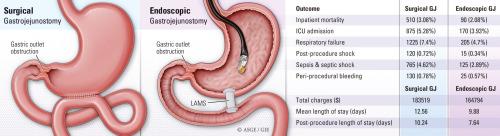
Malignant gastric outlet obstruction (MGOO) is an unfortunate adverse event of advanced upper GI malignancies. Historically, surgical gastrojejunostomy (SGJ) has been the procedure of choice to achieve enteral bypass. Recently, endoscopic techniques have gained popularity in the management of MGOO. We aimed to compare periprocedural outcomes between SGJ and endoscopic gastrojejunostomy (EGJ) in patients with MGOO.
Methods
The National Inpatient Sample was queried from 2016 through 2020. The International Classification of Diseases, Tenth Revision, codes were used to identify adult admissions with a principal diagnosis of gastric, pancreatic, or duodenal cancer undergoing EGJ or SGJ. The 2 cohorts were compared for periprocedural adverse events.
Results
Of 20,930 patients undergoing gastrojejunostomy for MGOO, 16,585 underwent SGJ and 4345 underwent EGJ. The SGJ cohort had a higher proportion of patients with pancreatic cancer (36.16% vs 19.56%) and a lower proportion of patients with gastric cancer (55.16% vs 71.99%). A higher percentage of EGJs were performed in the Northeast (20.33% vs 27.66%, P < .001), whereas a smaller percentage of EGJs were performed in the South (30.56% vs 39.52%, P < .001). Between the 2 groups, the difference in mortality rates was not significantly different (0.62; 95% CI, 0.35-1.10; P = .106), but the EGJ group had lower odds of respiratory failure (4.7% vs 7.4%; adjusted odds ratio [aOR], 0.68; 95% CI, 0.48-0.96; P = .032), blood transfusion (9.25% vs 13.74%; aOR, 0.63; 95% CI, 0.48-0.82; P = .001), and peritonitis (2.19% vs 4.5%; aOR, 0.55; 95% CI, 0.33-0.91; P = .022). The EGJ group had lesser hospitalization charges (mean $164,794 vs $183,519; adjusted difference on regression, $16,495; 95% CI, 29,204-3786; P = .011) and shorter hospital stays (mean, 9.88 vs 12.56 days; adjusted difference, 2.24 days; 95% CI, 1.53-2.96; P < .001). The use of EGJ increased over 5 years (16.86% in 2016 to 24.14% in 2020, P for trend = .002), whereas the use of SGJ decreased (83.13% in 2016 to 75.85% in 2020, P for trend = .002).
Conclusions
Compared with SGJ, EGJ is associated with lower rates of periprocedural adverse events, hospitalization charges, and length of stay. For these reasons, EGJ should be strongly considered in managing MGOO.
背景和目的:恶性胃出口梗阻(MGOO)是晚期上消化道恶性肿瘤的不幸并发症。从历史上看,外科胃空肠造口术一直是实现肠内分流的首选方法。最近,内窥镜技术在MGOO的治疗中得到了普及。我们的目的是比较手术和内镜下胃空肠造口术治疗MGOO患者的围手术期结果。方法:对2016 - 2020年全国住院患者样本(NIS)进行查询。国际疾病分类第十版(ICD-10)代码用于识别主要诊断为胃癌、胰腺癌或十二指肠癌的成人入院,接受内镜下胃空肠造口术(EGJ)或手术胃空肠造口术(SGJ)。比较两组患者的围手术期不良事件。结果:共有20,930例MGOO住院患者接受胃空肠吻合术(16,585例SGJ和4,345例EGJ)。SGJ队列中胰腺癌患者比例较高(36.16%对19.56%),胃癌患者比例较低(55.16%对71.99%)。东北地区内镜下GJ的比例较高(20.33% vs 27.66%)。结论:与外科GJ相比,内镜下GJ的术中不良事件发生率、住院费用和住院时间均较低。由于这些原因,在治疗恶性胃出口梗阻时应强烈考虑内镜下GJ。
期刊介绍:
Gastrointestinal Endoscopy is a journal publishing original, peer-reviewed articles on endoscopic procedures for studying, diagnosing, and treating digestive diseases. It covers outcomes research, prospective studies, and controlled trials of new endoscopic instruments and treatment methods. The online features include full-text articles, video and audio clips, and MEDLINE links. The journal serves as an international forum for the latest developments in the specialty, offering challenging reports from authorities worldwide. It also publishes abstracts of significant articles from other clinical publications, accompanied by expert commentaries.



 京公网安备 11010802042870号
京ICP备2023020795号-1
京公网安备 11010802042870号
京ICP备2023020795号-1

 分享
分享
 求助内容:
求助内容: 应助结果提醒方式:
 扫码关注我们
