Pablo Moraleda-Berral, Rosa Gálvez, Eva Martínez-Nevado, Lino Pérez de Quadros, Juncal García, Manuel de la Riva-Fraga, Juan Pedro Barrera, Efrén Estévez-Sánchez, Lourdes Cano, Rocío Checa, María Ángeles Jiménez-Martínez, Ana Montoya, Guadalupe Miró
{"title":"First clinical cases of leishmaniosis in meerkats (Suricata suricatta) housed in wildlife parks in Madrid, Spain.","authors":"Pablo Moraleda-Berral, Rosa Gálvez, Eva Martínez-Nevado, Lino Pérez de Quadros, Juncal García, Manuel de la Riva-Fraga, Juan Pedro Barrera, Efrén Estévez-Sánchez, Lourdes Cano, Rocío Checa, María Ángeles Jiménez-Martínez, Ana Montoya, Guadalupe Miró","doi":"10.1186/s13071-024-06647-1","DOIUrl":null,"url":null,"abstract":"<p><strong>Background: </strong>In recent years, cases of leishmaniosis have been described in animals housed in captivity in zoos in Spain [Bennett's wallaby (Macropus rufogriseus rufogriseus), orangutan (Pongo pygmaeus pygameus), and European otter (Lutra lutra)]. Some of these zoological parks are in endemic areas for both human and animal leishmaniosis, thus it should be very important to include this zoonosis in the differential diagnosis.</p><p><strong>Methods: </strong>The study was carried out in two zoological parks in Madrid, Madrid Zoo and Faunia, and analyzed seven meerkats. Serological tests [rK-39 and enzyme-linked immunosorbent assay (ELISA)] and molecular tests [nested polymerase chain reaction (PCR) and real-time PCR] were performed to detect Leishmania DNA. Additionally, an entomological study was carried out in both zoological parks, with molecular tests performed on female Phlebotomus perniciosus sand flies to determine their blood meal source and detect Leishmania DNA.</p><p><strong>Results: </strong>Two meerkats were positive for L. infantum. A 9-year-old male from the Madrid Zoo died suddenly, showing pale mucous membranes and bilateral noninflammatory alopecia and hyperpigmentation in the lateral area of the eyes. Positive results were obtained in serology, nested PCR, and real-time PCR (blood, conjunctival and oral swabs, hair, spleen, lymph node, liver, kidney, and skin), as well as numerous amastigotes in the liver and kidney tissue samples. The other meerkat, a 12-year-old male from Faunia that is still alive, presented an alopecic lesion at the base of the tail. Positive results were obtained by nested and real-time PCR from different tissues such as blood, hair, oral, and conjunctival swabs. It was treated with oral allopurinol (25 mg/kg) and miltefosine (2 mg/kg), but the molecular diagnosis remained positive after 8 months, regarding it as a mild stage of the disease. The rest of the tested meerkats were negative. The presence of P. perniciosus phlebotomine sand flies was also detected in both zoos. Although no L. infantum DNA was detected in any of sand flies analyzed, it was determined that their food sources were rabbits and humans.</p><p><strong>Conclusions: </strong>To our knowledge, this study describes, for the first time, the detection and infection by L. infantum in meerkats (Suricata suricatta).</p>","PeriodicalId":19793,"journal":{"name":"Parasites & Vectors","volume":"18 1","pages":"31"},"PeriodicalIF":3.5000,"publicationDate":"2025-01-28","publicationTypes":"Journal Article","fieldsOfStudy":null,"isOpenAccess":false,"openAccessPdf":"https://www.ncbi.nlm.nih.gov/pmc/articles/PMC11773741/pdf/","citationCount":"0","resultStr":null,"platform":"Semanticscholar","paperid":null,"PeriodicalName":"Parasites & Vectors","FirstCategoryId":"3","ListUrlMain":"https://doi.org/10.1186/s13071-024-06647-1","RegionNum":2,"RegionCategory":"医学","ArticlePicture":[],"TitleCN":null,"AbstractTextCN":null,"PMCID":null,"EPubDate":"","PubModel":"","JCR":"Q1","JCRName":"PARASITOLOGY","Score":null,"Total":0}
引用次数: 0
Abstract
Background: In recent years, cases of leishmaniosis have been described in animals housed in captivity in zoos in Spain [Bennett's wallaby (Macropus rufogriseus rufogriseus), orangutan (Pongo pygmaeus pygameus), and European otter (Lutra lutra)]. Some of these zoological parks are in endemic areas for both human and animal leishmaniosis, thus it should be very important to include this zoonosis in the differential diagnosis.
Methods: The study was carried out in two zoological parks in Madrid, Madrid Zoo and Faunia, and analyzed seven meerkats. Serological tests [rK-39 and enzyme-linked immunosorbent assay (ELISA)] and molecular tests [nested polymerase chain reaction (PCR) and real-time PCR] were performed to detect Leishmania DNA. Additionally, an entomological study was carried out in both zoological parks, with molecular tests performed on female Phlebotomus perniciosus sand flies to determine their blood meal source and detect Leishmania DNA.
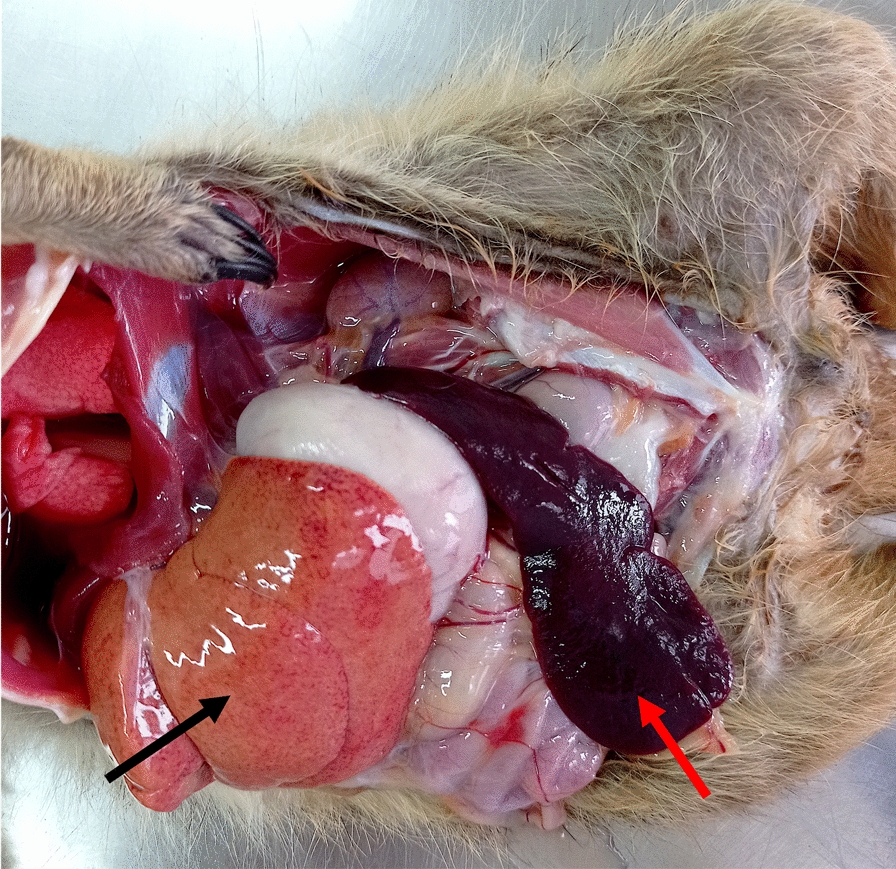
Results: Two meerkats were positive for L. infantum. A 9-year-old male from the Madrid Zoo died suddenly, showing pale mucous membranes and bilateral noninflammatory alopecia and hyperpigmentation in the lateral area of the eyes. Positive results were obtained in serology, nested PCR, and real-time PCR (blood, conjunctival and oral swabs, hair, spleen, lymph node, liver, kidney, and skin), as well as numerous amastigotes in the liver and kidney tissue samples. The other meerkat, a 12-year-old male from Faunia that is still alive, presented an alopecic lesion at the base of the tail. Positive results were obtained by nested and real-time PCR from different tissues such as blood, hair, oral, and conjunctival swabs. It was treated with oral allopurinol (25 mg/kg) and miltefosine (2 mg/kg), but the molecular diagnosis remained positive after 8 months, regarding it as a mild stage of the disease. The rest of the tested meerkats were negative. The presence of P. perniciosus phlebotomine sand flies was also detected in both zoos. Although no L. infantum DNA was detected in any of sand flies analyzed, it was determined that their food sources were rabbits and humans.
Conclusions: To our knowledge, this study describes, for the first time, the detection and infection by L. infantum in meerkats (Suricata suricatta).
期刊介绍:
Parasites & Vectors is an open access, peer-reviewed online journal dealing with the biology of parasites, parasitic diseases, intermediate hosts, vectors and vector-borne pathogens. Manuscripts published in this journal will be available to all worldwide, with no barriers to access, immediately following acceptance. However, authors retain the copyright of their material and may use it, or distribute it, as they wish.
Manuscripts on all aspects of the basic and applied biology of parasites, intermediate hosts, vectors and vector-borne pathogens will be considered. In addition to the traditional and well-established areas of science in these fields, we also aim to provide a vehicle for publication of the rapidly developing resources and technology in parasite, intermediate host and vector genomics and their impacts on biological research. We are able to publish large datasets and extensive results, frequently associated with genomic and post-genomic technologies, which are not readily accommodated in traditional journals. Manuscripts addressing broader issues, for example economics, social sciences and global climate change in relation to parasites, vectors and disease control, are also welcomed.





 京公网安备 11010802042870号
京ICP备2023020795号-1
京公网安备 11010802042870号
京ICP备2023020795号-1

 分享
分享
 求助内容:
求助内容: 应助结果提醒方式:
 扫码关注我们
