Sven J Van Der Lee, Marc Hulsman, Rosalina Van Spaendonk, Jetske Van Der Schaar, Janna Dijkstra, Niccoló Tesi, Fred van Ruissen, Mariet Elting, Marcel Reinders, Itziar De Rojas, Corien C Verschuuren-Bemelmans, Wiesje M Van Der Flier, Mieke M van Haelst, Christa de Geus, Yolande Pijnenburg, Henne Holstege
{"title":"Prevalence of Pathogenic Variants and Eligibility Criteria for Genetic Testing in Patients Who Visit a Memory Clinic.","authors":"Sven J Van Der Lee, Marc Hulsman, Rosalina Van Spaendonk, Jetske Van Der Schaar, Janna Dijkstra, Niccoló Tesi, Fred van Ruissen, Mariet Elting, Marcel Reinders, Itziar De Rojas, Corien C Verschuuren-Bemelmans, Wiesje M Van Der Flier, Mieke M van Haelst, Christa de Geus, Yolande Pijnenburg, Henne Holstege","doi":"10.1212/WNL.0000000000210273","DOIUrl":null,"url":null,"abstract":"<p><strong>Background and objectives: </strong>Identifying genetic causes of dementia in patients visiting memory clinics is important for patient care and family planning. Traditional clinical selection criteria for genetic testing may miss carriers of pathogenic variants in dementia-related genes. This study aimed identify how many carriers we are missing and to optimize criteria for selecting patients for genetic counseling in memory clinics.</p><p><strong>Methods: </strong>In this clinical cohort study, we retrospectively genetically tested patients during 2.5 years (2010-2012) visiting the Alzheimer Center Amsterdam, a specialized memory clinic. Genetic tests consisted of a 54-gene dementia panel, focusing on Class IV/V variants per American College of Medical Genetics and Genomics guidelines, including <i>APP</i> duplications and the <i>C9ORF72</i> repeat expansion. We determined the prevalence of pathogenic variants and propose new eligibility criteria for genetic testing in memory clinics. The eligibility criteria were prospectively applied for 1 year (2021-2022), and results were compared with the retrospective cohort.</p><p><strong>Results: </strong>Genetic tests were retrospectively performed in in 1,022 of 1,138 patients (90%) who consecutively visited the memory clinic. Among these, 1,022 patients analyzed (mean age 62.1 ± 8.9 years; 40.4% were female), 34 pathogenic variant carriers were identified (3.3%), with 24 being symptomatic. Previous clinical criteria would have identified only 15 carriers (44% of all carriers, 65% of symptomatic carriers). The proposed criteria increased identification to 22 carriers (62.5% of all carriers, 91% of symptomatic carriers). In the prospective cohort, 148 (28.7%) of 515 patients were eligible for testing under the new criteria. Of the 90 eligible patients who consented to testing, 13 pathogenic carriers were identified, representing a 73% increase compared with the previous criteria.</p><p><strong>Discussion: </strong>We found that patients who visit a memory clinic and carry a pathogenic genetic variant are often not eligible for genetic testing. The proposed new criteria improve the identification of patients with a genetic cause for their cognitive complaints. In systems without practical or financial barriers to genetic testing, the new criteria can enhance personalized care. In other countries where the health care systems differs and in other genetic ancestry groups, the performance of the criteria may be different.</p>","PeriodicalId":19256,"journal":{"name":"Neurology","volume":"104 4","pages":"e210273"},"PeriodicalIF":8.5000,"publicationDate":"2025-02-25","publicationTypes":"Journal Article","fieldsOfStudy":null,"isOpenAccess":false,"openAccessPdf":"https://www.ncbi.nlm.nih.gov/pmc/articles/PMC11776143/pdf/","citationCount":"0","resultStr":null,"platform":"Semanticscholar","paperid":null,"PeriodicalName":"Neurology","FirstCategoryId":"3","ListUrlMain":"https://doi.org/10.1212/WNL.0000000000210273","RegionNum":1,"RegionCategory":"医学","ArticlePicture":[],"TitleCN":null,"AbstractTextCN":null,"PMCID":null,"EPubDate":"2025/1/27 0:00:00","PubModel":"Epub","JCR":"Q1","JCRName":"CLINICAL NEUROLOGY","Score":null,"Total":0}
引用次数: 0
Abstract
Background and objectives: Identifying genetic causes of dementia in patients visiting memory clinics is important for patient care and family planning. Traditional clinical selection criteria for genetic testing may miss carriers of pathogenic variants in dementia-related genes. This study aimed identify how many carriers we are missing and to optimize criteria for selecting patients for genetic counseling in memory clinics.
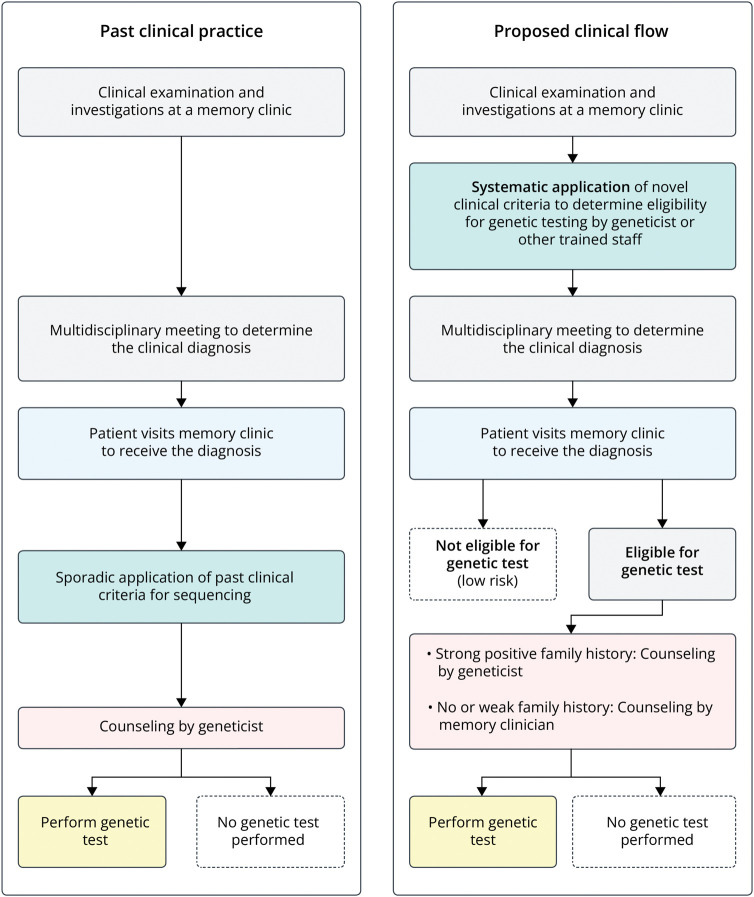
Methods: In this clinical cohort study, we retrospectively genetically tested patients during 2.5 years (2010-2012) visiting the Alzheimer Center Amsterdam, a specialized memory clinic. Genetic tests consisted of a 54-gene dementia panel, focusing on Class IV/V variants per American College of Medical Genetics and Genomics guidelines, including APP duplications and the C9ORF72 repeat expansion. We determined the prevalence of pathogenic variants and propose new eligibility criteria for genetic testing in memory clinics. The eligibility criteria were prospectively applied for 1 year (2021-2022), and results were compared with the retrospective cohort.
Results: Genetic tests were retrospectively performed in in 1,022 of 1,138 patients (90%) who consecutively visited the memory clinic. Among these, 1,022 patients analyzed (mean age 62.1 ± 8.9 years; 40.4% were female), 34 pathogenic variant carriers were identified (3.3%), with 24 being symptomatic. Previous clinical criteria would have identified only 15 carriers (44% of all carriers, 65% of symptomatic carriers). The proposed criteria increased identification to 22 carriers (62.5% of all carriers, 91% of symptomatic carriers). In the prospective cohort, 148 (28.7%) of 515 patients were eligible for testing under the new criteria. Of the 90 eligible patients who consented to testing, 13 pathogenic carriers were identified, representing a 73% increase compared with the previous criteria.
Discussion: We found that patients who visit a memory clinic and carry a pathogenic genetic variant are often not eligible for genetic testing. The proposed new criteria improve the identification of patients with a genetic cause for their cognitive complaints. In systems without practical or financial barriers to genetic testing, the new criteria can enhance personalized care. In other countries where the health care systems differs and in other genetic ancestry groups, the performance of the criteria may be different.
期刊介绍:
Neurology, the official journal of the American Academy of Neurology, aspires to be the premier peer-reviewed journal for clinical neurology research. Its mission is to publish exceptional peer-reviewed original research articles, editorials, and reviews to improve patient care, education, clinical research, and professionalism in neurology.
As the leading clinical neurology journal worldwide, Neurology targets physicians specializing in nervous system diseases and conditions. It aims to advance the field by presenting new basic and clinical research that influences neurological practice. The journal is a leading source of cutting-edge, peer-reviewed information for the neurology community worldwide. Editorial content includes Research, Clinical/Scientific Notes, Views, Historical Neurology, NeuroImages, Humanities, Letters, and position papers from the American Academy of Neurology. The online version is considered the definitive version, encompassing all available content.
Neurology is indexed in prestigious databases such as MEDLINE/PubMed, Embase, Scopus, Biological Abstracts®, PsycINFO®, Current Contents®, Web of Science®, CrossRef, and Google Scholar.





 京公网安备 11010802042870号
京ICP备2023020795号-1
京公网安备 11010802042870号
京ICP备2023020795号-1

 分享
分享
 求助内容:
求助内容: 应助结果提醒方式:
 扫码关注我们
