Lucas M Harrison, Kayla Prezelski, Rami R Hallac, Alex A Kane, Paymon Sanati-Mehrizy
{"title":"Two-Year Progressive Cranial Changes Following the Melbourne Technique for Sagittal Craniosynostosis.","authors":"Lucas M Harrison, Kayla Prezelski, Rami R Hallac, Alex A Kane, Paymon Sanati-Mehrizy","doi":"10.1177/10556656251314966","DOIUrl":null,"url":null,"abstract":"<p><p>ObjectiveThe Melbourne technique for total cranial vault remodeling aims to address all aspects of scaphocephaly in sagittal craniosynostosis. These features include anterior-posterior excessive length, anteriorly displaced vertex position, frontal bossing, vertex narrowing, and occipital bulleting. This study aimed to determine the progressive cranial changes that occur following the Melbourne technique for sagittal craniosynostosis.DesignRetrospective review of 3-dimensional images collected preoperatively and postoperatively at 3 weeks, 3 months, 1 year, and 2 years.SettingTertiary care pediatric institution.ParticipantsTwenty-five patients with sagittal craniosynostosis.InterventionsThe Melbourne technique for total cranial vault remodeling.Main Outcome Measure(s)Head circumference, cephalic index, frontal bossing index, occipital bulleting index, vertex narrowing index, and vertex-nasion-opisthocranion (VNO) angle were evaluated.ResultsThe cephalic index significantly increased postoperatively (<i>P</i> = .04) with a subsequent relapse at 3 months followed by progressively increased growth. The frontal bossing index significantly decreased postoperatively (<i>P</i> = .02) with a progressive decrease. The occipital bullet index had a relative decline postoperatively with relapse at 3 months, followed by a progressive decrease. The vertex narrowing index significantly decreased postoperatively (<i>P</i> < .001), with a plateau and slight relapse. The VNO angle showed a relative decline over time with a significant decrease by 1 year of age (<i>P</i> = .002).ConclusionsThe Melbourne technique improved the cephalic index, frontal bossing, vertex narrowing, occipital bulleting, and vertex positioning at 2 years of age. Cephalic index and occipital bulleting showed slight relapse at 3 months, followed by progressive improvement over time.</p>","PeriodicalId":49220,"journal":{"name":"Cleft Palate-Craniofacial Journal","volume":" ","pages":"804-810"},"PeriodicalIF":1.3000,"publicationDate":"2026-04-01","publicationTypes":"Journal Article","fieldsOfStudy":null,"isOpenAccess":false,"openAccessPdf":"https://www.ncbi.nlm.nih.gov/pmc/articles/PMC12996370/pdf/","citationCount":"0","resultStr":null,"platform":"Semanticscholar","paperid":null,"PeriodicalName":"Cleft Palate-Craniofacial Journal","FirstCategoryId":"3","ListUrlMain":"https://doi.org/10.1177/10556656251314966","RegionNum":4,"RegionCategory":"医学","ArticlePicture":[],"TitleCN":null,"AbstractTextCN":null,"PMCID":null,"EPubDate":"2025/1/28 0:00:00","PubModel":"Epub","JCR":"Q2","JCRName":"Dentistry","Score":null,"Total":0}
引用次数: 0
Abstract
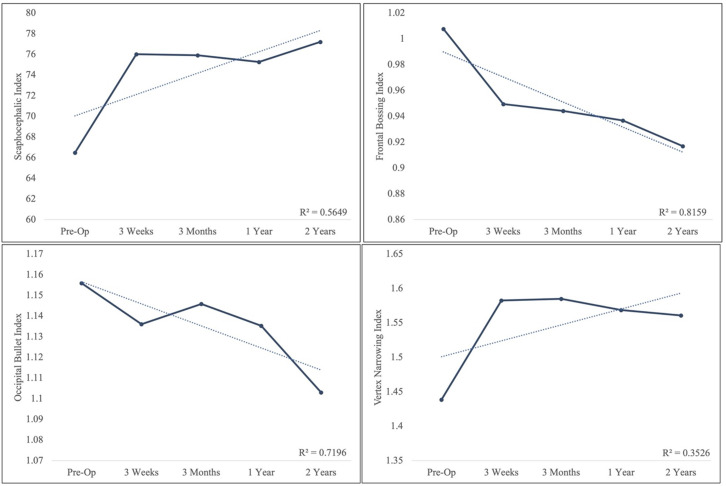
ObjectiveThe Melbourne technique for total cranial vault remodeling aims to address all aspects of scaphocephaly in sagittal craniosynostosis. These features include anterior-posterior excessive length, anteriorly displaced vertex position, frontal bossing, vertex narrowing, and occipital bulleting. This study aimed to determine the progressive cranial changes that occur following the Melbourne technique for sagittal craniosynostosis.DesignRetrospective review of 3-dimensional images collected preoperatively and postoperatively at 3 weeks, 3 months, 1 year, and 2 years.SettingTertiary care pediatric institution.ParticipantsTwenty-five patients with sagittal craniosynostosis.InterventionsThe Melbourne technique for total cranial vault remodeling.Main Outcome Measure(s)Head circumference, cephalic index, frontal bossing index, occipital bulleting index, vertex narrowing index, and vertex-nasion-opisthocranion (VNO) angle were evaluated.ResultsThe cephalic index significantly increased postoperatively (P = .04) with a subsequent relapse at 3 months followed by progressively increased growth. The frontal bossing index significantly decreased postoperatively (P = .02) with a progressive decrease. The occipital bullet index had a relative decline postoperatively with relapse at 3 months, followed by a progressive decrease. The vertex narrowing index significantly decreased postoperatively (P < .001), with a plateau and slight relapse. The VNO angle showed a relative decline over time with a significant decrease by 1 year of age (P = .002).ConclusionsThe Melbourne technique improved the cephalic index, frontal bossing, vertex narrowing, occipital bulleting, and vertex positioning at 2 years of age. Cephalic index and occipital bulleting showed slight relapse at 3 months, followed by progressive improvement over time.
期刊介绍:
The Cleft Palate-Craniofacial Journal (CPCJ) is the premiere peer-reviewed, interdisciplinary, international journal dedicated to current research on etiology, prevention, diagnosis, and treatment in all areas pertaining to craniofacial anomalies. CPCJ reports on basic science and clinical research aimed at better elucidating the pathogenesis, pathology, and optimal methods of treatment of cleft and craniofacial anomalies. The journal strives to foster communication and cooperation among professionals from all specialties.






 京公网安备 11010802042870号
京ICP备2023020795号-1
京公网安备 11010802042870号
京ICP备2023020795号-1

 分享
分享
 求助内容:
求助内容: 应助结果提醒方式:
 扫码关注我们
