Christian Blough, Kevin Huang, Samuel Raszka, Sapan Shah, John Garlich, Charles Moon, Geoffrey Marecek
{"title":"Comparison of software-assisted and freehand methods of rotational assessment for diaphyseal tibia fractures.","authors":"Christian Blough, Kevin Huang, Samuel Raszka, Sapan Shah, John Garlich, Charles Moon, Geoffrey Marecek","doi":"10.1007/s00590-025-04175-x","DOIUrl":null,"url":null,"abstract":"<p><strong>Objective: </strong>Accurate rotational reduction following tibial shaft fracture fixation is absent in up to 36% of cases yet may be critical for lower extremity biomechanics. The objective of this cadaveric study was to compare the results of freehand methods of reduction with software-assisted reduction.</p><p><strong>Methods: </strong>Four fellowship-trained orthopaedic trauma surgeons attempted rotational correction in a cadaveric model with fluoroscopic assistance (without radiographic visualization of the fracture site) using (1) their method of choice (MoC) and (2) software assistance (SA). After correction, deviation from baseline rotation was calculated.</p><p><strong>Results: </strong>The mean difference between the two methods (MoC-SA) was - 0.2° which was not statistically significant. There was no difference in variability between methods. The rate of clinically relevant rotational deformity (> 15°) was 28% using MoC and 31% using SA.</p><p><strong>Conclusion: </strong>Rotational assessment of diaphyseal tibia fractures in this cadaveric model was not significantly different when compared between method of choice and software augmentation.</p>","PeriodicalId":50484,"journal":{"name":"European Journal of Orthopaedic Surgery and Traumatology","volume":"35 1","pages":"59"},"PeriodicalIF":1.5000,"publicationDate":"2025-01-27","publicationTypes":"Journal Article","fieldsOfStudy":null,"isOpenAccess":false,"openAccessPdf":"https://www.ncbi.nlm.nih.gov/pmc/articles/PMC11772502/pdf/","citationCount":"0","resultStr":null,"platform":"Semanticscholar","paperid":null,"PeriodicalName":"European Journal of Orthopaedic Surgery and Traumatology","FirstCategoryId":"1085","ListUrlMain":"https://doi.org/10.1007/s00590-025-04175-x","RegionNum":0,"RegionCategory":null,"ArticlePicture":[],"TitleCN":null,"AbstractTextCN":null,"PMCID":null,"EPubDate":"","PubModel":"","JCR":"Q3","JCRName":"ORTHOPEDICS","Score":null,"Total":0}
引用次数: 0
Abstract
Objective: Accurate rotational reduction following tibial shaft fracture fixation is absent in up to 36% of cases yet may be critical for lower extremity biomechanics. The objective of this cadaveric study was to compare the results of freehand methods of reduction with software-assisted reduction.
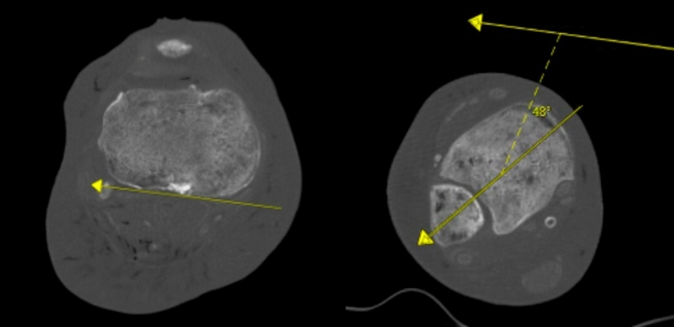
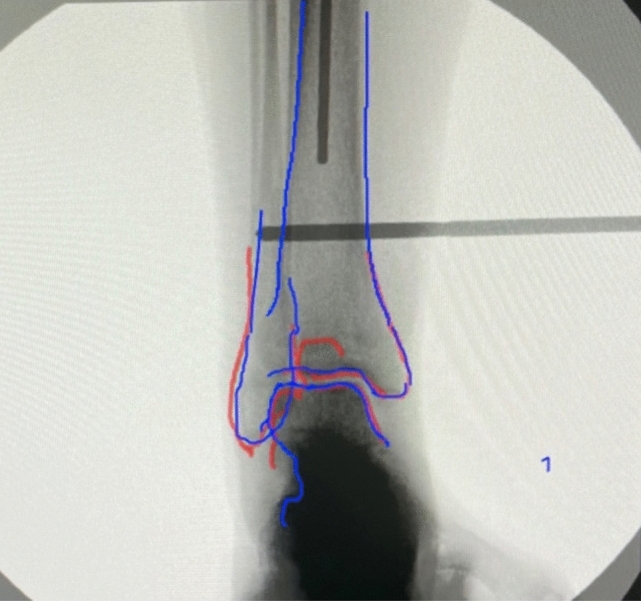
Methods: Four fellowship-trained orthopaedic trauma surgeons attempted rotational correction in a cadaveric model with fluoroscopic assistance (without radiographic visualization of the fracture site) using (1) their method of choice (MoC) and (2) software assistance (SA). After correction, deviation from baseline rotation was calculated.
Results: The mean difference between the two methods (MoC-SA) was - 0.2° which was not statistically significant. There was no difference in variability between methods. The rate of clinically relevant rotational deformity (> 15°) was 28% using MoC and 31% using SA.
Conclusion: Rotational assessment of diaphyseal tibia fractures in this cadaveric model was not significantly different when compared between method of choice and software augmentation.
期刊介绍:
The European Journal of Orthopaedic Surgery and Traumatology (EJOST) aims to publish high quality Orthopedic scientific work. The objective of our journal is to disseminate meaningful, impactful, clinically relevant work from each and every region of the world, that has the potential to change and or inform clinical practice.



 京公网安备 11010802042870号
京ICP备2023020795号-1
京公网安备 11010802042870号
京ICP备2023020795号-1

 分享
分享
 求助内容:
求助内容: 应助结果提醒方式:
 扫码关注我们
