{"title":"Effect of census-based correction of population figures on mortality rates in Germany.","authors":"Andreas Stang, Markus Deckert","doi":"10.1186/s12963-025-00361-5","DOIUrl":null,"url":null,"abstract":"<p><strong>Background: </strong>The population figures in Germany are obtained by updating the results of the latest census with information from the statistics on birth, deaths and migration statistics. The Census 2011 in Germany corrected population figures, which have only been updated over a long period of time. The aim of this work is to show the effect of the census-based correction of the population figures on the magnitude of mortality rates in Germany 2011-2013.</p><p><strong>Methods: </strong>We compared mortality rates (total, cancer, and cardiovascular disease) for the period 2011-2013 based on the uncorrected and Census 2011 corrected population figures. We also compared the effect of the choice of different standard populations in the age standardization of rates on the difference in uncorrected and corrected mortality rates.</p><p><strong>Results: </strong>There is a clear decline in age-specific cancer mortality among men aged 90 and over when using the uncorrected population figures, which is reversed as soon as the corrected population figures are used. Among women, there is hardly any difference between the uncorrected and corrected mortality rates. The correction of the population figures does not lead to a qualitatively different pattern in the mortality rates for cardiovascular diseases and myocardial infarction, but it increases the magnitude of the rates, particularly for elderly men. Standard populations with higher weights at older ages produced larger corrections in mortality rates.</p><p><strong>Conclusions: </strong>Even though the Census 2011 corrected nationwide mortality rates without age stratification differed only slightly from the uncorrected rates, there were noticeable increases in mortality, particularly in the city states of Hamburg and Berlin and in old age. Due to the particularly large error in the population figures in the older age range, an age standard that assigns lower weights at older ages should be used for age standardization of rates wherever possible.</p>","PeriodicalId":51476,"journal":{"name":"Population Health Metrics","volume":"23 1","pages":"1"},"PeriodicalIF":2.5000,"publicationDate":"2025-01-28","publicationTypes":"Journal Article","fieldsOfStudy":null,"isOpenAccess":false,"openAccessPdf":"https://www.ncbi.nlm.nih.gov/pmc/articles/PMC11773962/pdf/","citationCount":"0","resultStr":null,"platform":"Semanticscholar","paperid":null,"PeriodicalName":"Population Health Metrics","FirstCategoryId":"3","ListUrlMain":"https://doi.org/10.1186/s12963-025-00361-5","RegionNum":2,"RegionCategory":"医学","ArticlePicture":[],"TitleCN":null,"AbstractTextCN":null,"PMCID":null,"EPubDate":"","PubModel":"","JCR":"Q2","JCRName":"PUBLIC, ENVIRONMENTAL & OCCUPATIONAL HEALTH","Score":null,"Total":0}
引用次数: 0
Abstract
Background: The population figures in Germany are obtained by updating the results of the latest census with information from the statistics on birth, deaths and migration statistics. The Census 2011 in Germany corrected population figures, which have only been updated over a long period of time. The aim of this work is to show the effect of the census-based correction of the population figures on the magnitude of mortality rates in Germany 2011-2013.
Methods: We compared mortality rates (total, cancer, and cardiovascular disease) for the period 2011-2013 based on the uncorrected and Census 2011 corrected population figures. We also compared the effect of the choice of different standard populations in the age standardization of rates on the difference in uncorrected and corrected mortality rates.
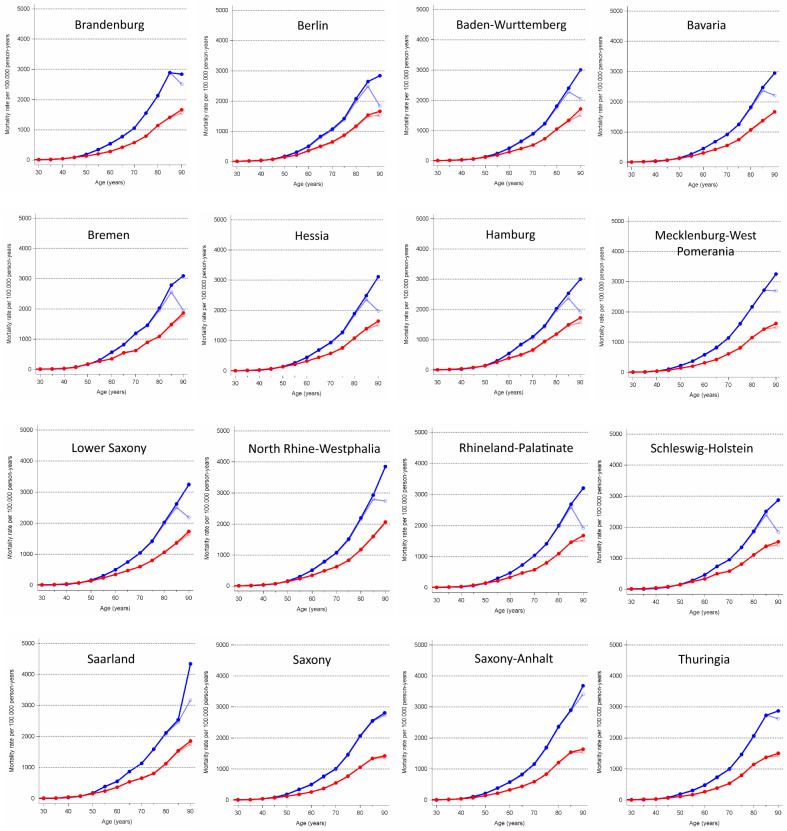
Results: There is a clear decline in age-specific cancer mortality among men aged 90 and over when using the uncorrected population figures, which is reversed as soon as the corrected population figures are used. Among women, there is hardly any difference between the uncorrected and corrected mortality rates. The correction of the population figures does not lead to a qualitatively different pattern in the mortality rates for cardiovascular diseases and myocardial infarction, but it increases the magnitude of the rates, particularly for elderly men. Standard populations with higher weights at older ages produced larger corrections in mortality rates.
Conclusions: Even though the Census 2011 corrected nationwide mortality rates without age stratification differed only slightly from the uncorrected rates, there were noticeable increases in mortality, particularly in the city states of Hamburg and Berlin and in old age. Due to the particularly large error in the population figures in the older age range, an age standard that assigns lower weights at older ages should be used for age standardization of rates wherever possible.
期刊介绍:
Population Health Metrics aims to advance the science of population health assessment, and welcomes papers relating to concepts, methods, ethics, applications, and summary measures of population health. The journal provides a unique platform for population health researchers to share their findings with the global community. We seek research that addresses the communication of population health measures and policy implications to stakeholders; this includes papers related to burden estimation and risk assessment, and research addressing population health across the full range of development. Population Health Metrics covers a broad range of topics encompassing health state measurement and valuation, summary measures of population health, descriptive epidemiology at the population level, burden of disease and injury analysis, disease and risk factor modeling for populations, and comparative assessment of risks to health at the population level. The journal is also interested in how to use and communicate indicators of population health to reduce disease burden, and the approaches for translating from indicators of population health to health-advancing actions. As a cross-cutting topic of importance, we are particularly interested in inequalities in population health and their measurement.





 京公网安备 11010802042870号
京ICP备2023020795号-1
京公网安备 11010802042870号
京ICP备2023020795号-1

 分享
分享
 求助内容:
求助内容: 应助结果提醒方式:
 扫码关注我们
