George Lawson, Alexander Sheeka, Pritika Gaur, Styliani Alifieraki, Nigel Basheer, Wajanat Jan, Carolina Kachramanoglou, Hermione Lyall
{"title":"Polymicrogyria in infants with symptomatic congenital cytomegalovirus at birth is associated with epilepsy: A retrospective, descriptive cohort study","authors":"George Lawson, Alexander Sheeka, Pritika Gaur, Styliani Alifieraki, Nigel Basheer, Wajanat Jan, Carolina Kachramanoglou, Hermione Lyall","doi":"10.1111/dmcn.16250","DOIUrl":null,"url":null,"abstract":"<div>\n \n \n <section>\n \n <h3> Aim</h3>\n \n <p>To identify neonatal magnetic resonance imaging (MRI) features that predict the likelihood of children with congenital cytomegalovirus (cCMV) developing epilepsy, together with clinical features and a validated MRI scoring system.</p>\n </section>\n \n <section>\n \n <h3> Method</h3>\n \n <p>This was a retrospective descriptive cohort study of infants with cCMV referred to a paediatric infectious disease centre between April 2012 and March 2022, and followed up for at least 2 years. MRI was performed before 4 months of age and assessed by two paediatric neuroradiologists.</p>\n </section>\n \n <section>\n \n <h3> Results</h3>\n \n <p>Ninety children with cCMV were included, 46 were female and 44 were male. The median age at MRI was 20 days, (standard deviation = 34, range = 1–200). Seventy-two of 90 children were symptomatic at birth and 7 of 72 developed epilepsy (9.7% of symptomatic infants, 7.8% of total). None of 18 asymptomatic children developed epilepsy. Those with epilepsy were more likely to be symptomatic at birth (100% vs. 76%, <i>p</i> = 0.14) and to have cortical malformations (86% vs. 15%, <i>p</i> < 0.001). Infants with polymicrogyria (PMG) were more likely to develop epilepsy (odds ratio = 35 [3.9–317.1], <i>p</i> < 0.001). A 1-year remission was achieved in three of seven children; four required multiple antiseizure medications without remission.</p>\n </section>\n \n <section>\n \n <h3> Interpretation</h3>\n \n <p>The strongest correlate of epilepsy development was PMG. Infants with symptomatic cCMV at birth and PMG were more likely to develop epilepsy, and were likely to require one or more antiseizure medications. Parents of infants with cCMV and cortical malformations should be counselled regarding this risk. Including PMG severity in cCMV MRI scoring could improve epilepsy risk prediction.</p>\n </section>\n </div>","PeriodicalId":50587,"journal":{"name":"Developmental Medicine and Child Neurology","volume":"67 8","pages":"1026-1033"},"PeriodicalIF":4.3000,"publicationDate":"2025-01-27","publicationTypes":"Journal Article","fieldsOfStudy":null,"isOpenAccess":false,"openAccessPdf":"https://onlinelibrary.wiley.com/doi/epdf/10.1111/dmcn.16250","citationCount":"0","resultStr":null,"platform":"Semanticscholar","paperid":null,"PeriodicalName":"Developmental Medicine and Child Neurology","FirstCategoryId":"3","ListUrlMain":"https://onlinelibrary.wiley.com/doi/10.1111/dmcn.16250","RegionNum":2,"RegionCategory":"医学","ArticlePicture":[],"TitleCN":null,"AbstractTextCN":null,"PMCID":null,"EPubDate":"","PubModel":"","JCR":"Q1","JCRName":"CLINICAL NEUROLOGY","Score":null,"Total":0}
引用次数: 0
Abstract
Aim
To identify neonatal magnetic resonance imaging (MRI) features that predict the likelihood of children with congenital cytomegalovirus (cCMV) developing epilepsy, together with clinical features and a validated MRI scoring system.
Method
This was a retrospective descriptive cohort study of infants with cCMV referred to a paediatric infectious disease centre between April 2012 and March 2022, and followed up for at least 2 years. MRI was performed before 4 months of age and assessed by two paediatric neuroradiologists.
Results
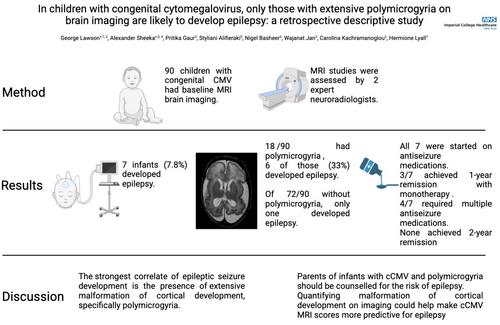
Ninety children with cCMV were included, 46 were female and 44 were male. The median age at MRI was 20 days, (standard deviation = 34, range = 1–200). Seventy-two of 90 children were symptomatic at birth and 7 of 72 developed epilepsy (9.7% of symptomatic infants, 7.8% of total). None of 18 asymptomatic children developed epilepsy. Those with epilepsy were more likely to be symptomatic at birth (100% vs. 76%, p = 0.14) and to have cortical malformations (86% vs. 15%, p < 0.001). Infants with polymicrogyria (PMG) were more likely to develop epilepsy (odds ratio = 35 [3.9–317.1], p < 0.001). A 1-year remission was achieved in three of seven children; four required multiple antiseizure medications without remission.
Interpretation
The strongest correlate of epilepsy development was PMG. Infants with symptomatic cCMV at birth and PMG were more likely to develop epilepsy, and were likely to require one or more antiseizure medications. Parents of infants with cCMV and cortical malformations should be counselled regarding this risk. Including PMG severity in cCMV MRI scoring could improve epilepsy risk prediction.
目的:确定新生儿磁共振成像(MRI)特征,预测先天性巨细胞病毒(cCMV)儿童发生癫痫的可能性,以及临床特征和经过验证的MRI评分系统。方法:这是一项回顾性描述性队列研究,研究对象是2012年4月至2022年3月间在儿科传染病中心转诊的cCMV婴儿,随访时间至少为2年。4个月前进行MRI检查,并由两名儿科神经放射学家进行评估。结果:纳入cCMV患儿90例,其中女46例,男44例。MRI的中位年龄为20天,(标准差= 34,范围= 1-200)。90名儿童中有72名在出生时出现症状,72名儿童中有7名出现癫痫(占有症状婴儿的9.7%,占总数的7.8%)。18名无症状儿童均未发生癫痫。癫痫患者在出生时更有可能出现症状(100% vs. 76%, p = 0.14),并有皮质畸形(86% vs. 15%, p)。出生时患有症状性cCMV和PMG的婴儿更容易发生癫痫,并且可能需要一种或多种抗癫痫药物。患有cCMV和皮质畸形的婴儿的父母应该被告知这种风险。将PMG严重程度纳入cCMV MRI评分可改善癫痫风险预测。
期刊介绍:
Wiley-Blackwell is pleased to publish Developmental Medicine & Child Neurology (DMCN), a Mac Keith Press publication and official journal of the American Academy for Cerebral Palsy and Developmental Medicine (AACPDM) and the British Paediatric Neurology Association (BPNA).
For over 50 years, DMCN has defined the field of paediatric neurology and neurodisability and is one of the world’s leading journals in the whole field of paediatrics. DMCN disseminates a range of information worldwide to improve the lives of disabled children and their families. The high quality of published articles is maintained by expert review, including independent statistical assessment, before acceptance.



 京公网安备 11010802042870号
京ICP备2023020795号-1
京公网安备 11010802042870号
京ICP备2023020795号-1

 分享
分享
 求助内容:
求助内容: 应助结果提醒方式:
 扫码关注我们
