Guenther C Feigl, Iván N Camal Ruggieri, Daniel Staribacher, Gavin Britz, Christiane Holländer, Dzmitry Kuzmin
{"title":"Optic nerve sheath schwannoma: illustrative case.","authors":"Guenther C Feigl, Iván N Camal Ruggieri, Daniel Staribacher, Gavin Britz, Christiane Holländer, Dzmitry Kuzmin","doi":"10.3171/CASE24638","DOIUrl":null,"url":null,"abstract":"<p><strong>Background: </strong>Optic nerve schwannomas are an extremely rare pathology in neurosurgery. Their origin is rather debatable given the structure of the optic nerve, which does not typically have Schwann cells therein. However, a number of clinical cases of optic nerve tumors classified as schwannomas have been described in the literature. At present, there is no fundamental understanding of the etiology and pathogenesis of these tumors or treatment due to their rare incidence.</p><p><strong>Observations: </strong>The authors describe the clinical case of a 40-year-old female patient with blurred vision in the left eye for 6 months who was operated on for an optic nerve tumor via a minimally invasive supraorbital approach. Complete resection of the tumor was achieved. Histopathological examination revealed a schwannoma. The patient had no postoperative complaints or neurological deficits. The authors also performed a detailed review of the literature for cases with optic nerve schwannomas. Only 18 patient outcomes have been published so far. There are significant differences in the structure, localization, size, and surgical treatment of optic nerve schwannomas.</p><p><strong>Lessons: </strong>Optic nerve schwannomas are extremely rare lesions. Hence, there is a need to accumulate knowledge in order to study the etiology, pathogenesis, and treatment of these tumors. The minimally invasive supraorbital approach can be successfully used in the surgical treatment of optic nerve schwannomas located in the optic canal. https://thejns.org/doi/10.3171/CASE24638.</p>","PeriodicalId":94098,"journal":{"name":"Journal of neurosurgery. Case lessons","volume":"9 4","pages":""},"PeriodicalIF":0.0000,"publicationDate":"2025-01-27","publicationTypes":"Journal Article","fieldsOfStudy":null,"isOpenAccess":false,"openAccessPdf":"https://www.ncbi.nlm.nih.gov/pmc/articles/PMC11775991/pdf/","citationCount":"0","resultStr":null,"platform":"Semanticscholar","paperid":null,"PeriodicalName":"Journal of neurosurgery. Case lessons","FirstCategoryId":"1085","ListUrlMain":"https://doi.org/10.3171/CASE24638","RegionNum":0,"RegionCategory":null,"ArticlePicture":[],"TitleCN":null,"AbstractTextCN":null,"PMCID":null,"EPubDate":"","PubModel":"","JCR":"","JCRName":"","Score":null,"Total":0}
引用次数: 0
Abstract
Background: Optic nerve schwannomas are an extremely rare pathology in neurosurgery. Their origin is rather debatable given the structure of the optic nerve, which does not typically have Schwann cells therein. However, a number of clinical cases of optic nerve tumors classified as schwannomas have been described in the literature. At present, there is no fundamental understanding of the etiology and pathogenesis of these tumors or treatment due to their rare incidence.
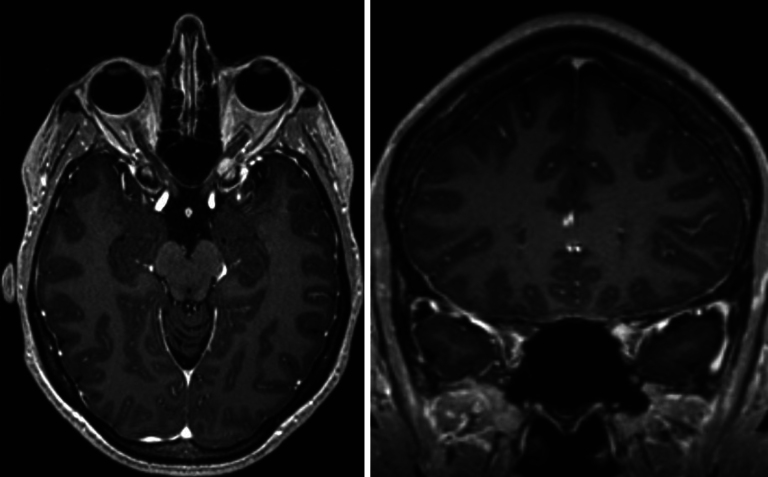
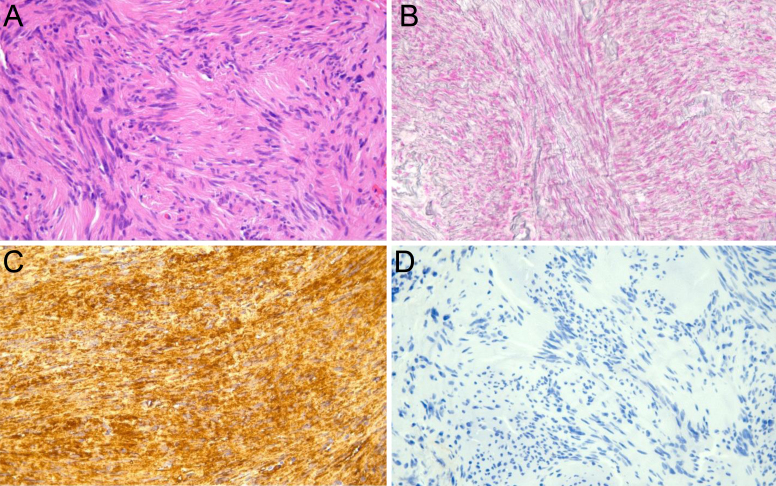
Observations: The authors describe the clinical case of a 40-year-old female patient with blurred vision in the left eye for 6 months who was operated on for an optic nerve tumor via a minimally invasive supraorbital approach. Complete resection of the tumor was achieved. Histopathological examination revealed a schwannoma. The patient had no postoperative complaints or neurological deficits. The authors also performed a detailed review of the literature for cases with optic nerve schwannomas. Only 18 patient outcomes have been published so far. There are significant differences in the structure, localization, size, and surgical treatment of optic nerve schwannomas.
Lessons: Optic nerve schwannomas are extremely rare lesions. Hence, there is a need to accumulate knowledge in order to study the etiology, pathogenesis, and treatment of these tumors. The minimally invasive supraorbital approach can be successfully used in the surgical treatment of optic nerve schwannomas located in the optic canal. https://thejns.org/doi/10.3171/CASE24638.




 京公网安备 11010802042870号
京ICP备2023020795号-1
京公网安备 11010802042870号
京ICP备2023020795号-1

 分享
分享

 求助内容:
求助内容: 应助结果提醒方式:
 扫码关注我们
