Comparison of Five Pathological Tumor Regression Grading Systems for Rectal Cancer Following Chemoradiation: Correlation Coefficient and Intra-Rater Reliability.
Sahaphol Anannamcharoen, Chinakrit Boonya-Ussadorn, K Satayasoontorn, Thirayost Nimmanon
{"title":"Comparison of Five Pathological Tumor Regression Grading Systems for Rectal Cancer Following Chemoradiation: Correlation Coefficient and Intra-Rater Reliability.","authors":"Sahaphol Anannamcharoen, Chinakrit Boonya-Ussadorn, K Satayasoontorn, Thirayost Nimmanon","doi":"10.31557/APJCP.2025.26.1.199","DOIUrl":null,"url":null,"abstract":"<p><strong>Objective: </strong>To determine the correlation among five different types of tumor regression grading (TRG) systems. Test-retest reliability analyses were conducted at two time points to assess the internal validity and consistency of these five TRG systems.</p><p><strong>Methods: </strong>A test-retest study was performed in 34 pathologically confirmed rectal adenocarcinoma specimens. All patients underwent pre-operative CRT followed by total mesorectal resection. Each specimen was examined twice to examine the variability of test-retest measurements. Every specimen was examined according to the 5 different TRG systems (Dworak, Mandard, Ryan, AJCC, modified Ryan). The time interval between the initial assessment and the repeat assessment was 3 weeks by the same pathologist who was not allowed to know the results of his initial measurements.</p><p><strong>Result: </strong>For TRG systems comparing therapy-induced fibrosis in relation to residual tumor, a very strong correlation among them was found, with correlation coefficient values ranging from 0.964 to 1. The modified Ryan TRG system determines the degree of tumor regression based solely on the quantity of residual viable cancer cells only (not fibrosis). The system had lower correlation coefficient values, ranging from 0.549 to 0.617. The present study revealed an excellent intra-rater correlation coefficient of 0.947 (95% CI: 0.895-0.974) for the Mandard and Dworak TRG systems, 0.918 (95% CI: 835-0.959) for the Ryan TRG system, 0.957 (95% CI: 0.913-0.978) for the AJCC TRG system, and 0.934 (95% CI: 0.867-0.967) for the modified Ryan TRG system.</p><p><strong>Conclusion: </strong>TRG systems with different scales categorizing tumor regression based on residual tumor and fibrosis revealed a strong to very strong correlation among them. The modified Ryan system, which categorizes tumor regression based solely on the quantity of residual viable cancer cells (not fibrosis), resulted in discrepancies in interpretations and lower correlation values. The present study revealed an excellent intra-rater correlation coefficient with high internal validity.</p>","PeriodicalId":55451,"journal":{"name":"Asian Pacific Journal of Cancer Prevention","volume":"26 1","pages":"199-205"},"PeriodicalIF":0.0000,"publicationDate":"2025-01-01","publicationTypes":"Journal Article","fieldsOfStudy":null,"isOpenAccess":false,"openAccessPdf":"https://www.ncbi.nlm.nih.gov/pmc/articles/PMC12082410/pdf/","citationCount":"0","resultStr":null,"platform":"Semanticscholar","paperid":null,"PeriodicalName":"Asian Pacific Journal of Cancer Prevention","FirstCategoryId":"1085","ListUrlMain":"https://doi.org/10.31557/APJCP.2025.26.1.199","RegionNum":0,"RegionCategory":null,"ArticlePicture":[],"TitleCN":null,"AbstractTextCN":null,"PMCID":null,"EPubDate":"","PubModel":"","JCR":"Q2","JCRName":"Medicine","Score":null,"Total":0}
引用次数: 0
Abstract
Objective: To determine the correlation among five different types of tumor regression grading (TRG) systems. Test-retest reliability analyses were conducted at two time points to assess the internal validity and consistency of these five TRG systems.
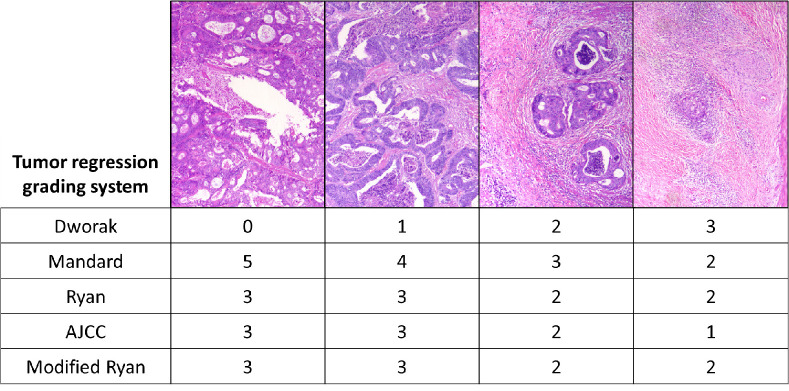
Methods: A test-retest study was performed in 34 pathologically confirmed rectal adenocarcinoma specimens. All patients underwent pre-operative CRT followed by total mesorectal resection. Each specimen was examined twice to examine the variability of test-retest measurements. Every specimen was examined according to the 5 different TRG systems (Dworak, Mandard, Ryan, AJCC, modified Ryan). The time interval between the initial assessment and the repeat assessment was 3 weeks by the same pathologist who was not allowed to know the results of his initial measurements.
Result: For TRG systems comparing therapy-induced fibrosis in relation to residual tumor, a very strong correlation among them was found, with correlation coefficient values ranging from 0.964 to 1. The modified Ryan TRG system determines the degree of tumor regression based solely on the quantity of residual viable cancer cells only (not fibrosis). The system had lower correlation coefficient values, ranging from 0.549 to 0.617. The present study revealed an excellent intra-rater correlation coefficient of 0.947 (95% CI: 0.895-0.974) for the Mandard and Dworak TRG systems, 0.918 (95% CI: 835-0.959) for the Ryan TRG system, 0.957 (95% CI: 0.913-0.978) for the AJCC TRG system, and 0.934 (95% CI: 0.867-0.967) for the modified Ryan TRG system.
Conclusion: TRG systems with different scales categorizing tumor regression based on residual tumor and fibrosis revealed a strong to very strong correlation among them. The modified Ryan system, which categorizes tumor regression based solely on the quantity of residual viable cancer cells (not fibrosis), resulted in discrepancies in interpretations and lower correlation values. The present study revealed an excellent intra-rater correlation coefficient with high internal validity.
期刊介绍:
Cancer is a very complex disease. While many aspects of carcinoge-nesis and oncogenesis are known, cancer control and prevention at the community level is however still in its infancy. Much more work needs to be done and many more steps need to be taken before effective strategies are developed. The multidisciplinary approaches and efforts to understand and control cancer in an effective and efficient manner, require highly trained scientists in all branches of the cancer sciences, from cellular and molecular aspects to patient care and palliation.
The Asia Pacific Organization for Cancer Prevention (APOCP) and its official publication, the Asia Pacific Journal of Cancer Prevention (APJCP), have served the community of cancer scientists very well and intends to continue to serve in this capacity to the best of its abilities. One of the objectives of the APOCP is to provide all relevant and current scientific information on the whole spectrum of cancer sciences. They aim to do this by providing a forum for communication and propagation of original and innovative research findings that have relevance to understanding the etiology, progression, treatment, and survival of patients, through their journal. The APJCP with its distinguished, diverse, and Asia-wide team of editors, reviewers, and readers, ensure the highest standards of research communication within the cancer sciences community across Asia as well as globally.
The APJCP publishes original research results under the following categories:
-Epidemiology, detection and screening.
-Cellular research and bio-markers.
-Identification of bio-targets and agents with novel mechanisms of action.
-Optimal clinical use of existing anti-cancer agents, including combination therapies.
-Radiation and surgery.
-Palliative care.
-Patient adherence, quality of life, satisfaction.
-Health economic evaluations.



 京公网安备 11010802042870号
京ICP备2023020795号-1
京公网安备 11010802042870号
京ICP备2023020795号-1

 分享
分享
 求助内容:
求助内容: 应助结果提醒方式:
 扫码关注我们
