{"title":"Comparison of Temperature Changes Between Holmium-YAG Laser and Thulium Fiber Laser in an In Vitro Setting.","authors":"Vaibhavkumar Patel, Kshitij Raghuvanshi, Krushnadevsinh Jadeja, Rajeev Chaudhari","doi":"10.5152/tud.2025.24100","DOIUrl":null,"url":null,"abstract":"<p><strong>Objective: </strong>We aimed to evaluate and compare the rise in the temperature for the safety of the ureter and kidney parenchyma when firing the holmium laser and the thulium fiber laser (TFL).</p><p><strong>Methods: </strong>We performed a laboratory experiment to measure the rise in temperature upon firing holmium laser and a TFL in a 10 cm3 transparent test tube in an outdoor environment and then in a container with normal saline.</p><p><strong>Results: </strong>In a 10 cc test tube with static water at 25°C, the rise in temperature with holmium and TFL depends on the firing time, keeping power constant. On continuous firing for 10, 20, and 30 seconds, the temperature rose to 35.1, 42.7, and 53.2°C with holmium. The temperature went up to 38.3, 46.8, and 55.4°C when TFL was used. The power was kept at 10 W for both types of lasers. The temperature rise was relatively low when the test tube was immersed in a water container. It was even lower with irrigation.</p><p><strong>Conclusion: </strong>The rise in the temperature reaches to hazardous level in static water with a firing time of 30 seconds, which is almost equivalent to holmium and TFL. Thus, while using lasers in RIRS and ureteroscopy, the firing time should not exceed 20 seconds and adequate irrigation is required to prevent damage to the tissues. Also, the rise in temperature was almost equivalent to holmium and TFL; hence, TFL can be safely used in laser lithotripsy in any part of the genitourinary (GU) system.</p>","PeriodicalId":101337,"journal":{"name":"Urology research & practice","volume":"50 4","pages":"219-224"},"PeriodicalIF":1.1000,"publicationDate":"2025-01-03","publicationTypes":"Journal Article","fieldsOfStudy":null,"isOpenAccess":false,"openAccessPdf":"https://www.ncbi.nlm.nih.gov/pmc/articles/PMC11883672/pdf/","citationCount":"0","resultStr":null,"platform":"Semanticscholar","paperid":null,"PeriodicalName":"Urology research & practice","FirstCategoryId":"1085","ListUrlMain":"https://doi.org/10.5152/tud.2025.24100","RegionNum":0,"RegionCategory":null,"ArticlePicture":[],"TitleCN":null,"AbstractTextCN":null,"PMCID":null,"EPubDate":"","PubModel":"","JCR":"0","JCRName":"UROLOGY & NEPHROLOGY","Score":null,"Total":0}
引用次数: 0
Abstract
Objective: We aimed to evaluate and compare the rise in the temperature for the safety of the ureter and kidney parenchyma when firing the holmium laser and the thulium fiber laser (TFL).
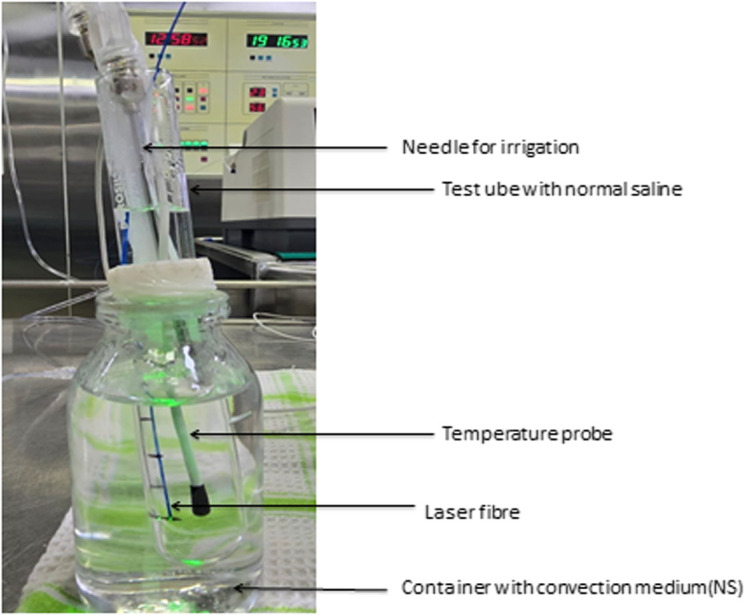
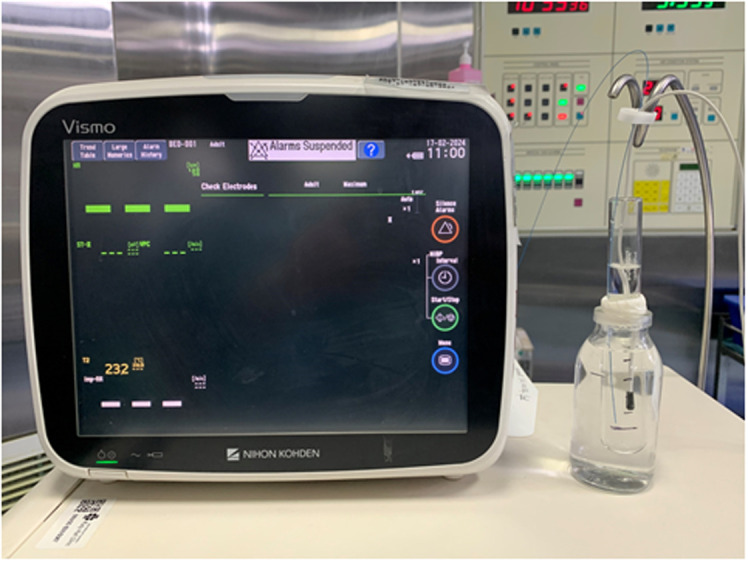
Methods: We performed a laboratory experiment to measure the rise in temperature upon firing holmium laser and a TFL in a 10 cm3 transparent test tube in an outdoor environment and then in a container with normal saline.
Results: In a 10 cc test tube with static water at 25°C, the rise in temperature with holmium and TFL depends on the firing time, keeping power constant. On continuous firing for 10, 20, and 30 seconds, the temperature rose to 35.1, 42.7, and 53.2°C with holmium. The temperature went up to 38.3, 46.8, and 55.4°C when TFL was used. The power was kept at 10 W for both types of lasers. The temperature rise was relatively low when the test tube was immersed in a water container. It was even lower with irrigation.
Conclusion: The rise in the temperature reaches to hazardous level in static water with a firing time of 30 seconds, which is almost equivalent to holmium and TFL. Thus, while using lasers in RIRS and ureteroscopy, the firing time should not exceed 20 seconds and adequate irrigation is required to prevent damage to the tissues. Also, the rise in temperature was almost equivalent to holmium and TFL; hence, TFL can be safely used in laser lithotripsy in any part of the genitourinary (GU) system.




 京公网安备 11010802042870号
京ICP备2023020795号-1
京公网安备 11010802042870号
京ICP备2023020795号-1

 分享
分享

 求助内容:
求助内容: 应助结果提醒方式:
 扫码关注我们
