{"title":"A Comprehensive Survey on Communication-Efficient Federated Learning in Mobile Edge Environments","authors":"Ninghui Jia;Zhihao Qu;Baoliu Ye;Yanyan Wang;Shihong Hu;Song Guo","doi":"10.1109/COMST.2025.3535957","DOIUrl":null,"url":null,"abstract":"In traditional centralized machine learning, transmitting raw data to a cloud center incurs high communication costs and raises privacy concerns. This is particularly challenging in mobile edge environments, where devices are dynamic and resource-constrained. Federated Learning (FL) addresses these issues by allowing devices to train models locally and upload parameters to a central server without sharing local data. However, limited wireless channel resources and dynamic transmission performance make communication overhead a major bottleneck of FL in mobile edge environments. Concerning this challenge, this survey provides a comprehensive summary of methods to improve communication efficiency in FL, focusing on: 1) minimizing communication complexity to reduce total transmission volume, 2) scheduling resources appropriately to improve training efficiency, 3) utilizing over-the-air computation (OTA) to integrate computation into communication for accommodating the computation/communication characteristics of FL in mobile edge environments. Thus, this work analyzes research from the perspective of convergence and data heterogeneity to reduce communication rounds by optimizing algorithm performance. We hope that this survey could offer insights into communication-efficient FL for future research.","PeriodicalId":55029,"journal":{"name":"IEEE Communications Surveys and Tutorials","volume":"27 6","pages":"3710-3741"},"PeriodicalIF":34.4000,"publicationDate":"2025-01-28","publicationTypes":"Journal Article","fieldsOfStudy":null,"isOpenAccess":false,"openAccessPdf":"","citationCount":"0","resultStr":null,"platform":"Semanticscholar","paperid":null,"PeriodicalName":"IEEE Communications Surveys and Tutorials","FirstCategoryId":"94","ListUrlMain":"https://ieeexplore.ieee.org/document/10856890/","RegionNum":1,"RegionCategory":"计算机科学","ArticlePicture":[],"TitleCN":null,"AbstractTextCN":null,"PMCID":null,"EPubDate":"","PubModel":"","JCR":"Q1","JCRName":"COMPUTER SCIENCE, INFORMATION SYSTEMS","Score":null,"Total":0}
引用次数: 0
Abstract
In traditional centralized machine learning, transmitting raw data to a cloud center incurs high communication costs and raises privacy concerns. This is particularly challenging in mobile edge environments, where devices are dynamic and resource-constrained. Federated Learning (FL) addresses these issues by allowing devices to train models locally and upload parameters to a central server without sharing local data. However, limited wireless channel resources and dynamic transmission performance make communication overhead a major bottleneck of FL in mobile edge environments. Concerning this challenge, this survey provides a comprehensive summary of methods to improve communication efficiency in FL, focusing on: 1) minimizing communication complexity to reduce total transmission volume, 2) scheduling resources appropriately to improve training efficiency, 3) utilizing over-the-air computation (OTA) to integrate computation into communication for accommodating the computation/communication characteristics of FL in mobile edge environments. Thus, this work analyzes research from the perspective of convergence and data heterogeneity to reduce communication rounds by optimizing algorithm performance. We hope that this survey could offer insights into communication-efficient FL for future research.
期刊介绍:
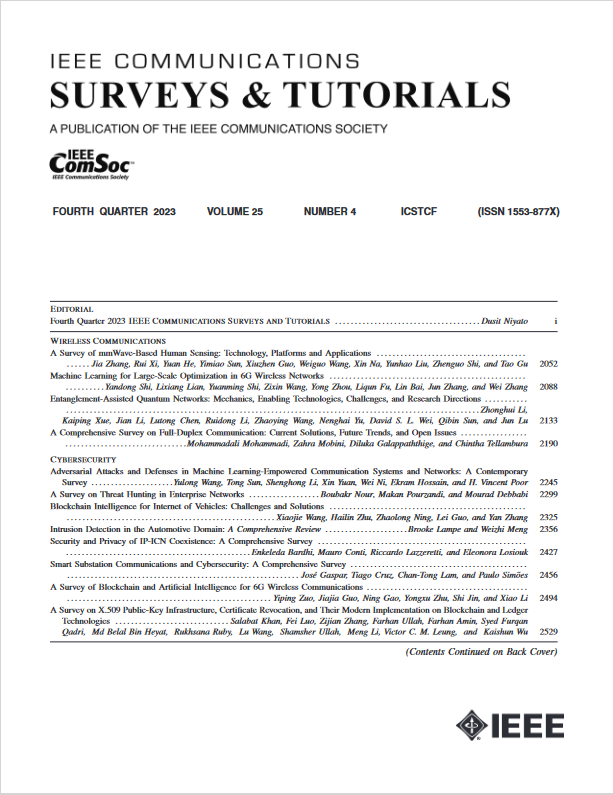
IEEE Communications Surveys & Tutorials is an online journal published by the IEEE Communications Society for tutorials and surveys covering all aspects of the communications field. Telecommunications technology is progressing at a rapid pace, and the IEEE Communications Society is committed to providing researchers and other professionals the information and tools to stay abreast. IEEE Communications Surveys and Tutorials focuses on integrating and adding understanding to the existing literature on communications, putting results in context. Whether searching for in-depth information about a familiar area or an introduction into a new area, IEEE Communications Surveys & Tutorials aims to be the premier source of peer-reviewed, comprehensive tutorials and surveys, and pointers to further sources. IEEE Communications Surveys & Tutorials publishes only articles exclusively written for IEEE Communications Surveys & Tutorials and go through a rigorous review process before their publication in the quarterly issues.
A tutorial article in the IEEE Communications Surveys & Tutorials should be designed to help the reader to become familiar with and learn something specific about a chosen topic. In contrast, the term survey, as applied here, is defined to mean a survey of the literature. A survey article in IEEE Communications Surveys & Tutorials should provide a comprehensive review of developments in a selected area, covering its development from its inception to its current state and beyond, and illustrating its development through liberal citations from the literature. Both tutorials and surveys should be tutorial in nature and should be written in a style comprehensible to readers outside the specialty of the article.



 京公网安备 11010802042870号
京ICP备2023020795号-1
京公网安备 11010802042870号
京ICP备2023020795号-1

 分享
分享
 求助内容:
求助内容: 应助结果提醒方式:
 扫码关注我们
