Srishruthi Thirumalai, Frederick J. Livesey, Rickie Patani, Christy Hung
{"title":"APP antisense oligonucleotides are effective in rescuing mitochondrial phenotypes in human iPSC-derived trisomy 21 astrocytes","authors":"Srishruthi Thirumalai, Frederick J. Livesey, Rickie Patani, Christy Hung","doi":"10.1002/alz.14560","DOIUrl":null,"url":null,"abstract":"<div>\n \n \n <section>\n \n <h3> INTRODUCTION</h3>\n \n <p>Antisense oligonucleotides (ASOs) have shown promise in reducing amyloid precursor protein (APP) levels in neurons, but their effects in astrocytes, key contributors to neurodegenerative diseases, remain unclear. This study evaluates the efficacy of APP ASOs in astrocytes derived from an individual with Down syndrome (DS), a population at high risk for Alzheimer's disease (AD).</p>\n </section>\n \n <section>\n \n <h3> METHODS</h3>\n \n <p>Human induced pluripotent stem cells (hiPSCs) from a healthy individual and an individual with DS were differentiated into astrocytes. Astrocytes were treated with APP ASOs for 10 days, and APP levels were quantified. Mitochondrial morphology and superoxide production in DS astrocytes were analyzed using super-resolution and confocal microscopy.</p>\n </section>\n \n <section>\n \n <h3> RESULTS</h3>\n \n <p>APP ASOs significantly reduced APP levels in astrocytes from both control and DS individuals. In DS astrocytes, treatment restored mitochondrial health, increasing mitochondrial number and size while reducing superoxide production.</p>\n </section>\n \n <section>\n \n <h3> DISCUSSION</h3>\n \n <p>APP ASOs effectively reduce APP levels and improve mitochondrial health in astrocytes, suggesting their potential as a therapeutic approach for DS and DS-related AD. Further in vivo studies are required to confirm these findings.</p>\n </section>\n \n <section>\n \n <h3> Highlights</h3>\n \n <div>\n <ul>\n \n <li>APP ASOs reduce APP levels in human iPSC-derived astrocytes.</li>\n \n <li>APP ASO treatment rescues mitochondrial phenotypes in trisomy 21 astrocytes.</li>\n \n <li>This study supports ASOs as a potential therapy for Down syndrome-related Alzheimer's disease.</li>\n </ul>\n </div>\n </section>\n </div>","PeriodicalId":7471,"journal":{"name":"Alzheimer's & Dementia","volume":"21 1","pages":""},"PeriodicalIF":11.1000,"publicationDate":"2025-01-29","publicationTypes":"Journal Article","fieldsOfStudy":null,"isOpenAccess":false,"openAccessPdf":"https://onlinelibrary.wiley.com/doi/epdf/10.1002/alz.14560","citationCount":"0","resultStr":null,"platform":"Semanticscholar","paperid":null,"PeriodicalName":"Alzheimer's & Dementia","FirstCategoryId":"3","ListUrlMain":"https://alz-journals.onlinelibrary.wiley.com/doi/10.1002/alz.14560","RegionNum":1,"RegionCategory":"医学","ArticlePicture":[],"TitleCN":null,"AbstractTextCN":null,"PMCID":null,"EPubDate":"","PubModel":"","JCR":"Q1","JCRName":"CLINICAL NEUROLOGY","Score":null,"Total":0}
引用次数: 0
Abstract
INTRODUCTION
Antisense oligonucleotides (ASOs) have shown promise in reducing amyloid precursor protein (APP) levels in neurons, but their effects in astrocytes, key contributors to neurodegenerative diseases, remain unclear. This study evaluates the efficacy of APP ASOs in astrocytes derived from an individual with Down syndrome (DS), a population at high risk for Alzheimer's disease (AD).
METHODS
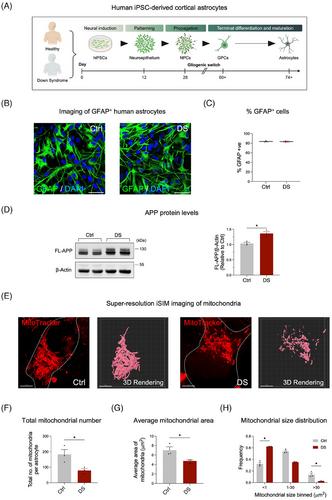
Human induced pluripotent stem cells (hiPSCs) from a healthy individual and an individual with DS were differentiated into astrocytes. Astrocytes were treated with APP ASOs for 10 days, and APP levels were quantified. Mitochondrial morphology and superoxide production in DS astrocytes were analyzed using super-resolution and confocal microscopy.
RESULTS
APP ASOs significantly reduced APP levels in astrocytes from both control and DS individuals. In DS astrocytes, treatment restored mitochondrial health, increasing mitochondrial number and size while reducing superoxide production.
DISCUSSION
APP ASOs effectively reduce APP levels and improve mitochondrial health in astrocytes, suggesting their potential as a therapeutic approach for DS and DS-related AD. Further in vivo studies are required to confirm these findings.
Highlights
APP ASOs reduce APP levels in human iPSC-derived astrocytes.
APP ASO treatment rescues mitochondrial phenotypes in trisomy 21 astrocytes.
This study supports ASOs as a potential therapy for Down syndrome-related Alzheimer's disease.
期刊介绍:
Alzheimer's & Dementia is a peer-reviewed journal that aims to bridge knowledge gaps in dementia research by covering the entire spectrum, from basic science to clinical trials to social and behavioral investigations. It provides a platform for rapid communication of new findings and ideas, optimal translation of research into practical applications, increasing knowledge across diverse disciplines for early detection, diagnosis, and intervention, and identifying promising new research directions. In July 2008, Alzheimer's & Dementia was accepted for indexing by MEDLINE, recognizing its scientific merit and contribution to Alzheimer's research.






 京公网安备 11010802042870号
京ICP备2023020795号-1
京公网安备 11010802042870号
京ICP备2023020795号-1

 分享
分享
 求助内容:
求助内容: 应助结果提醒方式:
 扫码关注我们
