Iron-associated lipid peroxidation in Alzheimer's disease is increased in lipid rafts with decreased ferroptosis suppressors, tested by chelation in mice
Max A. Thorwald, Jose A. Godoy-Lugo, Gilberto Garcia, Justine Silva, Minhoo Kim, Amy Christensen, Wendy J. Mack, Elizabeth Head, Peggy A. O'Day, Bérénice A. Benayoun, Todd E. Morgan, Christian J. Pike, Ryo Higuchi-Sanabria, Henry Jay Forman, Caleb E. Finch
{"title":"Iron-associated lipid peroxidation in Alzheimer's disease is increased in lipid rafts with decreased ferroptosis suppressors, tested by chelation in mice","authors":"Max A. Thorwald, Jose A. Godoy-Lugo, Gilberto Garcia, Justine Silva, Minhoo Kim, Amy Christensen, Wendy J. Mack, Elizabeth Head, Peggy A. O'Day, Bérénice A. Benayoun, Todd E. Morgan, Christian J. Pike, Ryo Higuchi-Sanabria, Henry Jay Forman, Caleb E. Finch","doi":"10.1002/alz.14541","DOIUrl":null,"url":null,"abstract":"<div>\n \n \n <section>\n \n <h3> INTRODUCTION</h3>\n \n <p>Iron-mediated cell death (ferroptosis) is a proposed mechanism of Alzheimer's disease (AD) pathology. While iron is essential for basic biological functions, its reactivity generates oxidants which contribute to cell damage and death.</p>\n </section>\n \n <section>\n \n <h3> METHODS</h3>\n \n <p>To further resolve mechanisms of iron-mediated toxicity in AD, we analyzed <i>post mortem</i> human brain and ApoEFAD mice.</p>\n </section>\n \n <section>\n \n <h3> RESULTS</h3>\n \n <p>AD brains had decreased antioxidant enzymes, including those mediated by glutathione (GSH). Subcellular analyses of AD brains showed greater oxidative damage and lower antioxidant enzymes in lipid rafts, the site of amyloid processing, than in the non-raft membrane fraction. Apolipoprotein E ε4 carriers had lower lipid raft yield with greater membrane oxidation. The hypothesized role of iron in AD pathology was tested in ApoEFAD mice by iron chelation with deferoxamine, which decreased fibrillar amyloid and lipid peroxidation, together with increased GSH-mediated antioxidants.</p>\n </section>\n \n <section>\n \n <h3> DISCUSSION</h3>\n \n <p>These novel molecular pathways highlight iron-mediated damage to lipid rafts during AD.</p>\n </section>\n \n <section>\n \n <h3> Highlghts</h3>\n \n <div>\n <ul>\n \n <li>Alzheimer's disease (AD) brains have numerous markers for ferroptosis, including increased lipid peroxidation, reduced antioxidant levels, and increased iron storage.</li>\n \n <li>Lipid rafts in AD cases have increased oxidative damage and reduced antioxidant enzyme levels and activity which are most severe in apolipoprotein E ε4 carriers.</li>\n \n <li>Neuronal markers are correlated with lipid peroxidation, antioxidant defense, and iron signaling proteins suggesting that neuronal loss is linked to these events.</li>\n \n <li>Chelation of iron in the early-onset familial AD model reduces iron-mediated lipid peroxidation and fibrillar amyloid.</li>\n </ul>\n </div>\n </section>\n </div>","PeriodicalId":7471,"journal":{"name":"Alzheimer's & Dementia","volume":"21 1","pages":""},"PeriodicalIF":11.1000,"publicationDate":"2025-01-29","publicationTypes":"Journal Article","fieldsOfStudy":null,"isOpenAccess":false,"openAccessPdf":"https://onlinelibrary.wiley.com/doi/epdf/10.1002/alz.14541","citationCount":"0","resultStr":null,"platform":"Semanticscholar","paperid":null,"PeriodicalName":"Alzheimer's & Dementia","FirstCategoryId":"3","ListUrlMain":"https://alz-journals.onlinelibrary.wiley.com/doi/10.1002/alz.14541","RegionNum":1,"RegionCategory":"医学","ArticlePicture":[],"TitleCN":null,"AbstractTextCN":null,"PMCID":null,"EPubDate":"","PubModel":"","JCR":"Q1","JCRName":"CLINICAL NEUROLOGY","Score":null,"Total":0}
引用次数: 0
Abstract
INTRODUCTION
Iron-mediated cell death (ferroptosis) is a proposed mechanism of Alzheimer's disease (AD) pathology. While iron is essential for basic biological functions, its reactivity generates oxidants which contribute to cell damage and death.
METHODS
To further resolve mechanisms of iron-mediated toxicity in AD, we analyzed post mortem human brain and ApoEFAD mice.
RESULTS
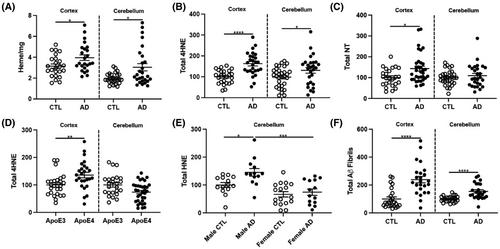
AD brains had decreased antioxidant enzymes, including those mediated by glutathione (GSH). Subcellular analyses of AD brains showed greater oxidative damage and lower antioxidant enzymes in lipid rafts, the site of amyloid processing, than in the non-raft membrane fraction. Apolipoprotein E ε4 carriers had lower lipid raft yield with greater membrane oxidation. The hypothesized role of iron in AD pathology was tested in ApoEFAD mice by iron chelation with deferoxamine, which decreased fibrillar amyloid and lipid peroxidation, together with increased GSH-mediated antioxidants.
DISCUSSION
These novel molecular pathways highlight iron-mediated damage to lipid rafts during AD.
Highlghts
Alzheimer's disease (AD) brains have numerous markers for ferroptosis, including increased lipid peroxidation, reduced antioxidant levels, and increased iron storage.
Lipid rafts in AD cases have increased oxidative damage and reduced antioxidant enzyme levels and activity which are most severe in apolipoprotein E ε4 carriers.
Neuronal markers are correlated with lipid peroxidation, antioxidant defense, and iron signaling proteins suggesting that neuronal loss is linked to these events.
Chelation of iron in the early-onset familial AD model reduces iron-mediated lipid peroxidation and fibrillar amyloid.
期刊介绍:
Alzheimer's & Dementia is a peer-reviewed journal that aims to bridge knowledge gaps in dementia research by covering the entire spectrum, from basic science to clinical trials to social and behavioral investigations. It provides a platform for rapid communication of new findings and ideas, optimal translation of research into practical applications, increasing knowledge across diverse disciplines for early detection, diagnosis, and intervention, and identifying promising new research directions. In July 2008, Alzheimer's & Dementia was accepted for indexing by MEDLINE, recognizing its scientific merit and contribution to Alzheimer's research.






 京公网安备 11010802042870号
京ICP备2023020795号-1
京公网安备 11010802042870号
京ICP备2023020795号-1

 分享
分享
 求助内容:
求助内容: 应助结果提醒方式:
 扫码关注我们
