Ruyan Zhao , Guoqin Liu , Philomène Leonore Koko , Mingchao Wang , Xinliang Feng
{"title":"Advances in synthetic strategies for two-dimensional conjugated polymers","authors":"Ruyan Zhao , Guoqin Liu , Philomène Leonore Koko , Mingchao Wang , Xinliang Feng","doi":"10.1039/d4qo02211d","DOIUrl":null,"url":null,"abstract":"<div><div>Two-dimensional conjugated polymers (2D CPs) are typically represented by 2D conjugated covalent organic frameworks (COFs) that consist of covalently cross-linked linear conjugated polymers, which possess extended in-plane π-conjugation and out-of-plane electronic couplings. The precise incorporation of molecular building blocks into ordered polymer frameworks through (semi)reversible 2D polycondensation methodologies enables the synthesis of novel polymer semiconductors with designable and predictable properties for various (opto)electronic, spintronic, photocatalytic, and electrochemical applications. Linkage chemistry lays the foundation for this class of synthetic materials and provides a library for subsequent investigations. In this review, we summarize recent advances in synthetic strategies for 2D CPs. By exploring synthetic approaches and the intricate interplay between chemical structure, the efficiency of 2D conjugation, and related physicochemical properties, we are expected to guide readers with a general background in synthetic chemistry and those actively involved in electronic device research. Furthermore, the discussion will appeal to researchers intrigued by the prospect of uncovering novel physical phenomena or mechanisms inherent in these emerging polymer semiconductors. Finally, future research directions and perspectives of highly crystalline and processable 2D CPs for electronics and other cutting-edge fields are discussed.</div></div>","PeriodicalId":94379,"journal":{"name":"Organic chemistry frontiers : an international journal of organic chemistry","volume":"12 7","pages":"Pages 2457-2480"},"PeriodicalIF":0.0000,"publicationDate":"2025-02-12","publicationTypes":"Journal Article","fieldsOfStudy":null,"isOpenAccess":false,"openAccessPdf":"https://pubs.rsc.org/en/content/articlepdf/2025/qo/d4qo02211d?page=search","citationCount":"0","resultStr":null,"platform":"Semanticscholar","paperid":null,"PeriodicalName":"Organic chemistry frontiers : an international journal of organic chemistry","FirstCategoryId":"1085","ListUrlMain":"https://www.sciencedirect.com/org/science/article/pii/S2052412925000932","RegionNum":0,"RegionCategory":null,"ArticlePicture":[],"TitleCN":null,"AbstractTextCN":null,"PMCID":null,"EPubDate":"2025/1/28 0:00:00","PubModel":"Epub","JCR":"","JCRName":"","Score":null,"Total":0}
引用次数: 0
Abstract
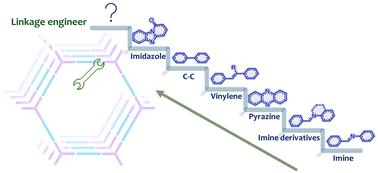
Two-dimensional conjugated polymers (2D CPs) are typically represented by 2D conjugated covalent organic frameworks (COFs) that consist of covalently cross-linked linear conjugated polymers, which possess extended in-plane π-conjugation and out-of-plane electronic couplings. The precise incorporation of molecular building blocks into ordered polymer frameworks through (semi)reversible 2D polycondensation methodologies enables the synthesis of novel polymer semiconductors with designable and predictable properties for various (opto)electronic, spintronic, photocatalytic, and electrochemical applications. Linkage chemistry lays the foundation for this class of synthetic materials and provides a library for subsequent investigations. In this review, we summarize recent advances in synthetic strategies for 2D CPs. By exploring synthetic approaches and the intricate interplay between chemical structure, the efficiency of 2D conjugation, and related physicochemical properties, we are expected to guide readers with a general background in synthetic chemistry and those actively involved in electronic device research. Furthermore, the discussion will appeal to researchers intrigued by the prospect of uncovering novel physical phenomena or mechanisms inherent in these emerging polymer semiconductors. Finally, future research directions and perspectives of highly crystalline and processable 2D CPs for electronics and other cutting-edge fields are discussed.




 京公网安备 11010802042870号
京ICP备2023020795号-1
京公网安备 11010802042870号
京ICP备2023020795号-1

 分享
分享

 求助内容:
求助内容: 应助结果提醒方式:
 扫码关注我们
