Ajith Manayil Parambil, Eepsita Priyadarshini, Shounik Paul, Aristides Bakandritsos, Virender K. Sharma and Radek Zbořil
{"title":"Emerging nanomaterials for the detection of per- and poly-fluorinated substances","authors":"Ajith Manayil Parambil, Eepsita Priyadarshini, Shounik Paul, Aristides Bakandritsos, Virender K. Sharma and Radek Zbořil","doi":"10.1039/D4TA07045C","DOIUrl":null,"url":null,"abstract":"<p >Per- and poly-fluoroalkyl substances (PFAS) are manmade chemicals that are extensively used in a wide range of industrial and consumer applications owing to their extraordinary features. However, PFAS are associated with potential risks because of their persistence and bioaccumulation, causing possible harm to human health and ecosystems. In this case, the fabrication of novel sensing technologies is an attractive approach that can address the limitations of conventional chromatographic techniques. Hence, this review highlights the cutting-edge improvements in engineering PFAS nano-sensors, emphasizing the molecular chemistry advancements in optical, electrochemical, aptamer-based, and immune-based nano-sensors. Insights into the tried-and-tested strategies according to the in-depth examination of the detection approach of each nano-sensor at the molecular level are presented. The potential mechanisms of the interactions between PFAS and emerging nanomaterials are presented, including fluorophilic interactions, electrostatic interactions, ion-bridging interactions with divalent cations, hydrophobic interactions, π–π bonds, hydrogen bonds, ionic exchange, and van der Waals forces in conjunction with materials such as single-atom-supported nanomaterials, carbon dots, graphene, and metallic nanostructures. This review uses an integrated approach to explore the current difficulties and potential in the manufacture of PFAS nano-sensors. Notably, the critical sensor development objectives and the challenges experienced during the process is described. This comprehensive analysis aims to offer a complete viewpoint that may direct future research toward a well-informed and strategic emphasis on enhancing PFAS detection technology. Researchers and practitioners may greatly benefit from these insights, making it easier from them to create innovative and effective PFAS-detecting systems.</p>","PeriodicalId":82,"journal":{"name":"Journal of Materials Chemistry A","volume":" 12","pages":" 8246-8281"},"PeriodicalIF":9.5000,"publicationDate":"2025-01-29","publicationTypes":"Journal Article","fieldsOfStudy":null,"isOpenAccess":false,"openAccessPdf":"https://pubs.rsc.org/en/content/articlepdf/2025/ta/d4ta07045c?page=search","citationCount":"0","resultStr":null,"platform":"Semanticscholar","paperid":null,"PeriodicalName":"Journal of Materials Chemistry A","FirstCategoryId":"88","ListUrlMain":"https://pubs.rsc.org/en/content/articlelanding/2025/ta/d4ta07045c","RegionNum":2,"RegionCategory":"材料科学","ArticlePicture":[],"TitleCN":null,"AbstractTextCN":null,"PMCID":null,"EPubDate":"","PubModel":"","JCR":"Q1","JCRName":"CHEMISTRY, PHYSICAL","Score":null,"Total":0}
引用次数: 0
Abstract
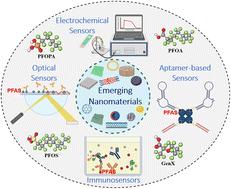
Per- and poly-fluoroalkyl substances (PFAS) are manmade chemicals that are extensively used in a wide range of industrial and consumer applications owing to their extraordinary features. However, PFAS are associated with potential risks because of their persistence and bioaccumulation, causing possible harm to human health and ecosystems. In this case, the fabrication of novel sensing technologies is an attractive approach that can address the limitations of conventional chromatographic techniques. Hence, this review highlights the cutting-edge improvements in engineering PFAS nano-sensors, emphasizing the molecular chemistry advancements in optical, electrochemical, aptamer-based, and immune-based nano-sensors. Insights into the tried-and-tested strategies according to the in-depth examination of the detection approach of each nano-sensor at the molecular level are presented. The potential mechanisms of the interactions between PFAS and emerging nanomaterials are presented, including fluorophilic interactions, electrostatic interactions, ion-bridging interactions with divalent cations, hydrophobic interactions, π–π bonds, hydrogen bonds, ionic exchange, and van der Waals forces in conjunction with materials such as single-atom-supported nanomaterials, carbon dots, graphene, and metallic nanostructures. This review uses an integrated approach to explore the current difficulties and potential in the manufacture of PFAS nano-sensors. Notably, the critical sensor development objectives and the challenges experienced during the process is described. This comprehensive analysis aims to offer a complete viewpoint that may direct future research toward a well-informed and strategic emphasis on enhancing PFAS detection technology. Researchers and practitioners may greatly benefit from these insights, making it easier from them to create innovative and effective PFAS-detecting systems.
期刊介绍:
The Journal of Materials Chemistry A, B & C covers a wide range of high-quality studies in the field of materials chemistry, with each section focusing on specific applications of the materials studied. Journal of Materials Chemistry A emphasizes applications in energy and sustainability, including topics such as artificial photosynthesis, batteries, and fuel cells. Journal of Materials Chemistry B focuses on applications in biology and medicine, while Journal of Materials Chemistry C covers applications in optical, magnetic, and electronic devices. Example topic areas within the scope of Journal of Materials Chemistry A include catalysis, green/sustainable materials, sensors, and water treatment, among others.



 京公网安备 11010802042870号
京ICP备2023020795号-1
京公网安备 11010802042870号
京ICP备2023020795号-1

 分享
分享
 求助内容:
求助内容: 应助结果提醒方式:
 扫码关注我们
