Mirella Russo, Davide Nardini, Sara Melchiorre, Consuelo Ciprietti, Gaetano Polito, Miriam Punzi, Fedele Dono, Matteo Santilli, Astrid Thomas, Stefano L. Sensi, the Alzheimer's Disease Neuroimaging Initiative
{"title":"Predicting conversion in cognitively normal and mild cognitive impairment individuals with machine learning: Is the CSF status still relevant?","authors":"Mirella Russo, Davide Nardini, Sara Melchiorre, Consuelo Ciprietti, Gaetano Polito, Miriam Punzi, Fedele Dono, Matteo Santilli, Astrid Thomas, Stefano L. Sensi, the Alzheimer's Disease Neuroimaging Initiative","doi":"10.1002/alz.14398","DOIUrl":null,"url":null,"abstract":"<div>\n \n \n <section>\n \n <h3> INTRODUCTION</h3>\n \n <p>Machine learning (ML) helps diagnose the mild cognitive impairment–Alzheimer's disease (MCI-AD) spectrum. However, ML is fed with data unavailable in standard clinical practice. Thus, we tested a novel multi-step ML approach to predict cognitive worsening.</p>\n </section>\n \n <section>\n \n <h3> METHODS</h3>\n \n <p>We selected cognitively normal and MCI participants from the Alzheimer's Disease Neuroimaging Initiative dataset and categorized them on total tau/amyloid beta 1-42 ratios. ML was applied to predict the 3-year conversion with standard clinical data (SCD), assess the model's accuracy, and identify the role of cerebrospinal fluid (CSF) biomarkers in this approach. Shapley Additive Explanations (SHAP) analysis was carried out to explore the automated decisional process.</p>\n </section>\n \n <section>\n \n <h3> RESULTS</h3>\n \n <p>The model achieved 84% accuracy across the entire cohort, 86% in patients with negative CSF, and 88% in individuals with AD-like CSF. SHAP analysis identified differences between CSF-positive and -negative patients in predictors of conversion and cut-offs.</p>\n </section>\n \n <section>\n \n <h3> CONCLUSIONS</h3>\n \n <p>The approach yielded good prediction accuracy using SCD. However, CSF-based categorizations are needed to improve predictive accuracy.</p>\n </section>\n \n <section>\n \n <h3> Highlights</h3>\n \n <div>\n <ul>\n \n <li>Machine learning algorithms can predict cognitive decline with standard and routinely used clinical data.</li>\n \n <li>Classification according to cerebrospinal fluid biomarkers enhances prediction accuracy.</li>\n \n <li>Different cut-offs could be applied to neuropsychological tests to predict conversion.</li>\n </ul>\n </div>\n </section>\n </div>","PeriodicalId":7471,"journal":{"name":"Alzheimer's & Dementia","volume":"21 2","pages":""},"PeriodicalIF":11.1000,"publicationDate":"2025-01-30","publicationTypes":"Journal Article","fieldsOfStudy":null,"isOpenAccess":false,"openAccessPdf":"https://onlinelibrary.wiley.com/doi/epdf/10.1002/alz.14398","citationCount":"0","resultStr":null,"platform":"Semanticscholar","paperid":null,"PeriodicalName":"Alzheimer's & Dementia","FirstCategoryId":"3","ListUrlMain":"https://alz-journals.onlinelibrary.wiley.com/doi/10.1002/alz.14398","RegionNum":1,"RegionCategory":"医学","ArticlePicture":[],"TitleCN":null,"AbstractTextCN":null,"PMCID":null,"EPubDate":"","PubModel":"","JCR":"Q1","JCRName":"CLINICAL NEUROLOGY","Score":null,"Total":0}
引用次数: 0
Abstract
INTRODUCTION
Machine learning (ML) helps diagnose the mild cognitive impairment–Alzheimer's disease (MCI-AD) spectrum. However, ML is fed with data unavailable in standard clinical practice. Thus, we tested a novel multi-step ML approach to predict cognitive worsening.
METHODS
We selected cognitively normal and MCI participants from the Alzheimer's Disease Neuroimaging Initiative dataset and categorized them on total tau/amyloid beta 1-42 ratios. ML was applied to predict the 3-year conversion with standard clinical data (SCD), assess the model's accuracy, and identify the role of cerebrospinal fluid (CSF) biomarkers in this approach. Shapley Additive Explanations (SHAP) analysis was carried out to explore the automated decisional process.
RESULTS
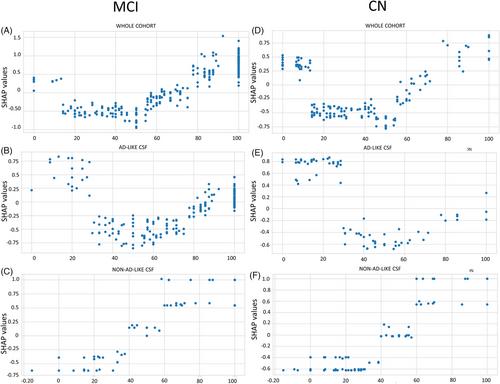
The model achieved 84% accuracy across the entire cohort, 86% in patients with negative CSF, and 88% in individuals with AD-like CSF. SHAP analysis identified differences between CSF-positive and -negative patients in predictors of conversion and cut-offs.
CONCLUSIONS
The approach yielded good prediction accuracy using SCD. However, CSF-based categorizations are needed to improve predictive accuracy.
Highlights
Machine learning algorithms can predict cognitive decline with standard and routinely used clinical data.
Classification according to cerebrospinal fluid biomarkers enhances prediction accuracy.
Different cut-offs could be applied to neuropsychological tests to predict conversion.
期刊介绍:
Alzheimer's & Dementia is a peer-reviewed journal that aims to bridge knowledge gaps in dementia research by covering the entire spectrum, from basic science to clinical trials to social and behavioral investigations. It provides a platform for rapid communication of new findings and ideas, optimal translation of research into practical applications, increasing knowledge across diverse disciplines for early detection, diagnosis, and intervention, and identifying promising new research directions. In July 2008, Alzheimer's & Dementia was accepted for indexing by MEDLINE, recognizing its scientific merit and contribution to Alzheimer's research.





 京公网安备 11010802042870号
京ICP备2023020795号-1
京公网安备 11010802042870号
京ICP备2023020795号-1

 分享
分享
 求助内容:
求助内容: 应助结果提醒方式:
 扫码关注我们
