Xue-Ning Hu, Xu-Hang Zhong, Rui-Ru Zhong, Lin-Mei Zhang, De-Bo Hao, Qian Xu, Hui-Zhi Wei, Rui Zhou, Jianyu Wei, Kuan-Guan Liu, Shang-Fu Yuan, Dong-Sheng Li and Tao Wu
{"title":"Significantly enhanced NIR emission of solid-state clusters based on Cu4Pt2 triggered with volatile organic compounds†","authors":"Xue-Ning Hu, Xu-Hang Zhong, Rui-Ru Zhong, Lin-Mei Zhang, De-Bo Hao, Qian Xu, Hui-Zhi Wei, Rui Zhou, Jianyu Wei, Kuan-Guan Liu, Shang-Fu Yuan, Dong-Sheng Li and Tao Wu","doi":"10.1039/D4NR04371E","DOIUrl":null,"url":null,"abstract":"<p >Near-infrared (NIR) emitting metal clusters, recognized for their low toxicity, large Stokes shift, and exceptional photostability, hold considerable promise as stimuli-responsive luminescent materials for applications including organic vapor sensing, pollutant detection, and photoluminescent thermometers. However, their limited quantum yield (QY) for NIR emission poses a challenge, highlighting the need for developing light-up sensors with NIR emitting metal clusters to broaden the scope of applications. Herein, the carbazole-alkyne ligand-incorporated novel bimetallic cluster, Cu<small><sub>4</sub></small>Pt<small><sub>2</sub></small>(CZ-PrA)<small><sub>4</sub></small>(dppy)<small><sub>4</sub></small>(PF<small><sub>6</sub></small>)<small><sub>2</sub></small> (<strong>CZ-Cu<small><sub>4</sub></small>Pt<small><sub>2</sub></small></strong>, CZ-PrAH = 9-(Prop-2-yn-1-yl)-9<em>H</em>-carbazole; dppy = diphenyl-2-pyridylphosphine), was synthesized, which exhibits NIR emission centered at 740 nm in the solid state and shows a significant blue shift compared to the previously reported analogues. Temperature-dependent luminescence tests demonstrated an increase in emission intensity with decreasing temperature and a blue shift in the emission peak. Remarkably, its photoluminescence (PL) intensity increased significantly upon exposure to solvents like ethyl acetate, formaldehyde (HCHO), and chlorobenzene, raising the QY from an initial 16.1% to a range of 46.7%–70.3%. HCHO, in particular, boosted the emission intensity by over 200 times. The emission enhancement mechanism, elucidated through UV-vis diffuse reflectance spectroscopy, powder X-ray diffraction, femtosecond transient absorption spectroscopy, and single-crystal X-ray diffraction, reveals that weak intermolecular interactions, particularly hydrogen bonding between solvent molecules and ligands, restrict intramolecular rotations and vibrations, thus promoting radiative transitions. The <strong>CZ-Cu<small><sub>4</sub></small>Pt<small><sub>2</sub></small></strong> cluster shows potential applications in non-contact fluorescence thermometry and organic vapor detection.</p>","PeriodicalId":92,"journal":{"name":"Nanoscale","volume":" 10","pages":" 5829-5837"},"PeriodicalIF":5.1000,"publicationDate":"2025-01-30","publicationTypes":"Journal Article","fieldsOfStudy":null,"isOpenAccess":false,"openAccessPdf":"","citationCount":"0","resultStr":null,"platform":"Semanticscholar","paperid":null,"PeriodicalName":"Nanoscale","FirstCategoryId":"88","ListUrlMain":"https://pubs.rsc.org/en/content/articlelanding/2025/nr/d4nr04371e","RegionNum":3,"RegionCategory":"材料科学","ArticlePicture":[],"TitleCN":null,"AbstractTextCN":null,"PMCID":null,"EPubDate":"","PubModel":"","JCR":"Q1","JCRName":"CHEMISTRY, MULTIDISCIPLINARY","Score":null,"Total":0}
引用次数: 0
Abstract
Near-infrared (NIR) emitting metal clusters, recognized for their low toxicity, large Stokes shift, and exceptional photostability, hold considerable promise as stimuli-responsive luminescent materials for applications including organic vapor sensing, pollutant detection, and photoluminescent thermometers. However, their limited quantum yield (QY) for NIR emission poses a challenge, highlighting the need for developing light-up sensors with NIR emitting metal clusters to broaden the scope of applications. Herein, the carbazole-alkyne ligand-incorporated novel bimetallic cluster, Cu4Pt2(CZ-PrA)4(dppy)4(PF6)2 (CZ-Cu4Pt2, CZ-PrAH = 9-(Prop-2-yn-1-yl)-9H-carbazole; dppy = diphenyl-2-pyridylphosphine), was synthesized, which exhibits NIR emission centered at 740 nm in the solid state and shows a significant blue shift compared to the previously reported analogues. Temperature-dependent luminescence tests demonstrated an increase in emission intensity with decreasing temperature and a blue shift in the emission peak. Remarkably, its photoluminescence (PL) intensity increased significantly upon exposure to solvents like ethyl acetate, formaldehyde (HCHO), and chlorobenzene, raising the QY from an initial 16.1% to a range of 46.7%–70.3%. HCHO, in particular, boosted the emission intensity by over 200 times. The emission enhancement mechanism, elucidated through UV-vis diffuse reflectance spectroscopy, powder X-ray diffraction, femtosecond transient absorption spectroscopy, and single-crystal X-ray diffraction, reveals that weak intermolecular interactions, particularly hydrogen bonding between solvent molecules and ligands, restrict intramolecular rotations and vibrations, thus promoting radiative transitions. The CZ-Cu4Pt2 cluster shows potential applications in non-contact fluorescence thermometry and organic vapor detection.
期刊介绍:
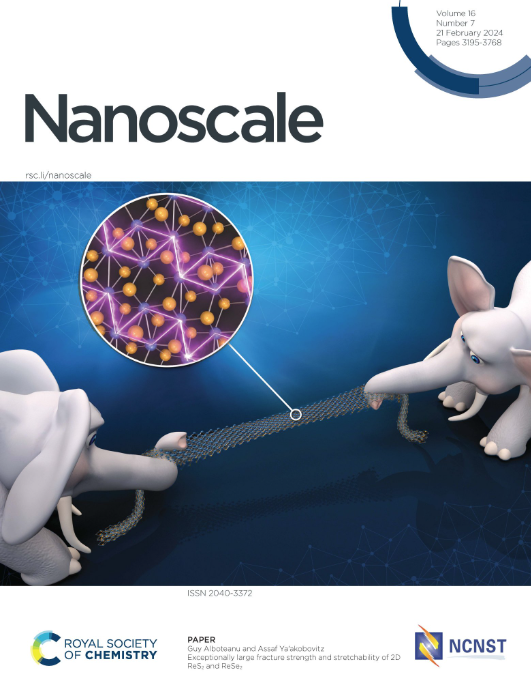
Nanoscale is a high-impact international journal, publishing high-quality research across nanoscience and nanotechnology. Nanoscale publishes a full mix of research articles on experimental and theoretical work, including reviews, communications, and full papers.Highly interdisciplinary, this journal appeals to scientists, researchers and professionals interested in nanoscience and nanotechnology, quantum materials and quantum technology, including the areas of physics, chemistry, biology, medicine, materials, energy/environment, information technology, detection science, healthcare and drug discovery, and electronics.




 京公网安备 11010802042870号
京ICP备2023020795号-1
京公网安备 11010802042870号
京ICP备2023020795号-1

 分享
分享
 求助内容:
求助内容: 应助结果提醒方式:
 扫码关注我们
