{"title":"Anionic Ring-Opening Polymerization of 2-oxabicyclo[2.1.1]hexan-3-One: Manipulating Topology and Conformation for Circular Polymer Design","authors":"Chaoqun Weng, Yanghaoyu Tan, Xiaoyan Tang","doi":"10.1002/cssc.202402667","DOIUrl":null,"url":null,"abstract":"<p>Polyesters featuring a linear topology and in-chain 1,3-cyclobutane rings, synthesized via ring-opening polymerization (ROP) of 2-oxabicyclo[2.1.1]hexan-3-one (4<sup>R</sup>-BL, R=Bu, Ph) through a coordination-insertion mechanism, display excellent thermal and hydrolytic stability, making them promising candidates for sustainable circular materials. However, achieving diverse topological and stereochemical structures remains challenging. Herein, we demonstrate precise control over linear and cyclic topologies of these polyesters and the conformation of in-chain cyclobutane rings through anionic ROP of 4<sup>R</sup>-BL with appropriate catalysts or initiators. Using <i>tert-</i>butoxide (<sup><i>t</i></sup>BuOK) as the catalyst, low loading (0.05–0.1 mol %) produces high-molar-mass cyclic polyester P(4<sup>R</sup>-BL) (up to 571 kg/mol), whereas high loading (2 mol %) promotes transesterification and isomerization, ultimately yielding cyclic oligomers. Remarkably, the tetramer (4<sup>Ph</sup>-BL)<sub>4</sub> undergoes conformational turnover of the puckered cyclobutane rings and can be repolymerized into polymer P(4<sup>Ph</sup>-BL). This establishes a “monomer ⇄ polymer ⇄ tetramer” dual closed-loop life cycle, enhancing the potential for a circular material economy.</p>","PeriodicalId":149,"journal":{"name":"ChemSusChem","volume":"18 11","pages":""},"PeriodicalIF":6.6000,"publicationDate":"2025-01-29","publicationTypes":"Journal Article","fieldsOfStudy":null,"isOpenAccess":false,"openAccessPdf":"","citationCount":"0","resultStr":null,"platform":"Semanticscholar","paperid":null,"PeriodicalName":"ChemSusChem","FirstCategoryId":"92","ListUrlMain":"https://chemistry-europe.onlinelibrary.wiley.com/doi/10.1002/cssc.202402667","RegionNum":2,"RegionCategory":"化学","ArticlePicture":[],"TitleCN":null,"AbstractTextCN":null,"PMCID":null,"EPubDate":"","PubModel":"","JCR":"Q1","JCRName":"CHEMISTRY, MULTIDISCIPLINARY","Score":null,"Total":0}
引用次数: 0
Abstract
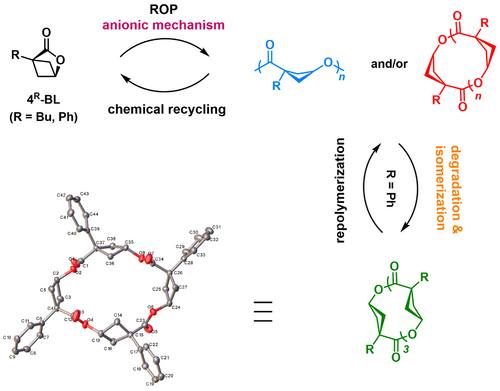
Polyesters featuring a linear topology and in-chain 1,3-cyclobutane rings, synthesized via ring-opening polymerization (ROP) of 2-oxabicyclo[2.1.1]hexan-3-one (4R-BL, R=Bu, Ph) through a coordination-insertion mechanism, display excellent thermal and hydrolytic stability, making them promising candidates for sustainable circular materials. However, achieving diverse topological and stereochemical structures remains challenging. Herein, we demonstrate precise control over linear and cyclic topologies of these polyesters and the conformation of in-chain cyclobutane rings through anionic ROP of 4R-BL with appropriate catalysts or initiators. Using tert-butoxide (tBuOK) as the catalyst, low loading (0.05–0.1 mol %) produces high-molar-mass cyclic polyester P(4R-BL) (up to 571 kg/mol), whereas high loading (2 mol %) promotes transesterification and isomerization, ultimately yielding cyclic oligomers. Remarkably, the tetramer (4Ph-BL)4 undergoes conformational turnover of the puckered cyclobutane rings and can be repolymerized into polymer P(4Ph-BL). This establishes a “monomer ⇄ polymer ⇄ tetramer” dual closed-loop life cycle, enhancing the potential for a circular material economy.
2-氧杂环[2.1.1]己烷-3- 1 (4R-BL, R = Bu, Ph)经开环聚合(ROP)通过配位插入机制合成的具有线性拓扑结构和链内1,3-环丁烷环的聚酯具有优异的热稳定性和水解稳定性,是可持续循环材料的理想候选材料。然而,实现不同的拓扑和立体化学结构仍然具有挑战性。在这里,我们证明了精确控制这些聚酯的线性和环状拓扑结构,以及通过在适当的催化剂或引发剂的4R-BL的阴离子ROP链内环丁烷环的构象。以叔丁醇(tBuOK)为催化剂,低负荷(0.05-0.1 mol%)可生成高摩尔质量的环聚酯P(4R-BL)(高达571 kg/mol),而高负荷(2 mol%)可促进酯交换和异构化,最终生成环低聚物。值得注意的是,四聚体(4Ph-BL)4发生了皱化环丁烷环的构象翻转,可以重新聚合成聚合物P(4Ph-BL)。这建立了一种“单体/聚合物/四聚物”双闭环生命周期,增强了循环材料经济的潜力。
期刊介绍:
ChemSusChem
Impact Factor (2016): 7.226
Scope:
Interdisciplinary journal
Focuses on research at the interface of chemistry and sustainability
Features the best research on sustainability and energy
Areas Covered:
Chemistry
Materials Science
Chemical Engineering
Biotechnology






 京公网安备 11010802042870号
京ICP备2023020795号-1
京公网安备 11010802042870号
京ICP备2023020795号-1

 分享
分享
 求助内容:
求助内容: 应助结果提醒方式:
 扫码关注我们
