Which combination of medical expulsive therapy is more effective for treatment of distal ureteral stone in adults? A systematic review and network meta-analysis.
Maryam Taheri, Nasrin Borumandnia, Hamidreza Abdi, Amir H Kashi, Setareh Nourani, Sogand Sheikholeslami, Yasamin Maleki Gilvaei, Pardis Ziaeefar, Abbas Basiri
{"title":"Which combination of medical expulsive therapy is more effective for treatment of distal ureteral stone in adults? A systematic review and network meta-analysis.","authors":"Maryam Taheri, Nasrin Borumandnia, Hamidreza Abdi, Amir H Kashi, Setareh Nourani, Sogand Sheikholeslami, Yasamin Maleki Gilvaei, Pardis Ziaeefar, Abbas Basiri","doi":"10.1186/s12894-024-01679-2","DOIUrl":null,"url":null,"abstract":"<p><strong>Background: </strong>Medical Expulsive Therapy (MET) has been recommended as an established modality for the treatment of distal ureteral stones due to its clearance rate, pain control, and patient satisfaction while having minimal morbidity in comparison to other urologic interventions. In some studies, a combination of medications has been used, which we assessed in this network meta-analysis (NMA).</p><p><strong>Methods: </strong>We conducted systematic searches in PubMed, Scopus, and Web of Science to identify relevant trials published between 2001 and 2024. We excluded articles that looked at MET for upper ureteral stone passage or after shock wave lithotripsy (SWL). NMA was performed to compare the effect of combination MET on stone expulsion rate (SER), stone expulsion time (SET), and need for analgesia.</p><p><strong>Results: </strong>We included 19 studies with 2414 participants. NMA results revealed that the combination MET of α-blockers with PDE-5 inhibitors (OR = 2.7, CI = 1.80,4.05), corticosteroids (OR = 2.7, CI = 1.81,4.13), and phytotherapy (OR: 3.10, CI = 1.62,5.92) were more effective than α-blockers alone in SER. The combination MET of α-blockers with PDE-5 inhibitors (MD: -3.8, CI=-7.0, -0.5) showed significantly lower SET compared to α-blockers alone. Finally, combination MET of α-blockers with PDE-5 inhibitors (MD:1.0, CI = 0.4,1.7) and nifedipine with corticosteroids (MD:1.2, CI = 0.4,1.9) showed a significant decrease in analgesia use.</p><p><strong>Conclusions: </strong>The combination MET of α-blockers with PDE-5 inhibitors, corticosteroids, and phytotherapy increases the rate of stone clearance 2.7 to 3.1 times more than α-blockers alone. The other benefits of combination MET were lower expulsion time and less analgesia use that needs further studies.</p>","PeriodicalId":9285,"journal":{"name":"BMC Urology","volume":"25 1","pages":"18"},"PeriodicalIF":1.9000,"publicationDate":"2025-01-28","publicationTypes":"Journal Article","fieldsOfStudy":null,"isOpenAccess":false,"openAccessPdf":"https://www.ncbi.nlm.nih.gov/pmc/articles/PMC11773972/pdf/","citationCount":"0","resultStr":null,"platform":"Semanticscholar","paperid":null,"PeriodicalName":"BMC Urology","FirstCategoryId":"3","ListUrlMain":"https://doi.org/10.1186/s12894-024-01679-2","RegionNum":3,"RegionCategory":"医学","ArticlePicture":[],"TitleCN":null,"AbstractTextCN":null,"PMCID":null,"EPubDate":"","PubModel":"","JCR":"Q3","JCRName":"UROLOGY & NEPHROLOGY","Score":null,"Total":0}
引用次数: 0
Abstract
Background: Medical Expulsive Therapy (MET) has been recommended as an established modality for the treatment of distal ureteral stones due to its clearance rate, pain control, and patient satisfaction while having minimal morbidity in comparison to other urologic interventions. In some studies, a combination of medications has been used, which we assessed in this network meta-analysis (NMA).
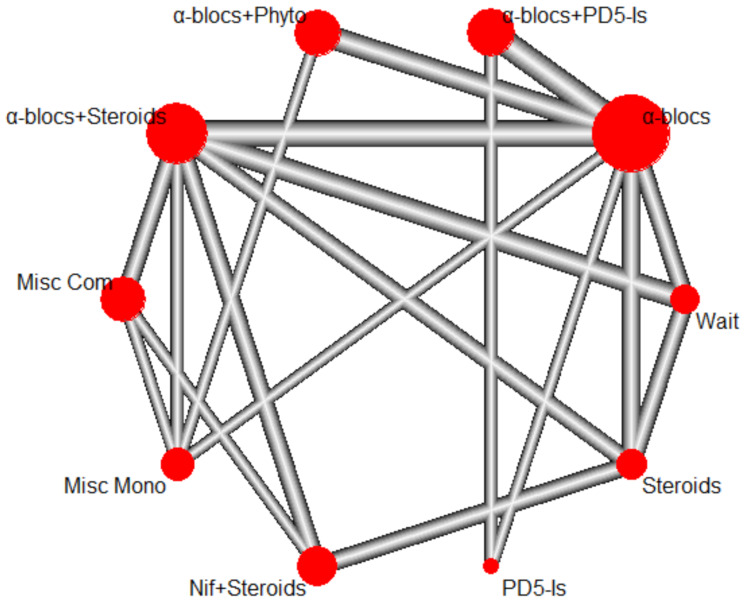
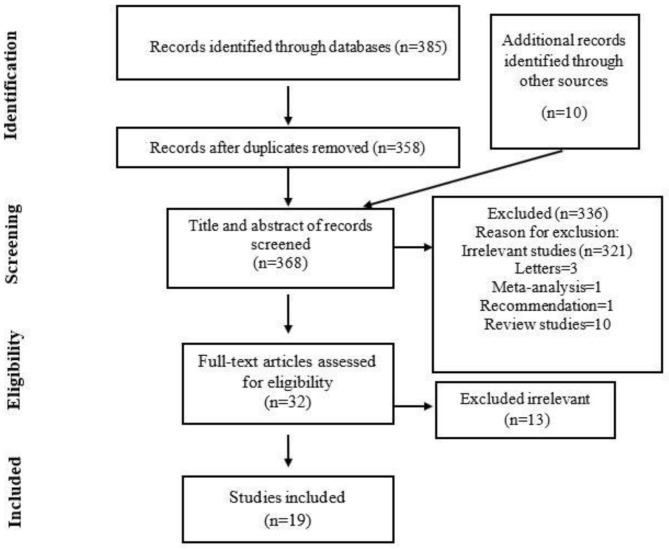
Methods: We conducted systematic searches in PubMed, Scopus, and Web of Science to identify relevant trials published between 2001 and 2024. We excluded articles that looked at MET for upper ureteral stone passage or after shock wave lithotripsy (SWL). NMA was performed to compare the effect of combination MET on stone expulsion rate (SER), stone expulsion time (SET), and need for analgesia.
Results: We included 19 studies with 2414 participants. NMA results revealed that the combination MET of α-blockers with PDE-5 inhibitors (OR = 2.7, CI = 1.80,4.05), corticosteroids (OR = 2.7, CI = 1.81,4.13), and phytotherapy (OR: 3.10, CI = 1.62,5.92) were more effective than α-blockers alone in SER. The combination MET of α-blockers with PDE-5 inhibitors (MD: -3.8, CI=-7.0, -0.5) showed significantly lower SET compared to α-blockers alone. Finally, combination MET of α-blockers with PDE-5 inhibitors (MD:1.0, CI = 0.4,1.7) and nifedipine with corticosteroids (MD:1.2, CI = 0.4,1.9) showed a significant decrease in analgesia use.
Conclusions: The combination MET of α-blockers with PDE-5 inhibitors, corticosteroids, and phytotherapy increases the rate of stone clearance 2.7 to 3.1 times more than α-blockers alone. The other benefits of combination MET were lower expulsion time and less analgesia use that needs further studies.
背景:医学排出疗法(MET)已被推荐作为治疗输尿管远端结石的一种既定模式,因为它的清除率,疼痛控制和患者满意度,同时与其他泌尿外科干预相比发病率最低。在一些研究中,已经使用了药物组合,我们在网络荟萃分析(NMA)中对其进行了评估。方法:系统检索PubMed、Scopus和Web of Science,确定2001年至2024年间发表的相关试验。我们排除了输尿管上段结石通过或冲击波碎石(SWL)后进行MET检查的文章。采用NMA比较联合MET对结石排出率(SER)、结石排出时间(SET)和镇痛需求的影响。结果:我们纳入了19项研究,共2414名受试者。NMA结果显示,α-受体阻滞剂联合PDE-5抑制剂(OR = 2.7, CI = 1.80,4.05)、皮质激素(OR = 2.7, CI = 1.81,4.13)和植物疗法(OR: 3.10, CI = 1.62,5.92)治疗SER的效果优于α-受体阻滞剂。α-受体阻滞剂与PDE-5抑制剂联合使用的MET (MD: -3.8, CI=-7.0, -0.5)显著低于单独使用α-受体阻滞剂。最后,α-受体阻滞剂联合PDE-5抑制剂(MD:1.0, CI = 0.4,1.7)和硝苯地平联合皮质类固醇(MD:1.2, CI = 0.4,1.9)联合使用的镇痛效果显著降低。结论:α-受体阻滞剂与PDE-5抑制剂、皮质类固醇和植物疗法联合使用,结石清除率比单独使用α-受体阻滞剂提高2.7 - 3.1倍。联合MET的其他好处是更短的排出时间和更少的镇痛使用,这需要进一步的研究。
期刊介绍:
BMC Urology is an open access journal publishing original peer-reviewed research articles in all aspects of the prevention, diagnosis and management of urological disorders, as well as related molecular genetics, pathophysiology, and epidemiology.
The journal considers manuscripts in the following broad subject-specific sections of urology:
Endourology and technology
Epidemiology and health outcomes
Pediatric urology
Pre-clinical and basic research
Reconstructive urology
Sexual function and fertility
Urological imaging
Urological oncology
Voiding dysfunction
Case reports.




 京公网安备 11010802042870号
京ICP备2023020795号-1
京公网安备 11010802042870号
京ICP备2023020795号-1

 分享
分享
 求助内容:
求助内容: 应助结果提醒方式:
 扫码关注我们
