Nicola Lindson, Ailsa R Butler, Hayden McRobbie, Chris Bullen, Peter Hajek, Angela Difeng Wu, Rachna Begh, Annika Theodoulou, Caitlin Notley, Nancy A Rigotti, Tari Turner, Jonathan Livingstone-Banks, Tom Morris, Jamie Hartmann-Boyce
{"title":"Electronic cigarettes for smoking cessation.","authors":"Nicola Lindson, Ailsa R Butler, Hayden McRobbie, Chris Bullen, Peter Hajek, Angela Difeng Wu, Rachna Begh, Annika Theodoulou, Caitlin Notley, Nancy A Rigotti, Tari Turner, Jonathan Livingstone-Banks, Tom Morris, Jamie Hartmann-Boyce","doi":"10.1002/14651858.CD010216.pub9","DOIUrl":null,"url":null,"abstract":"<p><strong>Background: </strong>Electronic cigarettes (ECs) are handheld electronic vaping devices that produce an aerosol by heating an e-liquid. People who smoke, healthcare providers, and regulators want to know if ECs can help people quit smoking, and if they are safe to use for this purpose. This is a review update conducted as part of a living systematic review.</p><p><strong>Objectives: </strong>To examine the safety, tolerability, and effectiveness of using EC to help people who smoke tobacco achieve long-term smoking abstinence, in comparison to non-nicotine EC, other smoking cessation treatments, and no treatment.</p><p><strong>Search methods: </strong>We searched the Cochrane Central Register of Controlled Trials (CENTRAL), MEDLINE, Embase, and PsycINFO to 1 February 2024 and the Cochrane Tobacco Addiction Group's Specialized Register to 1 February 2023, reference-checked, and contacted study authors.</p><p><strong>Selection criteria: </strong>We included trials randomizing people who smoke to an EC or control condition. We included uncontrolled intervention studies in which all participants received an EC intervention. Studies had to report an eligible outcome.</p><p><strong>Data collection and analysis: </strong>We followed standard Cochrane methods for screening and data extraction. We used the risk of bias tool (RoB 1) and GRADE to assess the certainty of evidence. Critical outcomes were abstinence from smoking after at least six months, adverse events (AEs), and serious adverse events (SAEs). Important outcomes were biomarkers, toxicants/carcinogens, and longer-term EC use. We used a fixed-effect Mantel-Haenszel model to calculate risk ratios (RRs) with a 95% confidence interval (CI) for dichotomous outcomes. For continuous outcomes, we calculated mean differences. Where appropriate, we pooled data in pairwise and network meta-analyses (NMA).</p><p><strong>Main results: </strong>We included 90 completed studies (two new to this update), representing 29,044 participants, of which 49 were randomized controlled trials (RCTs). Of the included studies, we rated 10 (all but one contributing to our main comparisons) at low risk of bias overall, 61 at high risk overall (including all non-randomized studies), and the remainder at unclear risk. Nicotine EC results in increased quit rates compared to nicotine replacement therapy (NRT) (high-certainty evidence) (RR 1.59, 95% CI 1.30 to 1.93; I<sup>2</sup> = 0%; 7 studies, 2544 participants). In absolute terms, this might translate to an additional four quitters per 100 (95% CI 2 to 6 more). The rate of occurrence of AEs is probably similar between groups (moderate-certainty evidence (limited by imprecision)) (RR 1.03, 95% CI 0.91 to 1.17; I<sup>2</sup> = 0%; 5 studies, 2052 participants). SAEs were rare, and there is insufficient evidence to determine whether rates differ between groups due to very serious imprecision (RR 1.20, 95% CI 0.90 to 1.60; I<sup>2</sup> = 32%; 6 studies, 2761 participants; low-certainty evidence). Nicotine EC probably results in increased quit rates compared to non-nicotine EC (moderate-certainty evidence, limited by imprecision) (RR 1.46, 95% CI 1.09 to 1.96; I<sup>2</sup> = 4%; 6 studies, 1613 participants). In absolute terms, this might lead to an additional three quitters per 100 (95% CI 1 to 7 more). There is probably little to no difference in the rate of AEs between these groups (moderate-certainty evidence) (RR 1.01, 95% CI 0.91 to 1.11; I<sup>2</sup> = 0%; 5 studies, 840 participants). There is insufficient evidence to determine whether rates of SAEs differ between groups, due to very serious imprecision (RR 1.00, 95% CI 0.56 to 1.79; I<sup>2</sup> = 0%; 9 studies, 1412 participants; low-certainty evidence). Compared to behavioural support only/no support, quit rates may be higher for participants randomized to nicotine EC (low-certainty evidence due to issues with risk of bias) (RR 1.96, 95% CI 1.66 to 2.32; I<sup>2</sup> = 0%; 11 studies, 6819 participants). In absolute terms, this represents an additional four quitters per 100 (95% CI 3 to 5 more). There was some evidence that (non-serious) AEs may be more common in people randomized to nicotine EC (RR 1.18, 95% CI 1.10 to 1.27; I<sup>2</sup> = 6%; low-certainty evidence; 6 studies, 2351 participants) and, again, insufficient evidence to determine whether rates of SAEs differed between groups (RR 0.93, 95% CI 0.68 to 1.28; I<sup>2</sup> = 0%; 12 studies, 4561 participants; very low-certainty evidence). Results from the NMA were consistent with those from pairwise meta-analyses for all critical outcomes. There was inconsistency in the AE network, which was explained by a single outlying study contributing the only direct evidence for one of the nodes. Data from non-randomized studies were consistent with RCT data. The most commonly reported AEs were throat/mouth irritation, headache, cough, and nausea, which tended to dissipate with continued EC use. Very few studies reported data on other outcomes or comparisons; hence, evidence for these is limited, with CIs often encompassing both clinically significant harm and benefit.</p><p><strong>Authors' conclusions: </strong>There is high-certainty evidence that ECs with nicotine increase quit rates compared to NRT and moderate-certainty evidence that they increase quit rates compared to ECs without nicotine. Evidence comparing nicotine EC with usual care or no treatment also suggests benefit, but is less certain due to risk of bias inherent in the study design. Confidence intervals were, for the most part, wide for data on AEs, SAEs, and other safety markers, with no evidence for a difference in AEs between nicotine and non-nicotine ECs nor between nicotine ECs and NRT, but low-certainty evidence for increased AEs compared with behavioural support/no support. Overall incidence of SAEs was low across all study arms. We did not detect evidence of serious harm from nicotine EC, but longer, larger studies are needed to fully evaluate EC safety. Our included studies tested regulated nicotine-containing EC; illicit products and/or products containing other active substances (e.g. tetrahydrocannabinol (THC)) may have different harm profiles. The main limitation of the evidence base remains imprecision due to the small number of RCTs, often with low event rates. Further RCTs are underway. To ensure the review continues to provide up-to-date information to decision-makers, this is a living systematic review. We run searches monthly, with the review updated when relevant new evidence becomes available. Please refer to the Cochrane Database of Systematic Reviews for the review's current status.</p>","PeriodicalId":10473,"journal":{"name":"Cochrane Database of Systematic Reviews","volume":"1 ","pages":"CD010216"},"PeriodicalIF":8.8000,"publicationDate":"2025-01-29","publicationTypes":"Journal Article","fieldsOfStudy":null,"isOpenAccess":false,"openAccessPdf":"https://www.ncbi.nlm.nih.gov/pmc/articles/PMC11776059/pdf/","citationCount":"0","resultStr":null,"platform":"Semanticscholar","paperid":null,"PeriodicalName":"Cochrane Database of Systematic Reviews","FirstCategoryId":"3","ListUrlMain":"https://doi.org/10.1002/14651858.CD010216.pub9","RegionNum":2,"RegionCategory":"医学","ArticlePicture":[],"TitleCN":null,"AbstractTextCN":null,"PMCID":null,"EPubDate":"","PubModel":"","JCR":"Q1","JCRName":"MEDICINE, GENERAL & INTERNAL","Score":null,"Total":0}
引用次数: 0
Abstract
Background: Electronic cigarettes (ECs) are handheld electronic vaping devices that produce an aerosol by heating an e-liquid. People who smoke, healthcare providers, and regulators want to know if ECs can help people quit smoking, and if they are safe to use for this purpose. This is a review update conducted as part of a living systematic review.
Objectives: To examine the safety, tolerability, and effectiveness of using EC to help people who smoke tobacco achieve long-term smoking abstinence, in comparison to non-nicotine EC, other smoking cessation treatments, and no treatment.
Search methods: We searched the Cochrane Central Register of Controlled Trials (CENTRAL), MEDLINE, Embase, and PsycINFO to 1 February 2024 and the Cochrane Tobacco Addiction Group's Specialized Register to 1 February 2023, reference-checked, and contacted study authors.
Selection criteria: We included trials randomizing people who smoke to an EC or control condition. We included uncontrolled intervention studies in which all participants received an EC intervention. Studies had to report an eligible outcome.
Data collection and analysis: We followed standard Cochrane methods for screening and data extraction. We used the risk of bias tool (RoB 1) and GRADE to assess the certainty of evidence. Critical outcomes were abstinence from smoking after at least six months, adverse events (AEs), and serious adverse events (SAEs). Important outcomes were biomarkers, toxicants/carcinogens, and longer-term EC use. We used a fixed-effect Mantel-Haenszel model to calculate risk ratios (RRs) with a 95% confidence interval (CI) for dichotomous outcomes. For continuous outcomes, we calculated mean differences. Where appropriate, we pooled data in pairwise and network meta-analyses (NMA).
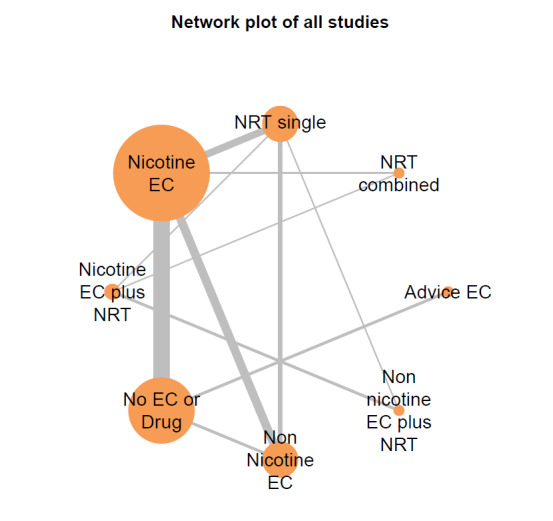
Main results: We included 90 completed studies (two new to this update), representing 29,044 participants, of which 49 were randomized controlled trials (RCTs). Of the included studies, we rated 10 (all but one contributing to our main comparisons) at low risk of bias overall, 61 at high risk overall (including all non-randomized studies), and the remainder at unclear risk. Nicotine EC results in increased quit rates compared to nicotine replacement therapy (NRT) (high-certainty evidence) (RR 1.59, 95% CI 1.30 to 1.93; I2 = 0%; 7 studies, 2544 participants). In absolute terms, this might translate to an additional four quitters per 100 (95% CI 2 to 6 more). The rate of occurrence of AEs is probably similar between groups (moderate-certainty evidence (limited by imprecision)) (RR 1.03, 95% CI 0.91 to 1.17; I2 = 0%; 5 studies, 2052 participants). SAEs were rare, and there is insufficient evidence to determine whether rates differ between groups due to very serious imprecision (RR 1.20, 95% CI 0.90 to 1.60; I2 = 32%; 6 studies, 2761 participants; low-certainty evidence). Nicotine EC probably results in increased quit rates compared to non-nicotine EC (moderate-certainty evidence, limited by imprecision) (RR 1.46, 95% CI 1.09 to 1.96; I2 = 4%; 6 studies, 1613 participants). In absolute terms, this might lead to an additional three quitters per 100 (95% CI 1 to 7 more). There is probably little to no difference in the rate of AEs between these groups (moderate-certainty evidence) (RR 1.01, 95% CI 0.91 to 1.11; I2 = 0%; 5 studies, 840 participants). There is insufficient evidence to determine whether rates of SAEs differ between groups, due to very serious imprecision (RR 1.00, 95% CI 0.56 to 1.79; I2 = 0%; 9 studies, 1412 participants; low-certainty evidence). Compared to behavioural support only/no support, quit rates may be higher for participants randomized to nicotine EC (low-certainty evidence due to issues with risk of bias) (RR 1.96, 95% CI 1.66 to 2.32; I2 = 0%; 11 studies, 6819 participants). In absolute terms, this represents an additional four quitters per 100 (95% CI 3 to 5 more). There was some evidence that (non-serious) AEs may be more common in people randomized to nicotine EC (RR 1.18, 95% CI 1.10 to 1.27; I2 = 6%; low-certainty evidence; 6 studies, 2351 participants) and, again, insufficient evidence to determine whether rates of SAEs differed between groups (RR 0.93, 95% CI 0.68 to 1.28; I2 = 0%; 12 studies, 4561 participants; very low-certainty evidence). Results from the NMA were consistent with those from pairwise meta-analyses for all critical outcomes. There was inconsistency in the AE network, which was explained by a single outlying study contributing the only direct evidence for one of the nodes. Data from non-randomized studies were consistent with RCT data. The most commonly reported AEs were throat/mouth irritation, headache, cough, and nausea, which tended to dissipate with continued EC use. Very few studies reported data on other outcomes or comparisons; hence, evidence for these is limited, with CIs often encompassing both clinically significant harm and benefit.
Authors' conclusions: There is high-certainty evidence that ECs with nicotine increase quit rates compared to NRT and moderate-certainty evidence that they increase quit rates compared to ECs without nicotine. Evidence comparing nicotine EC with usual care or no treatment also suggests benefit, but is less certain due to risk of bias inherent in the study design. Confidence intervals were, for the most part, wide for data on AEs, SAEs, and other safety markers, with no evidence for a difference in AEs between nicotine and non-nicotine ECs nor between nicotine ECs and NRT, but low-certainty evidence for increased AEs compared with behavioural support/no support. Overall incidence of SAEs was low across all study arms. We did not detect evidence of serious harm from nicotine EC, but longer, larger studies are needed to fully evaluate EC safety. Our included studies tested regulated nicotine-containing EC; illicit products and/or products containing other active substances (e.g. tetrahydrocannabinol (THC)) may have different harm profiles. The main limitation of the evidence base remains imprecision due to the small number of RCTs, often with low event rates. Further RCTs are underway. To ensure the review continues to provide up-to-date information to decision-makers, this is a living systematic review. We run searches monthly, with the review updated when relevant new evidence becomes available. Please refer to the Cochrane Database of Systematic Reviews for the review's current status.
期刊介绍:
The Cochrane Database of Systematic Reviews (CDSR) stands as the premier database for systematic reviews in healthcare. It comprises Cochrane Reviews, along with protocols for these reviews, editorials, and supplements. Owned and operated by Cochrane, a worldwide independent network of healthcare stakeholders, the CDSR (ISSN 1469-493X) encompasses a broad spectrum of health-related topics, including health services.





 京公网安备 11010802042870号
京ICP备2023020795号-1
京公网安备 11010802042870号
京ICP备2023020795号-1

 分享
分享
 求助内容:
求助内容: 应助结果提醒方式:
 扫码关注我们
