Wenyu Lin, Yuxuan Huang, Yan Zhang, Lixiang Huang, Hongning Cai, Guanxiang Huang, Ye Li, Qiaoyu Zhang, Huifeng Xue, Binhua Dong, Pengming Sun
{"title":"Risk of residual/recurrent cervical diseases in HPV-positive women post-conization depends on HPV integration status.","authors":"Wenyu Lin, Yuxuan Huang, Yan Zhang, Lixiang Huang, Hongning Cai, Guanxiang Huang, Ye Li, Qiaoyu Zhang, Huifeng Xue, Binhua Dong, Pengming Sun","doi":"10.1186/s13027-025-00637-3","DOIUrl":null,"url":null,"abstract":"<p><strong>Background: </strong>It is crucial to identify post-operative patients with HPV infection who are at high risk for residual/recurrent disease. This study aimed to evaluate the association between HPV integration and clinical outcomes in HPV-positive women after cervical conization, as well as to identify HPV integration breakpoints.</p><p><strong>Methods: </strong>This retrospective study analyzed data of 791 women who underwent cervical conization for cervical intraepithelial neoplasia grades 2-3 (CIN2-3) between September 2019 and September 2023, sourced from the Fujian and Hubei cervical lesion screening cohorts. Among these, 73 women with HPV infection post-conization underwent HPV integration test within 3 months after a positive HPV test. HPV integration test was performed using the high-throughput viral integration detection (HIVID), a sensitive method for genome-wide survey of HPV integration breakpoints.</p><p><strong>Results: </strong>Among the 73 participants with HPV infection post-conization, 10 cases (13.7%) were positive for HPV integration. The logistic regression analysis showed a higher residual/recurrent lesions risk in patients with HPV integration (OR = 3.917, p = 0.048). According to the Kaplan-Meier analysis, age ≥ 45 years (p = 0.016) and HPV integration (p = 0.035) were associated with a higher risk of residual/recurrent CIN at the 1-year follow-up. HPV 52 accounted for the majority of HPV integration genotype (3/10, 30.0%). Surprisingly, HPV 16 had the highest number of HPV average integration sequencing reads (n = 129), followed by HPV 31, 58, 52, 59, 35, and 39. The study also identified 13 HPV breakpoints, including TP63, TLR4, USP10, etc. CONCLUSIONS: HPV integration was identified as an independent risk factor for residual/recurrent CIN in HPV-positive women post-conization. Women with positive HPV integration should pay attention to careful post-treatment follow-up.</p>","PeriodicalId":13568,"journal":{"name":"Infectious Agents and Cancer","volume":"20 1","pages":"5"},"PeriodicalIF":2.8000,"publicationDate":"2025-01-28","publicationTypes":"Journal Article","fieldsOfStudy":null,"isOpenAccess":false,"openAccessPdf":"https://www.ncbi.nlm.nih.gov/pmc/articles/PMC11773928/pdf/","citationCount":"0","resultStr":null,"platform":"Semanticscholar","paperid":null,"PeriodicalName":"Infectious Agents and Cancer","FirstCategoryId":"3","ListUrlMain":"https://doi.org/10.1186/s13027-025-00637-3","RegionNum":2,"RegionCategory":"医学","ArticlePicture":[],"TitleCN":null,"AbstractTextCN":null,"PMCID":null,"EPubDate":"","PubModel":"","JCR":"Q3","JCRName":"IMMUNOLOGY","Score":null,"Total":0}
引用次数: 0
Abstract
Background: It is crucial to identify post-operative patients with HPV infection who are at high risk for residual/recurrent disease. This study aimed to evaluate the association between HPV integration and clinical outcomes in HPV-positive women after cervical conization, as well as to identify HPV integration breakpoints.
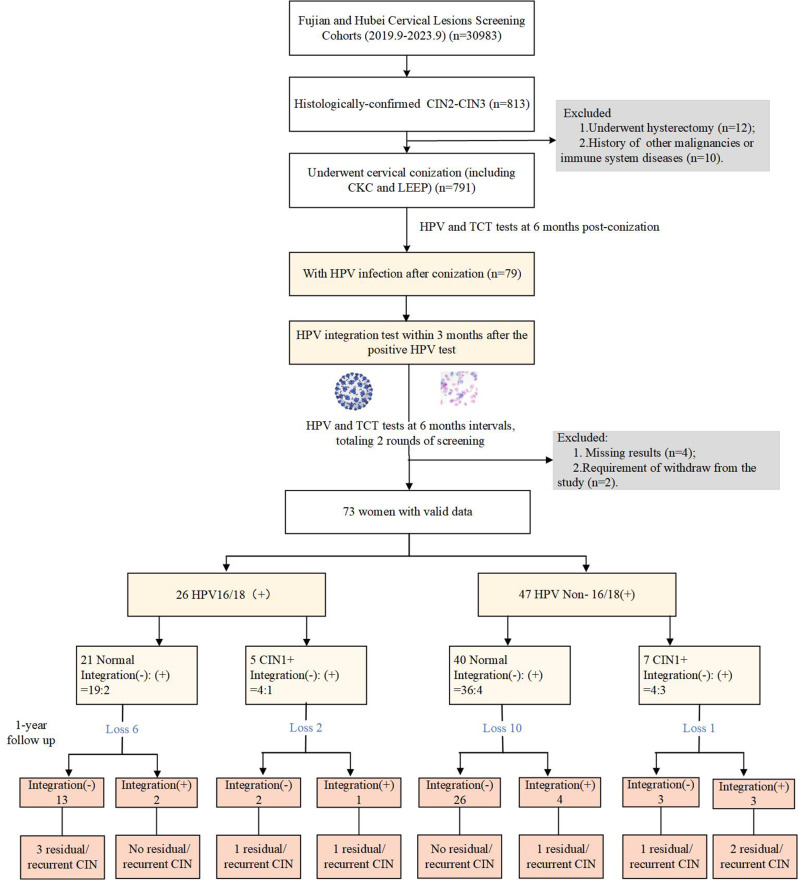
Methods: This retrospective study analyzed data of 791 women who underwent cervical conization for cervical intraepithelial neoplasia grades 2-3 (CIN2-3) between September 2019 and September 2023, sourced from the Fujian and Hubei cervical lesion screening cohorts. Among these, 73 women with HPV infection post-conization underwent HPV integration test within 3 months after a positive HPV test. HPV integration test was performed using the high-throughput viral integration detection (HIVID), a sensitive method for genome-wide survey of HPV integration breakpoints.
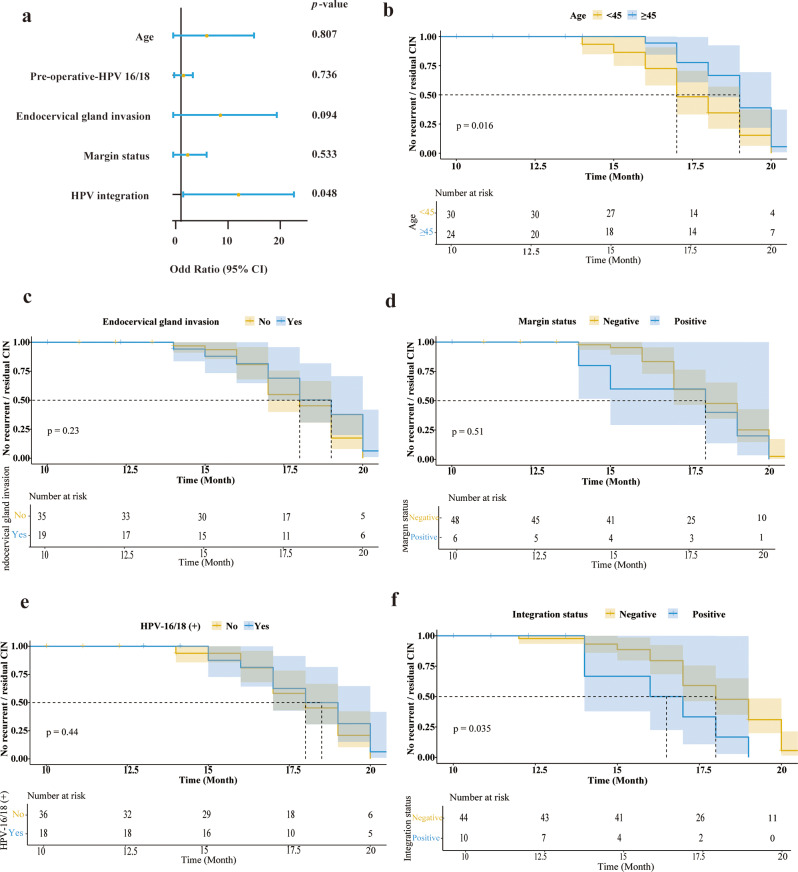
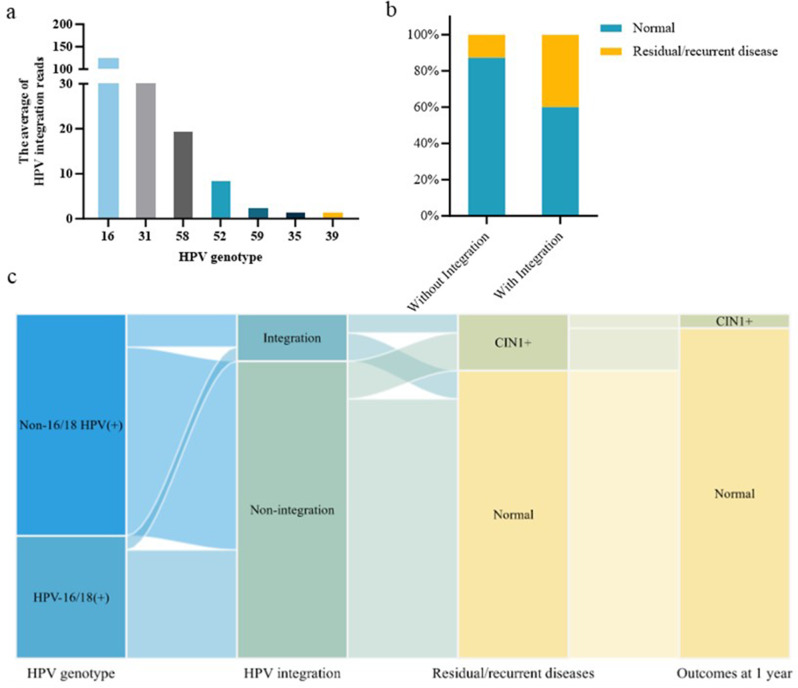
Results: Among the 73 participants with HPV infection post-conization, 10 cases (13.7%) were positive for HPV integration. The logistic regression analysis showed a higher residual/recurrent lesions risk in patients with HPV integration (OR = 3.917, p = 0.048). According to the Kaplan-Meier analysis, age ≥ 45 years (p = 0.016) and HPV integration (p = 0.035) were associated with a higher risk of residual/recurrent CIN at the 1-year follow-up. HPV 52 accounted for the majority of HPV integration genotype (3/10, 30.0%). Surprisingly, HPV 16 had the highest number of HPV average integration sequencing reads (n = 129), followed by HPV 31, 58, 52, 59, 35, and 39. The study also identified 13 HPV breakpoints, including TP63, TLR4, USP10, etc. CONCLUSIONS: HPV integration was identified as an independent risk factor for residual/recurrent CIN in HPV-positive women post-conization. Women with positive HPV integration should pay attention to careful post-treatment follow-up.
期刊介绍:
Infectious Agents and Cancer is an open access, peer-reviewed online journal that encompasses all aspects of basic, clinical, epidemiological and translational research providing an insight into the association between chronic infections and cancer.
The journal welcomes submissions in the pathogen-related cancer areas and other related topics, in particular:
• HPV and anogenital cancers, as well as head and neck cancers;
• EBV and Burkitt lymphoma;
• HCV/HBV and hepatocellular carcinoma as well as lymphoproliferative diseases;
• HHV8 and Kaposi sarcoma;
• HTLV and leukemia;
• Cancers in Low- and Middle-income countries.
The link between infection and cancer has become well established over the past 50 years, and infection-associated cancer contribute up to 16% of cancers in developed countries and 33% in less developed countries.
Preventive vaccines have been developed for only two cancer-causing viruses, highlighting both the opportunity to prevent infection-associated cancers by vaccination and the gaps that remain before vaccines can be developed for other cancer-causing agents. These gaps are due to incomplete understanding of the basic biology, natural history, epidemiology of many of the pathogens that cause cancer, the mechanisms they exploit to cause cancer, and how to interrupt progression to cancer in human populations. Early diagnosis or identification of lesions at high risk of progression represent the current most critical research area of the field supported by recent advances in genomics and proteomics technologies.



 京公网安备 11010802042870号
京ICP备2023020795号-1
京公网安备 11010802042870号
京ICP备2023020795号-1

 分享
分享
 求助内容:
求助内容: 应助结果提醒方式:
 扫码关注我们
