Ivan Gallegos, Vikas Varshney, Josh Kemppainen and Gregory M. Odegard
{"title":"Investigating the structure–property correlations of pyrolyzed phenolic resin as a function of degree of carbonization†","authors":"Ivan Gallegos, Vikas Varshney, Josh Kemppainen and Gregory M. Odegard","doi":"10.1039/D4NA00824C","DOIUrl":null,"url":null,"abstract":"<p >Carbon–carbon (C/C) composites are attractive materials for high-speed flights and terrestrial atmospheric reentry applications due to their insulating thermal properties, thermal resistance, and high strength-to-weight ratio. It is important to understand the evolving structure–property correlations in these materials during pyrolysis, but the extreme laboratory conditions required to produce C/C composites make it difficult to quantify the properties <em>in situ</em>. This work presents an atomistic modeling methodology to pyrolyze a crosslinked phenolic resin network and track the evolving thermomechanical properties of the skeletal matrix during simulated pyrolysis. First, the crosslinked resin is pyrolyzed and the resulting char yield and mass density are verified to match experimental values, establishing the model's powerful predictive capabilities. Young's modulus, yield stress, Poisson's ratio, and thermal conductivity are calculated for the polymerized structure, intermediate pyrolyzed structures, and fully pyrolyzed structure to reveal structure–property correlations, and the evolution of properties are linked to observed structural features. It is determined that reduction in fractional free volume and densification of the resin during pyrolysis contribute significantly to the increase in thermomechanical properties of the skeletal phenolic matrix. A complex interplay of the formation of six-membered carbon rings at the expense of five and seven-membered carbon rings is revealed to affect thermal conductivity. Increased anisotropy was observed in the latter stages of pyrolysis due to the development of aligned aromatic structures. Experimentally validated predictive atomistic models are a key first step to multiscale process modeling of C/C composites to optimize next-generation materials.</p>","PeriodicalId":18806,"journal":{"name":"Nanoscale Advances","volume":" 6","pages":" 1582-1595"},"PeriodicalIF":4.6000,"publicationDate":"2025-01-09","publicationTypes":"Journal Article","fieldsOfStudy":null,"isOpenAccess":false,"openAccessPdf":"https://www.ncbi.nlm.nih.gov/pmc/articles/PMC11770810/pdf/","citationCount":"0","resultStr":null,"platform":"Semanticscholar","paperid":null,"PeriodicalName":"Nanoscale Advances","FirstCategoryId":"88","ListUrlMain":"https://pubs.rsc.org/en/content/articlelanding/2025/na/d4na00824c","RegionNum":3,"RegionCategory":"材料科学","ArticlePicture":[],"TitleCN":null,"AbstractTextCN":null,"PMCID":null,"EPubDate":"","PubModel":"","JCR":"Q2","JCRName":"CHEMISTRY, MULTIDISCIPLINARY","Score":null,"Total":0}
引用次数: 0
Abstract
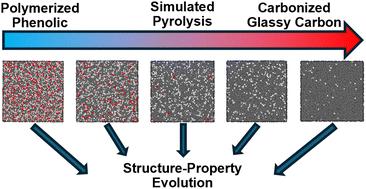
Carbon–carbon (C/C) composites are attractive materials for high-speed flights and terrestrial atmospheric reentry applications due to their insulating thermal properties, thermal resistance, and high strength-to-weight ratio. It is important to understand the evolving structure–property correlations in these materials during pyrolysis, but the extreme laboratory conditions required to produce C/C composites make it difficult to quantify the properties in situ. This work presents an atomistic modeling methodology to pyrolyze a crosslinked phenolic resin network and track the evolving thermomechanical properties of the skeletal matrix during simulated pyrolysis. First, the crosslinked resin is pyrolyzed and the resulting char yield and mass density are verified to match experimental values, establishing the model's powerful predictive capabilities. Young's modulus, yield stress, Poisson's ratio, and thermal conductivity are calculated for the polymerized structure, intermediate pyrolyzed structures, and fully pyrolyzed structure to reveal structure–property correlations, and the evolution of properties are linked to observed structural features. It is determined that reduction in fractional free volume and densification of the resin during pyrolysis contribute significantly to the increase in thermomechanical properties of the skeletal phenolic matrix. A complex interplay of the formation of six-membered carbon rings at the expense of five and seven-membered carbon rings is revealed to affect thermal conductivity. Increased anisotropy was observed in the latter stages of pyrolysis due to the development of aligned aromatic structures. Experimentally validated predictive atomistic models are a key first step to multiscale process modeling of C/C composites to optimize next-generation materials.




 京公网安备 11010802042870号
京ICP备2023020795号-1
京公网安备 11010802042870号
京ICP备2023020795号-1

 分享
分享
 求助内容:
求助内容: 应助结果提醒方式:
 扫码关注我们
