Philipp Mayer, Lotta Hielscher, Philipp Schuster, Michael Schlumberger, Tim Rolvien, Markus Geßlein, Wouter Beel, Jörg Richter
{"title":"Evaluating the Mechanical Axis for Detection of Posterior Tibial Slope Malalignment in ACL-Deficient Knees on Lateral Radiographs.","authors":"Philipp Mayer, Lotta Hielscher, Philipp Schuster, Michael Schlumberger, Tim Rolvien, Markus Geßlein, Wouter Beel, Jörg Richter","doi":"10.1177/23259671241296858","DOIUrl":null,"url":null,"abstract":"<p><strong>Background: </strong>Distal tibial deformities are not assessed using the proximal anatomical axis (PAA) to determine the posterior tibial slope (PTS). Therefore, it seems advantageous to measure PTS on full-length lateral tibial radiographs using the mechanical axis (MA).</p><p><strong>Purposes: </strong>To (1) compare the PTS measurements using the MA and the PAA and (2) determine whether using the PAA fails to detect a certain number of significantly elevated PTS values compared with using the MA.</p><p><strong>Study design: </strong>Cohort study (Diagnosis); Level of evidence, 3.</p><p><strong>Methods: </strong>Full-length lateral tibial radiographs of 218 consecutive cases were reviewed. Radiographs were checked for malrotation. Therefore, the distance between the posterior tibial condyles was measured in millimeters. Patients with a difference of ≥7 mm between the posterior tibial condyles were excluded, leaving 196 cases for the final statistical analysis. The PTS was measured using the MA and the PAA. Differences between these 2 techniques were analyzed. The sensitivity and specificity of the PAA as a screening method for pathological PTS were calculated, with the MA as the standard for comparison. Four subgroups were formed, all with PAA <12° and different lower limits for the MA: group 1, MA ≥10°; group 2, MA ≥10.5°; group 3, MA ≥11°; and group 4, MA ≥11.5°.</p><p><strong>Results: </strong>Radiographs with ≥7 mm between the posterior tibial condyles showed an increased inconsistency between the PTS measurement with the MA and the PAA. In the group with a distance of <7 mm between the posterior tibial condyles (n = 196), the mean PTS measured with the MA was 9.4°± 3.8° (range, 0.4° to 21.9°), and the mean PTS was 10.5°± 3.5° (range, 1.7° to 20.9°) according to the PAA. The mean difference in PTS between the PAA and the MA was 1.1°± 1.2° (range, -2.4° to 4.1°; <i>P</i> < .001). Group 1 had a sensitivity of 73% and specificity of 98%; group 2, sensitivity of 84% and specificity of 97%; group 3, sensitivity of 87% and specificity of 93%; and group 4, sensitivity of 95% and specificity of 89%.</p><p><strong>Conclusion: </strong>Measuring the PTS using the MA was advantageous, as the measurement with the PAA did not correctly identify all cases with sagittal alignment changes. The proportion of patients with pathologically increased PTS not identified with the proximal anatomical measurement, reflected by the sensitivity, depended on the threshold value defined for the MA. Lateral radiographs, showing an increased distance between the posterior tibial condyles, indicated malrotation of the tibia leading to measurement inaccuracy.</p>","PeriodicalId":19646,"journal":{"name":"Orthopaedic Journal of Sports Medicine","volume":"13 1","pages":"23259671241296858"},"PeriodicalIF":2.5000,"publicationDate":"2025-01-27","publicationTypes":"Journal Article","fieldsOfStudy":null,"isOpenAccess":false,"openAccessPdf":"https://www.ncbi.nlm.nih.gov/pmc/articles/PMC11773544/pdf/","citationCount":"0","resultStr":null,"platform":"Semanticscholar","paperid":null,"PeriodicalName":"Orthopaedic Journal of Sports Medicine","FirstCategoryId":"3","ListUrlMain":"https://doi.org/10.1177/23259671241296858","RegionNum":3,"RegionCategory":"医学","ArticlePicture":[],"TitleCN":null,"AbstractTextCN":null,"PMCID":null,"EPubDate":"2025/1/1 0:00:00","PubModel":"eCollection","JCR":"Q2","JCRName":"ORTHOPEDICS","Score":null,"Total":0}
引用次数: 0
Abstract
Background: Distal tibial deformities are not assessed using the proximal anatomical axis (PAA) to determine the posterior tibial slope (PTS). Therefore, it seems advantageous to measure PTS on full-length lateral tibial radiographs using the mechanical axis (MA).
Purposes: To (1) compare the PTS measurements using the MA and the PAA and (2) determine whether using the PAA fails to detect a certain number of significantly elevated PTS values compared with using the MA.
Study design: Cohort study (Diagnosis); Level of evidence, 3.
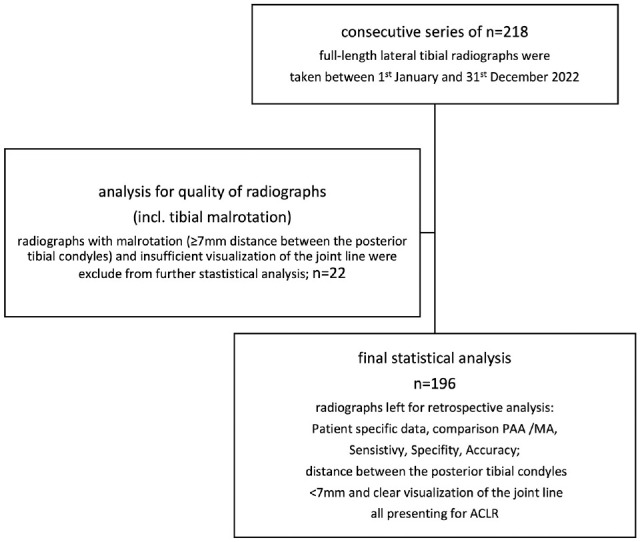
Methods: Full-length lateral tibial radiographs of 218 consecutive cases were reviewed. Radiographs were checked for malrotation. Therefore, the distance between the posterior tibial condyles was measured in millimeters. Patients with a difference of ≥7 mm between the posterior tibial condyles were excluded, leaving 196 cases for the final statistical analysis. The PTS was measured using the MA and the PAA. Differences between these 2 techniques were analyzed. The sensitivity and specificity of the PAA as a screening method for pathological PTS were calculated, with the MA as the standard for comparison. Four subgroups were formed, all with PAA <12° and different lower limits for the MA: group 1, MA ≥10°; group 2, MA ≥10.5°; group 3, MA ≥11°; and group 4, MA ≥11.5°.
Results: Radiographs with ≥7 mm between the posterior tibial condyles showed an increased inconsistency between the PTS measurement with the MA and the PAA. In the group with a distance of <7 mm between the posterior tibial condyles (n = 196), the mean PTS measured with the MA was 9.4°± 3.8° (range, 0.4° to 21.9°), and the mean PTS was 10.5°± 3.5° (range, 1.7° to 20.9°) according to the PAA. The mean difference in PTS between the PAA and the MA was 1.1°± 1.2° (range, -2.4° to 4.1°; P < .001). Group 1 had a sensitivity of 73% and specificity of 98%; group 2, sensitivity of 84% and specificity of 97%; group 3, sensitivity of 87% and specificity of 93%; and group 4, sensitivity of 95% and specificity of 89%.
Conclusion: Measuring the PTS using the MA was advantageous, as the measurement with the PAA did not correctly identify all cases with sagittal alignment changes. The proportion of patients with pathologically increased PTS not identified with the proximal anatomical measurement, reflected by the sensitivity, depended on the threshold value defined for the MA. Lateral radiographs, showing an increased distance between the posterior tibial condyles, indicated malrotation of the tibia leading to measurement inaccuracy.
期刊介绍:
The Orthopaedic Journal of Sports Medicine (OJSM), developed by the American Orthopaedic Society for Sports Medicine (AOSSM), is a global, peer-reviewed, open access journal that combines the interests of researchers and clinical practitioners across orthopaedic sports medicine, arthroscopy, and knee arthroplasty.
Topics include original research in the areas of:
-Orthopaedic Sports Medicine, including surgical and nonsurgical treatment of orthopaedic sports injuries
-Arthroscopic Surgery (Shoulder/Elbow/Wrist/Hip/Knee/Ankle/Foot)
-Relevant translational research
-Sports traumatology/epidemiology
-Knee and shoulder arthroplasty
The OJSM also publishes relevant systematic reviews and meta-analyses.
This journal is a member of the Committee on Publication Ethics (COPE).





 京公网安备 11010802042870号
京ICP备2023020795号-1
京公网安备 11010802042870号
京ICP备2023020795号-1

 分享
分享
 求助内容:
求助内容: 应助结果提醒方式:
 扫码关注我们
