Machine learning prediction of hepatic encephalopathy for long-term survival after transjugular intrahepatic portosystemic shunt in acute variceal bleeding.
{"title":"Machine learning prediction of hepatic encephalopathy for long-term survival after transjugular intrahepatic portosystemic shunt in acute variceal bleeding.","authors":"De-Jia Liu, Li-Xuan Jia, Feng-Xia Zeng, Wei-Xiong Zeng, Geng-Geng Qin, Qi-Feng Peng, Qing Tan, Hui Zeng, Zhong-Yue Ou, Li-Zi Kun, Jian-Bo Zhao, Wei-Guo Chen","doi":"10.3748/wjg.v31.i4.100401","DOIUrl":null,"url":null,"abstract":"<p><strong>Background: </strong>Transjugular intrahepatic portosystemic shunt (TIPS) is an effective intervention for managing complications of portal hypertension, particularly acute variceal bleeding (AVB). While effective in reducing portal pressure and preventing rebleeding, TIPS is associated with a considerable risk of overt hepatic encephalopathy (OHE), a complication that significantly elevates mortality rates.</p><p><strong>Aim: </strong>To develop a machine learning (ML) model to predict OHE occurrence post-TIPS in patients with AVB using a 5-year dataset.</p><p><strong>Methods: </strong>This retrospective single-center study included 218 patients with AVB who underwent TIPS. The dataset was divided into training (70%) and testing (30%) sets. Critical features were identified using embedded methods and recursive feature elimination. Three ML algorithms-random forest, extreme gradient boosting, and logistic regression-were validated <i>via</i> 10-fold cross-validation. SHapley Additive exPlanations analysis was employed to interpret the model's predictions. Survival analysis was conducted using Kaplan-Meier curves and stepwise Cox regression analysis to compare overall survival (OS) between patients with and without OHE.</p><p><strong>Results: </strong>The median OS of the study cohort was 47.83 ± 22.95 months. Among the models evaluated, logistic regression demonstrated the highest performance with an area under the curve (AUC) of 0.825. Key predictors identified were Child-Pugh score, age, and portal vein thrombosis. Kaplan-Meier analysis revealed that patients without OHE had a significantly longer OS (<i>P</i> = 0.005). The 5-year survival rate was 78.4%, with an OHE incidence of 15.1%. Both actual OHE status and predicted OHE value were significant predictors in each Cox model, with model-predicted OHE achieving an AUC of 88.1 in survival prediction.</p><p><strong>Conclusion: </strong>The ML model accurately predicts post-TIPS OHE and outperforms traditional models, supporting its use in improving outcomes in patients with AVB.</p>","PeriodicalId":23778,"journal":{"name":"World Journal of Gastroenterology","volume":"31 4","pages":"100401"},"PeriodicalIF":5.4000,"publicationDate":"2025-01-28","publicationTypes":"Journal Article","fieldsOfStudy":null,"isOpenAccess":false,"openAccessPdf":"https://www.ncbi.nlm.nih.gov/pmc/articles/PMC11718638/pdf/","citationCount":"0","resultStr":null,"platform":"Semanticscholar","paperid":null,"PeriodicalName":"World Journal of Gastroenterology","FirstCategoryId":"3","ListUrlMain":"https://doi.org/10.3748/wjg.v31.i4.100401","RegionNum":3,"RegionCategory":"医学","ArticlePicture":[],"TitleCN":null,"AbstractTextCN":null,"PMCID":null,"EPubDate":"","PubModel":"","JCR":"Q1","JCRName":"GASTROENTEROLOGY & HEPATOLOGY","Score":null,"Total":0}
引用次数: 0
Abstract
Background: Transjugular intrahepatic portosystemic shunt (TIPS) is an effective intervention for managing complications of portal hypertension, particularly acute variceal bleeding (AVB). While effective in reducing portal pressure and preventing rebleeding, TIPS is associated with a considerable risk of overt hepatic encephalopathy (OHE), a complication that significantly elevates mortality rates.
Aim: To develop a machine learning (ML) model to predict OHE occurrence post-TIPS in patients with AVB using a 5-year dataset.
Methods: This retrospective single-center study included 218 patients with AVB who underwent TIPS. The dataset was divided into training (70%) and testing (30%) sets. Critical features were identified using embedded methods and recursive feature elimination. Three ML algorithms-random forest, extreme gradient boosting, and logistic regression-were validated via 10-fold cross-validation. SHapley Additive exPlanations analysis was employed to interpret the model's predictions. Survival analysis was conducted using Kaplan-Meier curves and stepwise Cox regression analysis to compare overall survival (OS) between patients with and without OHE.
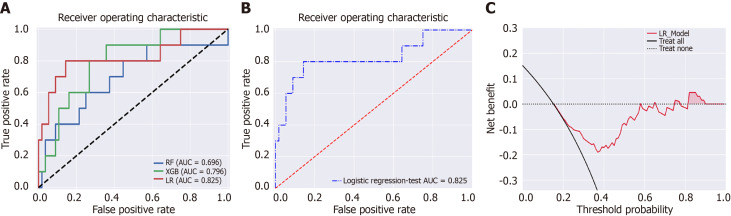
Results: The median OS of the study cohort was 47.83 ± 22.95 months. Among the models evaluated, logistic regression demonstrated the highest performance with an area under the curve (AUC) of 0.825. Key predictors identified were Child-Pugh score, age, and portal vein thrombosis. Kaplan-Meier analysis revealed that patients without OHE had a significantly longer OS (P = 0.005). The 5-year survival rate was 78.4%, with an OHE incidence of 15.1%. Both actual OHE status and predicted OHE value were significant predictors in each Cox model, with model-predicted OHE achieving an AUC of 88.1 in survival prediction.
Conclusion: The ML model accurately predicts post-TIPS OHE and outperforms traditional models, supporting its use in improving outcomes in patients with AVB.
期刊介绍:
The primary aims of the WJG are to improve diagnostic, therapeutic and preventive modalities and the skills of clinicians and to guide clinical practice in gastroenterology and hepatology.





 京公网安备 11010802042870号
京ICP备2023020795号-1
京公网安备 11010802042870号
京ICP备2023020795号-1

 分享
分享
 求助内容:
求助内容: 应助结果提醒方式:
 扫码关注我们
