{"title":"Assessment of retinal pigment epithelium tears in eyes with submacular hemorrhage secondary to age-related macular degeneration.","authors":"Tomoko Ueda-Consolvo, Syogo Takahashi, Toshihiko Oiwake, Tomoko Nakamura, Masaaki Ishida, Shuichiro Yanagisawa, Atsushi Hayashi","doi":"10.1038/s41598-025-88128-8","DOIUrl":null,"url":null,"abstract":"<p><p>To assess retinal pigment epithelium (RPE) tears in eyes which underwent pars plana vitrectomy (PPV) for submacular hemorrhage (SMH) secondary to age-related macular degeneration and to investigate the prognostic factors of visual outcomes. This study was a retrospective, observational case series that included 24 eyes of 24 patients who underwent PPV with subretinal tissue plasminogen activator and air for SMH. RPE tears were investigated using spectral-domain or swept-source optical coherence tomography images with raster scan, combined confocal scanning laser ophthalmoscope near-infrared images and color fundus photographs. Multiple regression analysis was performed to identify the predictors of visual outcome at month 3 and 6 after surgery. In 21 eyes out of 24 eyes (87.5%), RPE tear was detected in the posterior pole. Eight eyes (33.3%) had large RPE tears ( ≧ 1 disc diameter (DD)). Out of the 8 eyes, 5 eyes progressed fibrotic scars within 3 months despite successful SMH removal and showed decrease in their visual acuity (VA). The ratio of eyes with large RPE tears ( ≧ 1DD) were significantly higher in eyes which had undergone anti-VEGF therapy within 3 months than in treatment-naïve eyes (71.4% vs. 25.0%, p = 0.048). The multiple regression analysis revealed that a small RPE tear (< 1DD) and treatment-naïve condition were associated with better VA at month 3 and 6. SMH within 3 months after anti-VEGF therapy might be accompanied by a large RPE tear. An RPE tear which was smaller than 1DD and treatment-naïve condition were associated with better prognosis.</p>","PeriodicalId":21811,"journal":{"name":"Scientific Reports","volume":"15 1","pages":"3606"},"PeriodicalIF":3.9000,"publicationDate":"2025-01-29","publicationTypes":"Journal Article","fieldsOfStudy":null,"isOpenAccess":false,"openAccessPdf":"https://www.ncbi.nlm.nih.gov/pmc/articles/PMC11775338/pdf/","citationCount":"0","resultStr":null,"platform":"Semanticscholar","paperid":null,"PeriodicalName":"Scientific Reports","FirstCategoryId":"103","ListUrlMain":"https://doi.org/10.1038/s41598-025-88128-8","RegionNum":2,"RegionCategory":"综合性期刊","ArticlePicture":[],"TitleCN":null,"AbstractTextCN":null,"PMCID":null,"EPubDate":"","PubModel":"","JCR":"Q1","JCRName":"MULTIDISCIPLINARY SCIENCES","Score":null,"Total":0}
引用次数: 0
Abstract
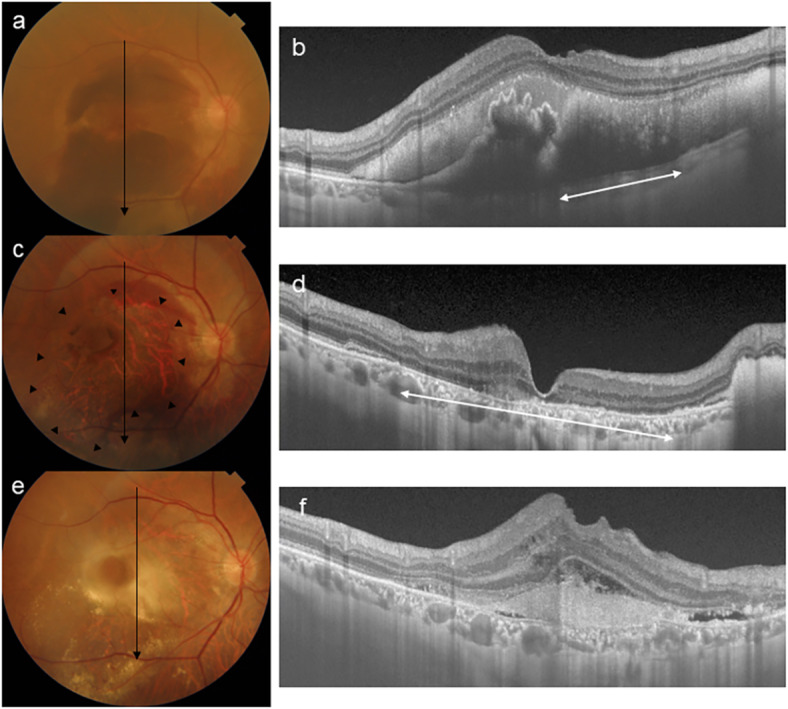
To assess retinal pigment epithelium (RPE) tears in eyes which underwent pars plana vitrectomy (PPV) for submacular hemorrhage (SMH) secondary to age-related macular degeneration and to investigate the prognostic factors of visual outcomes. This study was a retrospective, observational case series that included 24 eyes of 24 patients who underwent PPV with subretinal tissue plasminogen activator and air for SMH. RPE tears were investigated using spectral-domain or swept-source optical coherence tomography images with raster scan, combined confocal scanning laser ophthalmoscope near-infrared images and color fundus photographs. Multiple regression analysis was performed to identify the predictors of visual outcome at month 3 and 6 after surgery. In 21 eyes out of 24 eyes (87.5%), RPE tear was detected in the posterior pole. Eight eyes (33.3%) had large RPE tears ( ≧ 1 disc diameter (DD)). Out of the 8 eyes, 5 eyes progressed fibrotic scars within 3 months despite successful SMH removal and showed decrease in their visual acuity (VA). The ratio of eyes with large RPE tears ( ≧ 1DD) were significantly higher in eyes which had undergone anti-VEGF therapy within 3 months than in treatment-naïve eyes (71.4% vs. 25.0%, p = 0.048). The multiple regression analysis revealed that a small RPE tear (< 1DD) and treatment-naïve condition were associated with better VA at month 3 and 6. SMH within 3 months after anti-VEGF therapy might be accompanied by a large RPE tear. An RPE tear which was smaller than 1DD and treatment-naïve condition were associated with better prognosis.
目的评估黄斑变性继发黄斑下出血(SMH)患者行玻璃体切除术(PPV)后视网膜色素上皮(RPE)泪液的变化,并探讨影响视力的预后因素。这项研究是一个回顾性的观察性病例系列,包括24例患者的24只眼睛,他们接受了视网膜下组织纤溶酶原激活剂和空气治疗SMH的PPV。使用光谱域或扫描源光学相干断层扫描图像与光栅扫描,联合共聚焦扫描激光检眼镜近红外图像和彩色眼底照片研究RPE泪液。采用多元回归分析确定术后第3个月和第6个月视力预后的预测因素。24眼中有21眼(87.5%)在后极发现RPE撕裂。8眼(33.3%)RPE大撕裂(≥1椎间盘直径)。8只眼中,5只眼在成功摘除SMH后3个月内出现纤维化瘢痕,视力下降。3个月内接受抗vegf治疗的眼睛RPE泪≥1DD的比例明显高于treatment-naïve组(71.4% vs. 25.0%, p = 0.048)。多元回归分析显示,小的RPE撕裂(
期刊介绍:
We publish original research from all areas of the natural sciences, psychology, medicine and engineering. You can learn more about what we publish by browsing our specific scientific subject areas below or explore Scientific Reports by browsing all articles and collections.
Scientific Reports has a 2-year impact factor: 4.380 (2021), and is the 6th most-cited journal in the world, with more than 540,000 citations in 2020 (Clarivate Analytics, 2021).
•Engineering
Engineering covers all aspects of engineering, technology, and applied science. It plays a crucial role in the development of technologies to address some of the world''s biggest challenges, helping to save lives and improve the way we live.
•Physical sciences
Physical sciences are those academic disciplines that aim to uncover the underlying laws of nature — often written in the language of mathematics. It is a collective term for areas of study including astronomy, chemistry, materials science and physics.
•Earth and environmental sciences
Earth and environmental sciences cover all aspects of Earth and planetary science and broadly encompass solid Earth processes, surface and atmospheric dynamics, Earth system history, climate and climate change, marine and freshwater systems, and ecology. It also considers the interactions between humans and these systems.
•Biological sciences
Biological sciences encompass all the divisions of natural sciences examining various aspects of vital processes. The concept includes anatomy, physiology, cell biology, biochemistry and biophysics, and covers all organisms from microorganisms, animals to plants.
•Health sciences
The health sciences study health, disease and healthcare. This field of study aims to develop knowledge, interventions and technology for use in healthcare to improve the treatment of patients.





 京公网安备 11010802042870号
京ICP备2023020795号-1
京公网安备 11010802042870号
京ICP备2023020795号-1

 分享
分享
 求助内容:
求助内容: 应助结果提醒方式:
 扫码关注我们
