{"title":"(South-)West to (North-)East Directional Movement of Respiratory Virus Activity in Europe: A Spatial-Temporal Cross-Sectional Study","authors":"Karin Ebert, Therese Janzén, Patrik Dinnétz","doi":"10.1002/hsr2.70400","DOIUrl":null,"url":null,"abstract":"<p>Respiratory virus infections comprise a serious global health problem [<span>1</span>]. For efficient and effective disease control, monitoring of local outbreaks needs to be supported by knowledge of regional distribution patterns. Spatial mapping can be a useful tool for increased understanding of the development of respiratory virus distribution during seasonal epidemics and pandemics.</p><p>Earlier studies suggest a west to east directional continental spread in Europe for seasonal influenza during two seasons [<span>2, 3</span>], and a general west to east and south to north spread of Respiratory Syncytial Virus during a time span of 15 years between 1999 and 2014 [<span>4</span>]. The aim of this study is to map the spatiotemporal patterns of seasonal influenza during a 10-year period, and the emerging severe acute respiratory syndrome coronavirus 2 (SARS-CoV-2) virus and associated coronavirus disease 2019 (COVID-19) pattern, and to examine if outbreak waves of these viruses display a southwest to northwest directional movement, across 18 European countries.</p><p>We analyzed the distribution patterns for seasonal influenza and COVID-19 in Ireland, France, Germany, Portugal, Poland, UK, Belgium, Norway, Sweden, Netherlands, Switzerland, Austria, Spain, Italy, Finland, Luxembourg, Denmark, and Czechia; 18 European countries covering the distance of approximately 3000 km west–east, and 4000 km south–north [<span>5</span>]. For both influenza and Sars-CoV-2 virus we identified waves of different outbreaks and the dates for the incidence peaks for each country.</p><p>Outbreak peak data for influenza from 2010 to 2020 was derived from FLUNET [<span>6</span>]. We compiled to total number for influenza type A and B. For each country we calculated the median outbreak peak of seasonal influenza waves for the 10-year study period. Countries were then ranked from first to latest outbreak peak.</p><p>Data for peaks of outbreak waves within different SARS-Cov-2 virus variants were retrieved from the COVID-19 section in “our world in data” [<span>7</span>]. From Januari 2021 to April 2022, the weekly percentage share of each virus variant in each country was displayed graphically, and dates for each virus variant of each country were grouped to identify emerging SARS-CoV-2 variants as distributional waves in Europe. The outbreak peak dates for each country for each identified SARS-CoV-2 variant wave were used to rank the included countries in the same way as for the seasonal influenza outbreaks.</p><p>To analyze if the distribution patterns of seasonal influenza and COVID-19 follow a west-east and south-north distribution pattern we used GIS (ArcGIS 3.0) and calculated each country's centroid position for both longitude and latitude. Using principal component analyses we projected each country's position on PC1 representing their relative position along the diagonal from southwest to northeast. The spatiotemporal correlation between the position on the southwest to northeast axis and the relative time for the disease peak was analyzed with the Spearman rank correlation test. All statistical tests were performed in R 4.02 [<span>8</span>].</p><p>We found a significant positive correlation (<i>ρ</i> = 0.57, <i>p</i> = 0.01, Spearman rank correlation) between the median peak of the yearly seasonal influenza from 2010 to 2020 and the 18 European countries' geographical positions from southwest to northeast (Figure 1).</p><p>The development of new SARS-CoV-2 virus variants occurred comparatively parallel in all 18 countries (Supporting Information: S1), with small differences in timing (days or weeks). We found that all COVID-19 infection peaks were associated with the dominance of a certain SARS-CoV-2 variant (Supporting Information: S1).</p><p>The movement patterns of the outbreak waves within different SARS-CoV-2 variants were not uniform. The Spearman rank correlation did not show a significant directional movement from southwest to northeast for Alpha (<i>p</i> = 0.53), Delta (<i>p</i> = 0.17), and Omicron BA.1 (<i>p</i> = 0.24). A west to east observational trend appears for Delta and BA.1, where the earliest peaks occurred in the westernmost countries (Portugal, Spain, Ireland, and UK), and later peaks further east, with exception for Finland, that stands out as an early-peak outlier (Figure 2a,b). Omicron BA.2 shows a significant (<i>ρ</i> = −0.70, <i>p</i> = 0.001, Spearman rank correlation) inverse directional movement from northwest to southeast (Figure 2c). And lastly, Omicron BA.5 shows a significant positive (<i>ρ</i> = 0.71, <i>p</i> < 0.001, Spearman rank correlation) southwest to northeast movement (Figure 2d).</p><p>If a variant persisted over many months, like the Delta wave (Supporting Information: S1), two subsequent peaks could develop in the same country. Norway, Germany, Switzerland, Austria, the Netherlands and the UK had two Delta waves. Belgium, Czechia and Poland did not have an early Delta wave but only a late one.</p><p>In this study we show that it is possible to see regional movement patterns of respiratory virus infections. We can also see that the movements are not uniform and that we need to develop our simple linear hypothesis for distributional directions. To increase our understanding of movement patterns of respiratory viral infections, higher spatial resolution, using smaller aerial entities, like states, counties or municipalities will be necessary [<span>9</span>]. The use of entire countries, with relatively large spatial extensions in different directions, and the average peak for the entire country, is not precise enough for studying diseases with rapid geographical spread.</p><p>Possible reasons for the (south-)west to (north-)east movement are unknown; a west–east direction of respiratory virus spread has been described previously [<span>2-4</span>], but reasons barely discussed. A related west–east (coast to inland) static trend for COVID-19 was presented for five European countries by [<span>9</span>], who found a statistical connection between low continentality (oceanic influence) at the European west coast and lower COVID-19 incidence in the west-wind zone of Europe, with predominantly westerly, but changing wind directions. A similar observation was made previously for France [<span>10</span>].</p><p>Our study confirms a significant trend for south-west to north-east directional movement for Influenza and for COVID-19 variant Omicron BA.5. For the other studied SARS-CoV-2 variants the peaks of outbreak waves start predominantly in the westernmost countries, apart from Omicron BA.2, that shows an inverse movement direction. Overall, a (south)west to (north) east directional movement trend for respiratory virus activity in Europe is dominating, but refined studies controlling for possible confounders like vaccination coverage and socioeconomic development are needed to understand the causal mechanisms behind global and regional distribution of respiratory viral infections.</p><p><b>Karin Ebert:</b> conceptualization, methodology, software, data curation, investigation, validation, formal analysis, visualization, writing–original draft, writing–review and editing. <b>Therese Janzén:</b> methodology, software, formal analysis, writing–review and editing, validation, data curation. <b>Patrik Dinnétz:</b> methodology, software, validation, formal analysis, writing–review and editing.</p><p>The authors declare no conflicts of interest.</p><p>The lead author Karin Ebert affirms that this manuscript is an honest, accurate, and transparent account of the study being reported; that no important aspects of the study have been omitted; and that any discrepancies from the study as planned (and, if relevant, registered) have been explained.</p>","PeriodicalId":36518,"journal":{"name":"Health Science Reports","volume":"8 1","pages":""},"PeriodicalIF":2.1000,"publicationDate":"2025-01-27","publicationTypes":"Journal Article","fieldsOfStudy":null,"isOpenAccess":false,"openAccessPdf":"https://www.ncbi.nlm.nih.gov/pmc/articles/PMC11773155/pdf/","citationCount":"0","resultStr":null,"platform":"Semanticscholar","paperid":null,"PeriodicalName":"Health Science Reports","FirstCategoryId":"1085","ListUrlMain":"https://onlinelibrary.wiley.com/doi/10.1002/hsr2.70400","RegionNum":0,"RegionCategory":null,"ArticlePicture":[],"TitleCN":null,"AbstractTextCN":null,"PMCID":null,"EPubDate":"","PubModel":"","JCR":"Q2","JCRName":"MEDICINE, GENERAL & INTERNAL","Score":null,"Total":0}
引用次数: 0
Abstract
Respiratory virus infections comprise a serious global health problem [1]. For efficient and effective disease control, monitoring of local outbreaks needs to be supported by knowledge of regional distribution patterns. Spatial mapping can be a useful tool for increased understanding of the development of respiratory virus distribution during seasonal epidemics and pandemics.
Earlier studies suggest a west to east directional continental spread in Europe for seasonal influenza during two seasons [2, 3], and a general west to east and south to north spread of Respiratory Syncytial Virus during a time span of 15 years between 1999 and 2014 [4]. The aim of this study is to map the spatiotemporal patterns of seasonal influenza during a 10-year period, and the emerging severe acute respiratory syndrome coronavirus 2 (SARS-CoV-2) virus and associated coronavirus disease 2019 (COVID-19) pattern, and to examine if outbreak waves of these viruses display a southwest to northwest directional movement, across 18 European countries.
We analyzed the distribution patterns for seasonal influenza and COVID-19 in Ireland, France, Germany, Portugal, Poland, UK, Belgium, Norway, Sweden, Netherlands, Switzerland, Austria, Spain, Italy, Finland, Luxembourg, Denmark, and Czechia; 18 European countries covering the distance of approximately 3000 km west–east, and 4000 km south–north [5]. For both influenza and Sars-CoV-2 virus we identified waves of different outbreaks and the dates for the incidence peaks for each country.
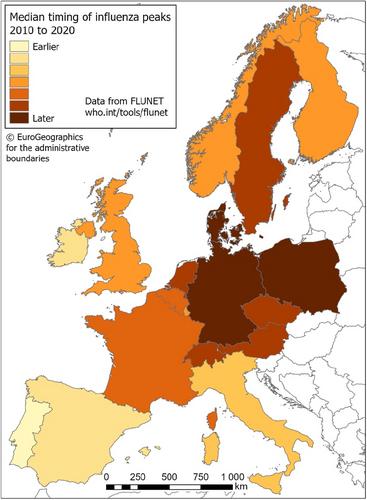
Outbreak peak data for influenza from 2010 to 2020 was derived from FLUNET [6]. We compiled to total number for influenza type A and B. For each country we calculated the median outbreak peak of seasonal influenza waves for the 10-year study period. Countries were then ranked from first to latest outbreak peak.
Data for peaks of outbreak waves within different SARS-Cov-2 virus variants were retrieved from the COVID-19 section in “our world in data” [7]. From Januari 2021 to April 2022, the weekly percentage share of each virus variant in each country was displayed graphically, and dates for each virus variant of each country were grouped to identify emerging SARS-CoV-2 variants as distributional waves in Europe. The outbreak peak dates for each country for each identified SARS-CoV-2 variant wave were used to rank the included countries in the same way as for the seasonal influenza outbreaks.
To analyze if the distribution patterns of seasonal influenza and COVID-19 follow a west-east and south-north distribution pattern we used GIS (ArcGIS 3.0) and calculated each country's centroid position for both longitude and latitude. Using principal component analyses we projected each country's position on PC1 representing their relative position along the diagonal from southwest to northeast. The spatiotemporal correlation between the position on the southwest to northeast axis and the relative time for the disease peak was analyzed with the Spearman rank correlation test. All statistical tests were performed in R 4.02 [8].
We found a significant positive correlation (ρ = 0.57, p = 0.01, Spearman rank correlation) between the median peak of the yearly seasonal influenza from 2010 to 2020 and the 18 European countries' geographical positions from southwest to northeast (Figure 1).
The development of new SARS-CoV-2 virus variants occurred comparatively parallel in all 18 countries (Supporting Information: S1), with small differences in timing (days or weeks). We found that all COVID-19 infection peaks were associated with the dominance of a certain SARS-CoV-2 variant (Supporting Information: S1).
The movement patterns of the outbreak waves within different SARS-CoV-2 variants were not uniform. The Spearman rank correlation did not show a significant directional movement from southwest to northeast for Alpha (p = 0.53), Delta (p = 0.17), and Omicron BA.1 (p = 0.24). A west to east observational trend appears for Delta and BA.1, where the earliest peaks occurred in the westernmost countries (Portugal, Spain, Ireland, and UK), and later peaks further east, with exception for Finland, that stands out as an early-peak outlier (Figure 2a,b). Omicron BA.2 shows a significant (ρ = −0.70, p = 0.001, Spearman rank correlation) inverse directional movement from northwest to southeast (Figure 2c). And lastly, Omicron BA.5 shows a significant positive (ρ = 0.71, p < 0.001, Spearman rank correlation) southwest to northeast movement (Figure 2d).
If a variant persisted over many months, like the Delta wave (Supporting Information: S1), two subsequent peaks could develop in the same country. Norway, Germany, Switzerland, Austria, the Netherlands and the UK had two Delta waves. Belgium, Czechia and Poland did not have an early Delta wave but only a late one.
In this study we show that it is possible to see regional movement patterns of respiratory virus infections. We can also see that the movements are not uniform and that we need to develop our simple linear hypothesis for distributional directions. To increase our understanding of movement patterns of respiratory viral infections, higher spatial resolution, using smaller aerial entities, like states, counties or municipalities will be necessary [9]. The use of entire countries, with relatively large spatial extensions in different directions, and the average peak for the entire country, is not precise enough for studying diseases with rapid geographical spread.
Possible reasons for the (south-)west to (north-)east movement are unknown; a west–east direction of respiratory virus spread has been described previously [2-4], but reasons barely discussed. A related west–east (coast to inland) static trend for COVID-19 was presented for five European countries by [9], who found a statistical connection between low continentality (oceanic influence) at the European west coast and lower COVID-19 incidence in the west-wind zone of Europe, with predominantly westerly, but changing wind directions. A similar observation was made previously for France [10].
Our study confirms a significant trend for south-west to north-east directional movement for Influenza and for COVID-19 variant Omicron BA.5. For the other studied SARS-CoV-2 variants the peaks of outbreak waves start predominantly in the westernmost countries, apart from Omicron BA.2, that shows an inverse movement direction. Overall, a (south)west to (north) east directional movement trend for respiratory virus activity in Europe is dominating, but refined studies controlling for possible confounders like vaccination coverage and socioeconomic development are needed to understand the causal mechanisms behind global and regional distribution of respiratory viral infections.
Karin Ebert: conceptualization, methodology, software, data curation, investigation, validation, formal analysis, visualization, writing–original draft, writing–review and editing. Therese Janzén: methodology, software, formal analysis, writing–review and editing, validation, data curation. Patrik Dinnétz: methodology, software, validation, formal analysis, writing–review and editing.
The authors declare no conflicts of interest.
The lead author Karin Ebert affirms that this manuscript is an honest, accurate, and transparent account of the study being reported; that no important aspects of the study have been omitted; and that any discrepancies from the study as planned (and, if relevant, registered) have been explained.





 京公网安备 11010802042870号
京ICP备2023020795号-1
京公网安备 11010802042870号
京ICP备2023020795号-1

 分享
分享
 求助内容:
求助内容: 应助结果提醒方式:
 扫码关注我们
