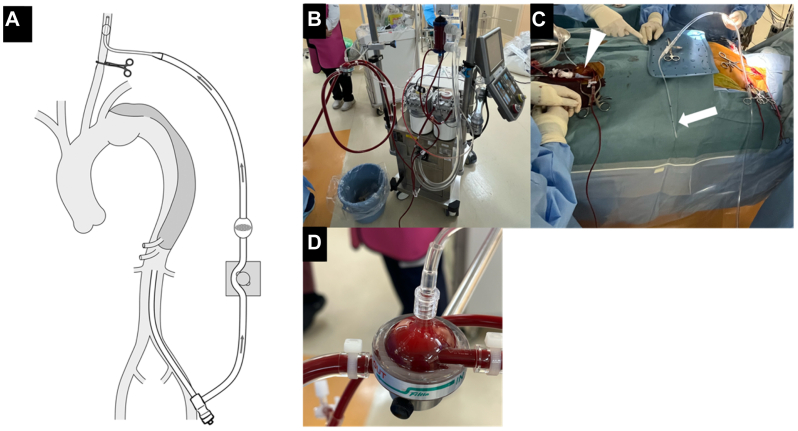
{"title":"Selective cerebral perfusion for reduced cerebral blood flow during debranching thoracic endovascular aortic repair","authors":"Satoshi Sakakibara MD, Takashi Yamauchi MD, PhD","doi":"10.1016/j.jvscit.2024.101707","DOIUrl":null,"url":null,"abstract":"<div><div>A 69-year-old man with chest pain was diagnosed with acute type B aortic dissection with the entry tear located at distal arch and a distal aortic arch aneurysm. Therefore, we performed debranching thoracic endovascular aortic repair 2 weeks after type B aortic dissection onset. First, the graft was anastomosed to bilateral axillary arteries. After clamping the left common carotid artery (LCCA), the regional cerebral oxygen saturation decreased notably. Therefore, we used selective cerebral perfusion using a roller pump with a filter to prevent embolization, a 24F sheath inserted into the left common femoral artery (drainage cannula), and a balloon perfusion catheter inserted into the LCCA (arterial cannula). This technique improved the rSO<sub>2</sub> and was continued during anastomosis of the graft to the LCCA. Thoracic endovascular aortic repair was performed after debranching from the right axillary artery to the LCCA and left axillary artery. The patient was discharged 7 days postoperatively without cerebral complications.</div></div>","PeriodicalId":45071,"journal":{"name":"Journal of Vascular Surgery Cases Innovations and Techniques","volume":"11 2","pages":"Article 101707"},"PeriodicalIF":0.7000,"publicationDate":"2025-04-01","publicationTypes":"Journal Article","fieldsOfStudy":null,"isOpenAccess":false,"openAccessPdf":"https://www.ncbi.nlm.nih.gov/pmc/articles/PMC11772940/pdf/","citationCount":"0","resultStr":null,"platform":"Semanticscholar","paperid":null,"PeriodicalName":"Journal of Vascular Surgery Cases Innovations and Techniques","FirstCategoryId":"1085","ListUrlMain":"https://www.sciencedirect.com/science/article/pii/S2468428724002910","RegionNum":0,"RegionCategory":null,"ArticlePicture":[],"TitleCN":null,"AbstractTextCN":null,"PMCID":null,"EPubDate":"2024/12/17 0:00:00","PubModel":"Epub","JCR":"Q4","JCRName":"SURGERY","Score":null,"Total":0}
引用次数: 0
Abstract
A 69-year-old man with chest pain was diagnosed with acute type B aortic dissection with the entry tear located at distal arch and a distal aortic arch aneurysm. Therefore, we performed debranching thoracic endovascular aortic repair 2 weeks after type B aortic dissection onset. First, the graft was anastomosed to bilateral axillary arteries. After clamping the left common carotid artery (LCCA), the regional cerebral oxygen saturation decreased notably. Therefore, we used selective cerebral perfusion using a roller pump with a filter to prevent embolization, a 24F sheath inserted into the left common femoral artery (drainage cannula), and a balloon perfusion catheter inserted into the LCCA (arterial cannula). This technique improved the rSO2 and was continued during anastomosis of the graft to the LCCA. Thoracic endovascular aortic repair was performed after debranching from the right axillary artery to the LCCA and left axillary artery. The patient was discharged 7 days postoperatively without cerebral complications.
期刊介绍:
Journal of Vascular Surgery Cases and Innovative Techniques is a surgical journal dedicated to publishing peer review high quality case reports, vascular images and innovative techniques related to all aspects of arterial, venous, and lymphatic diseases and disorders, including vascular trauma, malformations, wound care and the placement and maintenance of arterio-venous dialysis accesses with an emphasis on the practicing clinician. The Journal seeks to provide novel and timely information to vascular surgeons, interventionalists, phlebologists, wound care specialists, and allied health professionals involved with the management of patients with the entire spectrum of vascular disorders.





 京公网安备 11010802042870号
京ICP备2023020795号-1
京公网安备 11010802042870号
京ICP备2023020795号-1

 分享
分享

 求助内容:
求助内容: 应助结果提醒方式:
 扫码关注我们
