Helene Sieberer, Michela Luciano, Diana Amend, Constantin Blöchl, Anna Eglseer, Alina Steinkellner, Sebastian Rieser, Ancuela Andosch, Philip Steiner, Laura Hummer, Peter W Krenn, Hieu-Hoa Dang, Christian G Huber, Fritz Aberger, Theresa Neuper, Jutta Horejs-Hoeck
{"title":"Inhibition of NLRP3 enhances pro-apoptotic effects of FLT3 inhibition in AML.","authors":"Helene Sieberer, Michela Luciano, Diana Amend, Constantin Blöchl, Anna Eglseer, Alina Steinkellner, Sebastian Rieser, Ancuela Andosch, Philip Steiner, Laura Hummer, Peter W Krenn, Hieu-Hoa Dang, Christian G Huber, Fritz Aberger, Theresa Neuper, Jutta Horejs-Hoeck","doi":"10.1186/s12964-025-02046-w","DOIUrl":null,"url":null,"abstract":"<p><p>FLT3 mutations occur in approximately 25% of all acute myeloid leukemia (AML) patients. While several FLT3 inhibitors have received FDA approval, their use is currently limited to combination therapies with chemotherapy, as resistance occurs, and efficacy decreases when the inhibitors are used alone. Given the highly heterogeneous nature of AML, there is an urgent need for novel targeted therapies that address the disease from multiple angles. Recent research has identified the NLRP3 inflammasome as a potential new driver in AML. Here, we investigated the efficacy of different NLRP3 inhibitors in targeting AML cells in vitro. Our findings reveal that NLRP3 inhibition induces cell cycle arrest as well as signs of senescence in multiple AML cell lines. In contrast, NLRP3 inhibition selectively induced apoptosis in FLT3 mutant AML cell lines, but not in FLT3 wild-type AML cells. Moreover, we show that NLRP3 inhibition impairs FLT3 signaling by reducing both FLT3 expression as well as downstream signaling in FLT3 mutant cells. A database analysis revealed a strong positive correlation between FLT3 and NLRP3 in cancer, which was particularly evident in AML patients. Strikingly, the simultaneous inhibition of NLRP3 and FLT3 markedly enhanced apoptosis in FLT3-ITD mutant AML cells, but not in FLT3 wild-type cells. In summary, this study reveals a promising combined therapeutic strategy specifically targeting NLRP3/FLT3-ITD positive AML blasts in vitro, highlighting a potential new avenue for AML treatment.</p>","PeriodicalId":55268,"journal":{"name":"Cell Communication and Signaling","volume":"23 1","pages":"53"},"PeriodicalIF":8.2000,"publicationDate":"2025-01-28","publicationTypes":"Journal Article","fieldsOfStudy":null,"isOpenAccess":false,"openAccessPdf":"https://www.ncbi.nlm.nih.gov/pmc/articles/PMC11773904/pdf/","citationCount":"0","resultStr":null,"platform":"Semanticscholar","paperid":null,"PeriodicalName":"Cell Communication and Signaling","FirstCategoryId":"99","ListUrlMain":"https://doi.org/10.1186/s12964-025-02046-w","RegionNum":2,"RegionCategory":"生物学","ArticlePicture":[],"TitleCN":null,"AbstractTextCN":null,"PMCID":null,"EPubDate":"","PubModel":"","JCR":"Q1","JCRName":"CELL BIOLOGY","Score":null,"Total":0}
引用次数: 0
Abstract
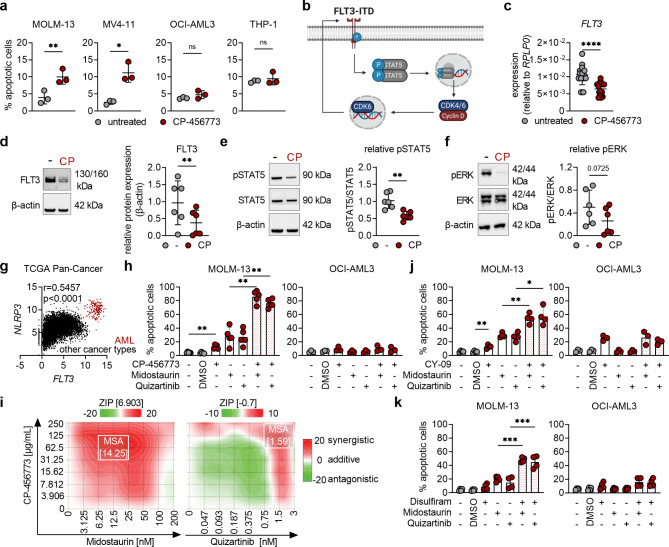
FLT3 mutations occur in approximately 25% of all acute myeloid leukemia (AML) patients. While several FLT3 inhibitors have received FDA approval, their use is currently limited to combination therapies with chemotherapy, as resistance occurs, and efficacy decreases when the inhibitors are used alone. Given the highly heterogeneous nature of AML, there is an urgent need for novel targeted therapies that address the disease from multiple angles. Recent research has identified the NLRP3 inflammasome as a potential new driver in AML. Here, we investigated the efficacy of different NLRP3 inhibitors in targeting AML cells in vitro. Our findings reveal that NLRP3 inhibition induces cell cycle arrest as well as signs of senescence in multiple AML cell lines. In contrast, NLRP3 inhibition selectively induced apoptosis in FLT3 mutant AML cell lines, but not in FLT3 wild-type AML cells. Moreover, we show that NLRP3 inhibition impairs FLT3 signaling by reducing both FLT3 expression as well as downstream signaling in FLT3 mutant cells. A database analysis revealed a strong positive correlation between FLT3 and NLRP3 in cancer, which was particularly evident in AML patients. Strikingly, the simultaneous inhibition of NLRP3 and FLT3 markedly enhanced apoptosis in FLT3-ITD mutant AML cells, but not in FLT3 wild-type cells. In summary, this study reveals a promising combined therapeutic strategy specifically targeting NLRP3/FLT3-ITD positive AML blasts in vitro, highlighting a potential new avenue for AML treatment.
期刊介绍:
Cell Communication and Signaling (CCS) is a peer-reviewed, open-access scientific journal that focuses on cellular signaling pathways in both normal and pathological conditions. It publishes original research, reviews, and commentaries, welcoming studies that utilize molecular, morphological, biochemical, structural, and cell biology approaches. CCS also encourages interdisciplinary work and innovative models, including in silico, in vitro, and in vivo approaches, to facilitate investigations of cell signaling pathways, networks, and behavior.
Starting from January 2019, CCS is proud to announce its affiliation with the International Cell Death Society. The journal now encourages submissions covering all aspects of cell death, including apoptotic and non-apoptotic mechanisms, cell death in model systems, autophagy, clearance of dying cells, and the immunological and pathological consequences of dying cells in the tissue microenvironment.




 京公网安备 11010802042870号
京ICP备2023020795号-1
京公网安备 11010802042870号
京ICP备2023020795号-1

 分享
分享
 求助内容:
求助内容: 应助结果提醒方式:
 扫码关注我们
