{"title":"Knee phenotypes distribution according to CPAK classification in Turkish population.","authors":"Vahit Emre Özden, Göksel Dikmen, Kayahan Karaytuğ, Arda Mavi, Yılmaz Onat Köylüoğlu, İsmail Remzi Tözün","doi":"10.5152/j.aott.2024.24053","DOIUrl":null,"url":null,"abstract":"<p><strong>Objective: </strong>This study aimed to investigate the distribution of knee phenotypes based on the CPAK classification in healthy nonarthritic subjects and osteoarthritic patients in Türkiye.</p><p><strong>Methods: </strong>Radiological EOS analysis of nonarthritic 1172 knees and osteoarthritic 571 knees was evaluated to clarify the distribution of CPAK classification. The knees were categorized into 9 subgroups according to the arithmetic hip-knee-ankle (aHKA) angle and joint-line obliquity (JLO). The medial proximal tibial angle (MPTA) and lateral distal femoral angle (LDFA) were used to calculate aHKA and JLO. The Sectra workstation program was used for all radiological measurements.</p><p><strong>Results: </strong>In the nonarthritic group, CPAK distribution was 20.9% type I (n=245), 2.5% type II (n=30), 0.08% type III (n=1), 46.67% type IV (n=545), 7.7% type V (n=91), 0.7% type VI (n=9), 18% type VII (n=211), 2.9% type VIII (n=35), 0.2% type IX (n=3). The mean JLO was 173.7 ± 4.38, and the mean aHKA was 0.15 ± 3.81 in nonarthritic group. Arthritic group CPAK type distribution was 20.7% type I (n=118), 3.1% type II (n=18), 0.17% type III (n=1), 57.1% type IV (n=326), 8.4% type V (n=48), 0.17% type VI (n=1), 7.8% type VII (n=45), 1.4% type VIII (n=8), and 0.8% type IX (n=5). The mean JLO was 174.2 ± 3.78, and the mean aHKA was !2.21 ± 4.48 in the osteoarthritic group.</p><p><strong>Conclusion: </strong>CPAK type IV and CPAK type I were the most common subgroups in the nonarthritic and arthritic groups. CPAK type 5, which is the target of the mechanical alignment strategy, is only 7.8% in the nonarthritic group and 8.4% in the osteoarthritic group in the Turkish population.</p><p><strong>Level of evidence: </strong>Level III, Diagnostic Study.</p>","PeriodicalId":93854,"journal":{"name":"Acta orthopaedica et traumatologica turcica","volume":"58 6","pages":"341-345"},"PeriodicalIF":1.0000,"publicationDate":"2024-12-31","publicationTypes":"Journal Article","fieldsOfStudy":null,"isOpenAccess":false,"openAccessPdf":"https://www.ncbi.nlm.nih.gov/pmc/articles/PMC11740235/pdf/","citationCount":"0","resultStr":null,"platform":"Semanticscholar","paperid":null,"PeriodicalName":"Acta orthopaedica et traumatologica turcica","FirstCategoryId":"1085","ListUrlMain":"https://doi.org/10.5152/j.aott.2024.24053","RegionNum":0,"RegionCategory":null,"ArticlePicture":[],"TitleCN":null,"AbstractTextCN":null,"PMCID":null,"EPubDate":"","PubModel":"","JCR":"","JCRName":"","Score":null,"Total":0}
引用次数: 0
Abstract
Objective: This study aimed to investigate the distribution of knee phenotypes based on the CPAK classification in healthy nonarthritic subjects and osteoarthritic patients in Türkiye.
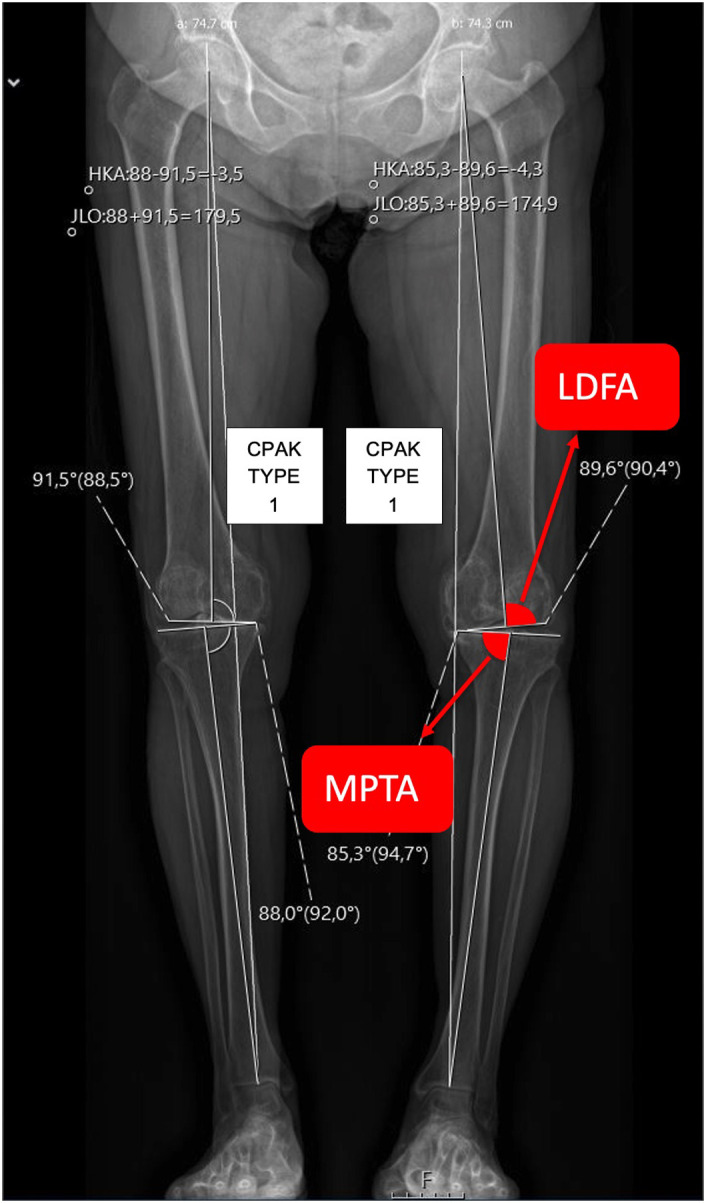
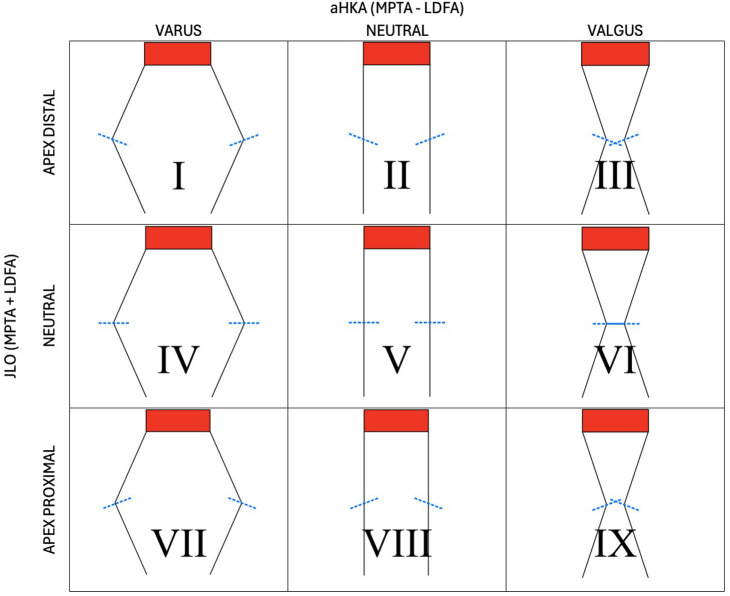
Methods: Radiological EOS analysis of nonarthritic 1172 knees and osteoarthritic 571 knees was evaluated to clarify the distribution of CPAK classification. The knees were categorized into 9 subgroups according to the arithmetic hip-knee-ankle (aHKA) angle and joint-line obliquity (JLO). The medial proximal tibial angle (MPTA) and lateral distal femoral angle (LDFA) were used to calculate aHKA and JLO. The Sectra workstation program was used for all radiological measurements.
Results: In the nonarthritic group, CPAK distribution was 20.9% type I (n=245), 2.5% type II (n=30), 0.08% type III (n=1), 46.67% type IV (n=545), 7.7% type V (n=91), 0.7% type VI (n=9), 18% type VII (n=211), 2.9% type VIII (n=35), 0.2% type IX (n=3). The mean JLO was 173.7 ± 4.38, and the mean aHKA was 0.15 ± 3.81 in nonarthritic group. Arthritic group CPAK type distribution was 20.7% type I (n=118), 3.1% type II (n=18), 0.17% type III (n=1), 57.1% type IV (n=326), 8.4% type V (n=48), 0.17% type VI (n=1), 7.8% type VII (n=45), 1.4% type VIII (n=8), and 0.8% type IX (n=5). The mean JLO was 174.2 ± 3.78, and the mean aHKA was !2.21 ± 4.48 in the osteoarthritic group.
Conclusion: CPAK type IV and CPAK type I were the most common subgroups in the nonarthritic and arthritic groups. CPAK type 5, which is the target of the mechanical alignment strategy, is only 7.8% in the nonarthritic group and 8.4% in the osteoarthritic group in the Turkish population.




 京公网安备 11010802042870号
京ICP备2023020795号-1
京公网安备 11010802042870号
京ICP备2023020795号-1

 分享
分享

 求助内容:
求助内容: 应助结果提醒方式:
 扫码关注我们
