{"title":"Identification and structural characterization of a novel acetyl xylan esterase from Aspergillus oryzae","authors":"Chihaya Yamada, Tomoe Kato, Yoshihito Shiono, Takuya Koseki, Shinya Fushinobu","doi":"10.1111/febs.17420","DOIUrl":null,"url":null,"abstract":"<p>Acetyl xylan esterase plays a crucial role in the degradation of xylan, the major plant hemicellulose, by liberating acetic acid from the backbone polysaccharides. Acetyl xylan esterase B from <i>Aspergillus oryzae</i>, designated <i>Ao</i>AxeB, was biochemically and structurally investigated. The <i>Ao</i>AxeB-encoding gene with a native signal peptide was successfully expressed in <i>Pichia pastoris</i> as an active extracellular protein. The purified recombinant protein had pH and temperature optima of 8.0 and 30 °C, respectively, and was stable up to 35 °C. The optimal substrate for hydrolysis by purified recombinant <i>Ao</i>AxeB among a panel of α-naphthyl esters was α-naphthyl acetate. Recombinant <i>Ao</i>AxeB catalyzed the release of acetic acid from wheat arabinoxylan. The release of acetic acid from wheat arabinoxylan increased synergistically with xylanase addition. No activity was detected for the methyl esters of ferulic, <i>p</i>-coumaric, caffeic, or sinapic acids. The crystal structures of <i>Ao</i>AxeB in the apo and succinate complexes were determined at resolutions of 1.75 and 1.90 Å, respectively. Although <i>Ao</i>AxeB has been classified in the Esterase_phb family in the ESTerases and alpha/beta-Hydrolase Enzymes and Relatives (ESTHER) database, its structural features partly resemble those of ferulic acid esterase in the FaeC family. Phylogenetic analysis also indicated that <i>Ao</i>AxeB is located between the clades of the two families. Docking analysis provided a plausible binding mode for xylotriose substrates acetylated at the 2- or 3-hydroxy position. This study expands the current knowledge of the structures of acetyl xylan esterases and ferulic acid esterases that are required for complete plant biomass degradation.</p>","PeriodicalId":94226,"journal":{"name":"The FEBS journal","volume":"292 10","pages":"2527-2544"},"PeriodicalIF":4.2000,"publicationDate":"2025-01-28","publicationTypes":"Journal Article","fieldsOfStudy":null,"isOpenAccess":false,"openAccessPdf":"https://onlinelibrary.wiley.com/doi/epdf/10.1111/febs.17420","citationCount":"0","resultStr":null,"platform":"Semanticscholar","paperid":null,"PeriodicalName":"The FEBS journal","FirstCategoryId":"1085","ListUrlMain":"https://febs.onlinelibrary.wiley.com/doi/10.1111/febs.17420","RegionNum":0,"RegionCategory":null,"ArticlePicture":[],"TitleCN":null,"AbstractTextCN":null,"PMCID":null,"EPubDate":"","PubModel":"","JCR":"","JCRName":"","Score":null,"Total":0}
引用次数: 0
Abstract
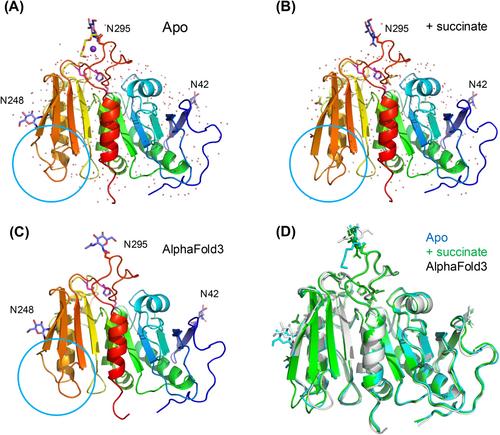
Acetyl xylan esterase plays a crucial role in the degradation of xylan, the major plant hemicellulose, by liberating acetic acid from the backbone polysaccharides. Acetyl xylan esterase B from Aspergillus oryzae, designated AoAxeB, was biochemically and structurally investigated. The AoAxeB-encoding gene with a native signal peptide was successfully expressed in Pichia pastoris as an active extracellular protein. The purified recombinant protein had pH and temperature optima of 8.0 and 30 °C, respectively, and was stable up to 35 °C. The optimal substrate for hydrolysis by purified recombinant AoAxeB among a panel of α-naphthyl esters was α-naphthyl acetate. Recombinant AoAxeB catalyzed the release of acetic acid from wheat arabinoxylan. The release of acetic acid from wheat arabinoxylan increased synergistically with xylanase addition. No activity was detected for the methyl esters of ferulic, p-coumaric, caffeic, or sinapic acids. The crystal structures of AoAxeB in the apo and succinate complexes were determined at resolutions of 1.75 and 1.90 Å, respectively. Although AoAxeB has been classified in the Esterase_phb family in the ESTerases and alpha/beta-Hydrolase Enzymes and Relatives (ESTHER) database, its structural features partly resemble those of ferulic acid esterase in the FaeC family. Phylogenetic analysis also indicated that AoAxeB is located between the clades of the two families. Docking analysis provided a plausible binding mode for xylotriose substrates acetylated at the 2- or 3-hydroxy position. This study expands the current knowledge of the structures of acetyl xylan esterases and ferulic acid esterases that are required for complete plant biomass degradation.
乙酰木聚糖酯酶在木聚糖这种主要的植物半纤维素的降解过程中起着至关重要的作用,它能从主干多糖中释放出乙酸。对米曲霉乙酰木聚糖酯酶B (AoAxeB)进行了生化和结构研究。在毕赤酵母中,aoaxeb编码基因作为活性细胞外蛋白成功表达。纯化后的重组蛋白最适pH值为8.0℃,最适温度为30℃,最适温度为35℃。经纯化的重组AoAxeB酶解α-萘酯的最佳底物为α-萘酯乙酸酯。重组AoAxeB催化小麦阿拉伯木聚糖中乙酸的释放。随着木聚糖酶的添加,小麦阿拉伯木聚糖的乙酸释放量呈增效增加的趋势。没有检测到阿魏酸、对香豆酸、咖啡酸或辛酸甲酯的活性。AoAxeB在载脂蛋白和琥珀酸盐配合物中的晶体结构分别以1.75和1.90 Å的分辨率测定。虽然AoAxeB在ESTerases and alpha/beta-Hydrolase Enzymes and Relatives (ESTHER)数据库中被归类为Esterase_phb家族,但其结构特征部分类似于FaeC家族的阿卫酸酯酶。系统发育分析也表明AoAxeB位于两个科的分支之间。对接分析为2-羟基或3-羟基乙酰化的木糖底物提供了一种合理的结合模式。这项研究扩展了目前对乙酰木聚糖酯酶和阿魏酸酯酶的结构的了解,这些酶是完全植物生物量降解所必需的。





 京公网安备 11010802042870号
京ICP备2023020795号-1
京公网安备 11010802042870号
京ICP备2023020795号-1

 分享
分享

 求助内容:
求助内容: 应助结果提醒方式:
 扫码关注我们
