Michal Javorek, Michal Hendrych, Kateřina Ondráková, Jan Preisler, Antonín Bednařík
{"title":"Staining Tissues with Basic Blue 7: A New Dual-Polarity Matrix for MALDI Mass Spectrometry Imaging.","authors":"Michal Javorek, Michal Hendrych, Kateřina Ondráková, Jan Preisler, Antonín Bednařík","doi":"10.1021/acs.analchem.4c05244","DOIUrl":null,"url":null,"abstract":"<p><p>Obtaining high-quality matrix-assisted laser desorption/ionization mass spectrometry (MALDI MS) images and the reproducibility of the technique depend strongly on the sample preparation protocol. The most crucial part is the application of the MALDI matrix, which often relies on expensive spraying or sublimation coaters. In this work, we present a new dual-polarity matrix for MALDI mass spectrometry imaging (MSI): Basic Blue 7 (BB7), which belongs to the group of triarylmethane dyes. Thanks to its good solubility in water, this matrix allows a quick and simple sample preparation protocol without the need for sophisticated spraying or sublimation instrumentation: dipping the glass with tissue into the dye solution. This technique closely resembles the staining methods employed in classical histopathology. The technique is demonstrated on MSI of lipids in mouse brain sections in positive and negative ion modes using a subatmospheric pressure MALDI source coupled with an orbital trap mass spectrometer. The results are compared with traditional matrices, such as 2,5-dihydroxybenzoic acid (DHB) and 1,5-diaminonaphthalene (DAN). BB7 excels, especially in negative ion mode, offering low background signals and high signal intensities of many lipid classes. Furthermore, the stained tissue can simply be inspected visually and allows basic histopathology annotation prior to MSI. Here, we demonstrate that staining offers excellent image quality, reproducible sample preparation, and the potential for automation and utilization for high spatial resolution MSI.</p>","PeriodicalId":27,"journal":{"name":"Analytical Chemistry","volume":" ","pages":"2828-2836"},"PeriodicalIF":6.7000,"publicationDate":"2025-02-11","publicationTypes":"Journal Article","fieldsOfStudy":null,"isOpenAccess":false,"openAccessPdf":"https://www.ncbi.nlm.nih.gov/pmc/articles/PMC11822741/pdf/","citationCount":"0","resultStr":null,"platform":"Semanticscholar","paperid":null,"PeriodicalName":"Analytical Chemistry","FirstCategoryId":"92","ListUrlMain":"https://doi.org/10.1021/acs.analchem.4c05244","RegionNum":1,"RegionCategory":"化学","ArticlePicture":[],"TitleCN":null,"AbstractTextCN":null,"PMCID":null,"EPubDate":"2025/1/30 0:00:00","PubModel":"Epub","JCR":"Q1","JCRName":"CHEMISTRY, ANALYTICAL","Score":null,"Total":0}
引用次数: 0
Abstract
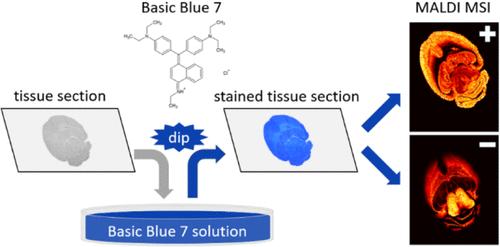
Obtaining high-quality matrix-assisted laser desorption/ionization mass spectrometry (MALDI MS) images and the reproducibility of the technique depend strongly on the sample preparation protocol. The most crucial part is the application of the MALDI matrix, which often relies on expensive spraying or sublimation coaters. In this work, we present a new dual-polarity matrix for MALDI mass spectrometry imaging (MSI): Basic Blue 7 (BB7), which belongs to the group of triarylmethane dyes. Thanks to its good solubility in water, this matrix allows a quick and simple sample preparation protocol without the need for sophisticated spraying or sublimation instrumentation: dipping the glass with tissue into the dye solution. This technique closely resembles the staining methods employed in classical histopathology. The technique is demonstrated on MSI of lipids in mouse brain sections in positive and negative ion modes using a subatmospheric pressure MALDI source coupled with an orbital trap mass spectrometer. The results are compared with traditional matrices, such as 2,5-dihydroxybenzoic acid (DHB) and 1,5-diaminonaphthalene (DAN). BB7 excels, especially in negative ion mode, offering low background signals and high signal intensities of many lipid classes. Furthermore, the stained tissue can simply be inspected visually and allows basic histopathology annotation prior to MSI. Here, we demonstrate that staining offers excellent image quality, reproducible sample preparation, and the potential for automation and utilization for high spatial resolution MSI.
期刊介绍:
Analytical Chemistry, a peer-reviewed research journal, focuses on disseminating new and original knowledge across all branches of analytical chemistry. Fundamental articles may explore general principles of chemical measurement science and need not directly address existing or potential analytical methodology. They can be entirely theoretical or report experimental results. Contributions may cover various phases of analytical operations, including sampling, bioanalysis, electrochemistry, mass spectrometry, microscale and nanoscale systems, environmental analysis, separations, spectroscopy, chemical reactions and selectivity, instrumentation, imaging, surface analysis, and data processing. Papers discussing known analytical methods should present a significant, original application of the method, a notable improvement, or results on an important analyte.




 京公网安备 11010802042870号
京ICP备2023020795号-1
京公网安备 11010802042870号
京ICP备2023020795号-1

 分享
分享
 求助内容:
求助内容: 应助结果提醒方式:
 扫码关注我们
