Theoretical Investigations on the n-Type and p-Type Conductivity Mechanisms in BiTaO4 Photocatalysts through Intrinsic Point Defects and Group IIA and Group VIB Element Doping.
HongChun Zheng, Song Ling, Bo Kong, Ti-Xian Zeng, Shan Jiang, Wentao Wang
{"title":"Theoretical Investigations on the n-Type and p-Type Conductivity Mechanisms in BiTaO<sub>4</sub> Photocatalysts through Intrinsic Point Defects and Group IIA and Group VIB Element Doping.","authors":"HongChun Zheng, Song Ling, Bo Kong, Ti-Xian Zeng, Shan Jiang, Wentao Wang","doi":"10.1021/acs.inorgchem.4c04888","DOIUrl":null,"url":null,"abstract":"<p><p>The n-type and p-type conductivity mechanisms from intrinsic defects and Group IIA and Group VIB element doping in the photocatalyst BiTaO<sub>4</sub> are systematically investigated by employing hybrid density functional calculations. The results reveal that vacancies <i>V</i><sub>Bi</sub>, <i>V</i><sub>Ta</sub>, <i>V</i><sub>O</sub>, and antisite Ta<sub>Bi</sub> are the predominant defects, depending on growth conditions. Bi-rich, appropriate Ta-rich, and O-poor conditions can promote BiTaO<sub>4</sub> to form n-type conductivity due to the presence of the Ta<sub>Bi</sub> donor defect and its easier ionization. This explains the experimental n-type conductivity character well. Meanwhile, under O-rich, Bi-poor, and Ta-poor conditions, BiTaO<sub>4</sub> exhibits superior p-type conductivity by forming the excellent acceptor defects <i>V</i><sub>Bi</sub> and <i>V</i><sub>Ta</sub>. Moreover, the intrinsic p-type conductivity can be further strengthened via the introductions of the substitutional doping of M<sub>Bi</sub> (M = Mg, Ca, Sr, and Ba) under the Bi-poor, Ta-poor, and O-rich conditions, where the O vacancies should be induced and Sr is the best candidate. On the other hand, Group VIB element (Cr, Mo, and W) doping can improve intrinsic n-type conductivity under Bi-rich, appropriate Ta-rich, and O-poor conditions. W is the best candidate. These findings provide a comprehensive understanding of defect physics in BiTaO<sub>4</sub> and offer insights into optimizing its photocatalytic performance through targeted defect engineering and impurity doping.</p>","PeriodicalId":40,"journal":{"name":"Inorganic Chemistry","volume":" ","pages":"2443-2457"},"PeriodicalIF":4.6000,"publicationDate":"2025-02-10","publicationTypes":"Journal Article","fieldsOfStudy":null,"isOpenAccess":false,"openAccessPdf":"","citationCount":"0","resultStr":null,"platform":"Semanticscholar","paperid":null,"PeriodicalName":"Inorganic Chemistry","FirstCategoryId":"92","ListUrlMain":"https://doi.org/10.1021/acs.inorgchem.4c04888","RegionNum":2,"RegionCategory":"化学","ArticlePicture":[],"TitleCN":null,"AbstractTextCN":null,"PMCID":null,"EPubDate":"2025/1/31 0:00:00","PubModel":"Epub","JCR":"Q1","JCRName":"CHEMISTRY, INORGANIC & NUCLEAR","Score":null,"Total":0}
引用次数: 0
Abstract
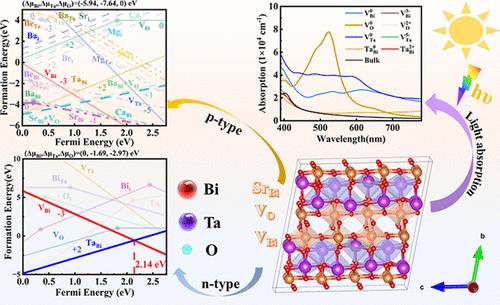
The n-type and p-type conductivity mechanisms from intrinsic defects and Group IIA and Group VIB element doping in the photocatalyst BiTaO4 are systematically investigated by employing hybrid density functional calculations. The results reveal that vacancies VBi, VTa, VO, and antisite TaBi are the predominant defects, depending on growth conditions. Bi-rich, appropriate Ta-rich, and O-poor conditions can promote BiTaO4 to form n-type conductivity due to the presence of the TaBi donor defect and its easier ionization. This explains the experimental n-type conductivity character well. Meanwhile, under O-rich, Bi-poor, and Ta-poor conditions, BiTaO4 exhibits superior p-type conductivity by forming the excellent acceptor defects VBi and VTa. Moreover, the intrinsic p-type conductivity can be further strengthened via the introductions of the substitutional doping of MBi (M = Mg, Ca, Sr, and Ba) under the Bi-poor, Ta-poor, and O-rich conditions, where the O vacancies should be induced and Sr is the best candidate. On the other hand, Group VIB element (Cr, Mo, and W) doping can improve intrinsic n-type conductivity under Bi-rich, appropriate Ta-rich, and O-poor conditions. W is the best candidate. These findings provide a comprehensive understanding of defect physics in BiTaO4 and offer insights into optimizing its photocatalytic performance through targeted defect engineering and impurity doping.
期刊介绍:
Inorganic Chemistry publishes fundamental studies in all phases of inorganic chemistry. Coverage includes experimental and theoretical reports on quantitative studies of structure and thermodynamics, kinetics, mechanisms of inorganic reactions, bioinorganic chemistry, and relevant aspects of organometallic chemistry, solid-state phenomena, and chemical bonding theory. Emphasis is placed on the synthesis, structure, thermodynamics, reactivity, spectroscopy, and bonding properties of significant new and known compounds.




 京公网安备 11010802042870号
京ICP备2023020795号-1
京公网安备 11010802042870号
京ICP备2023020795号-1

 分享
分享
 求助内容:
求助内容: 应助结果提醒方式:
 扫码关注我们
